
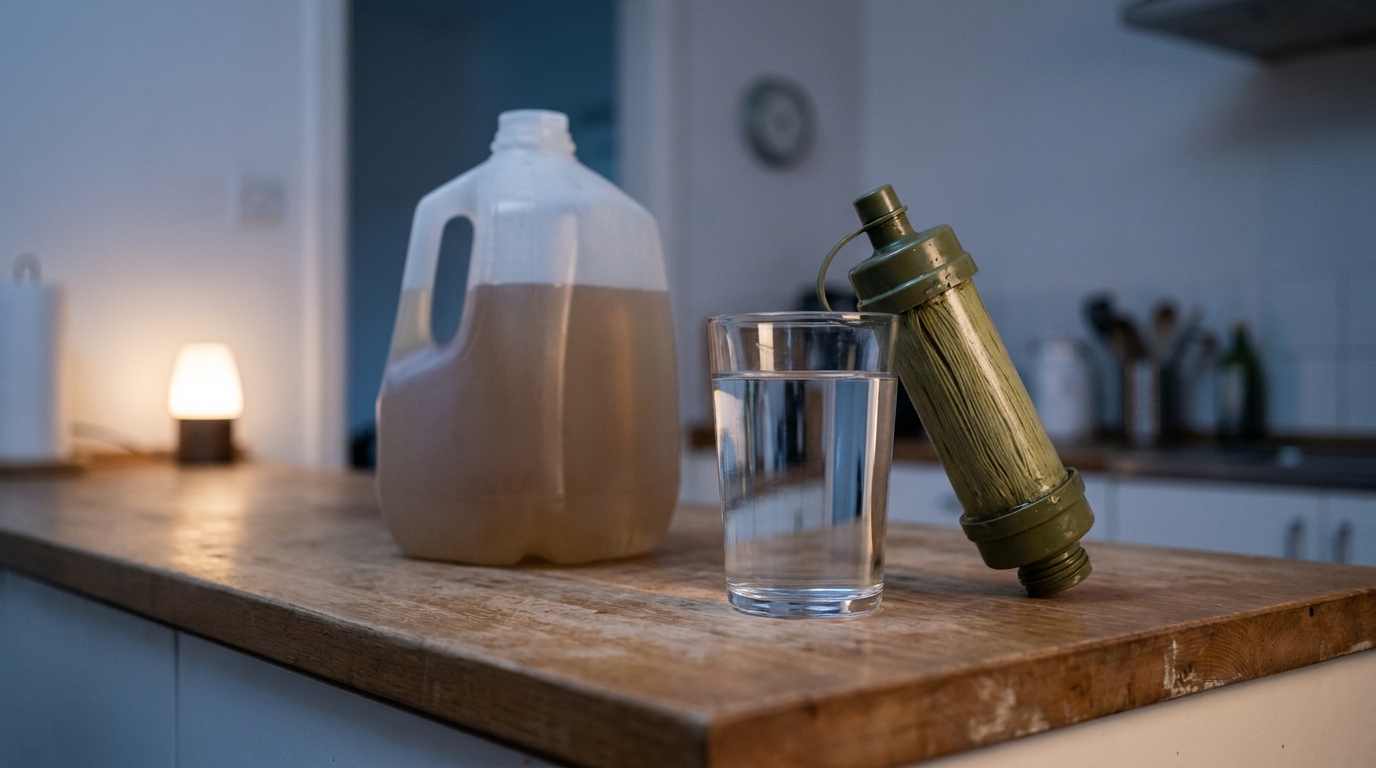
in late august 2022 the main treatment plant in jackson, mississippi failed after the pearl river flooded, and roughly 150,000 people watched their taps turn into something they could not drink. the water still ran. you could shower, sort of, and flush. you just could not safely put it in your body, and the boil-water notice sitting over the city had already been in effect since july. bottled water lines stretched around blocks. the ones who were fine were the ones who, on some boring day before any of it, had put a real filter in a closet.
here is the trap that catches almost everyone at that moment. they own a filter. it is the wrong filter. it strains out the thing they were picturing and leaves in the thing that actually matters, because they bought on the picture of survival instead of the specific threat in their own pipes.
that is the whole subject here. not one magic device. the small, unglamorous skill of knowing what a given water filter actually removes, and matching it to the water you are likely to be handed.
Disclosure: As an Amazon Associate, s1gma earns from qualifying purchases. Some links below are affiliate links. If you buy through them, s1gma may earn a small commission at no extra cost to you. It doesn't change what gets recommended.
Your tap is one bad day from undrinkable
It is comforting to file Jackson under "old southern city, not me." The national picture says otherwise. The American Society of Civil Engineers grades US drinking water a C-, with roughly 240,000 water main breaks a year and an estimated 9.2 million lead service lines still carrying water to homes. Boil-water notices are not rare events. Texas alone issued at least 2,457 of them in 2022, an average of seven a day.
A main break, a flood, a power loss at a treatment plant, a hurricane. Any of them can turn the safest tap in the country into a question mark for a few days. You do not need to believe the system is collapsing. You just need to notice that "the water is always fine" is a habit, not a guarantee.
The mistake: there is no everything filter
Before you spend a dollar, absorb the one idea the whole industry blurs: no single affordable filter removes everything. Water can go bad in three completely different ways, and the tools that fix each one are different.
- Living things (bacteria like E. coli, protozoa like Giardia and Cryptosporidium, and viruses like norovirus and hepatitis A).
- Metals (lead, above all, leaching from old pipes).
- Chemicals (industrial and agricultural runoff, and PFAS, the "forever chemicals").
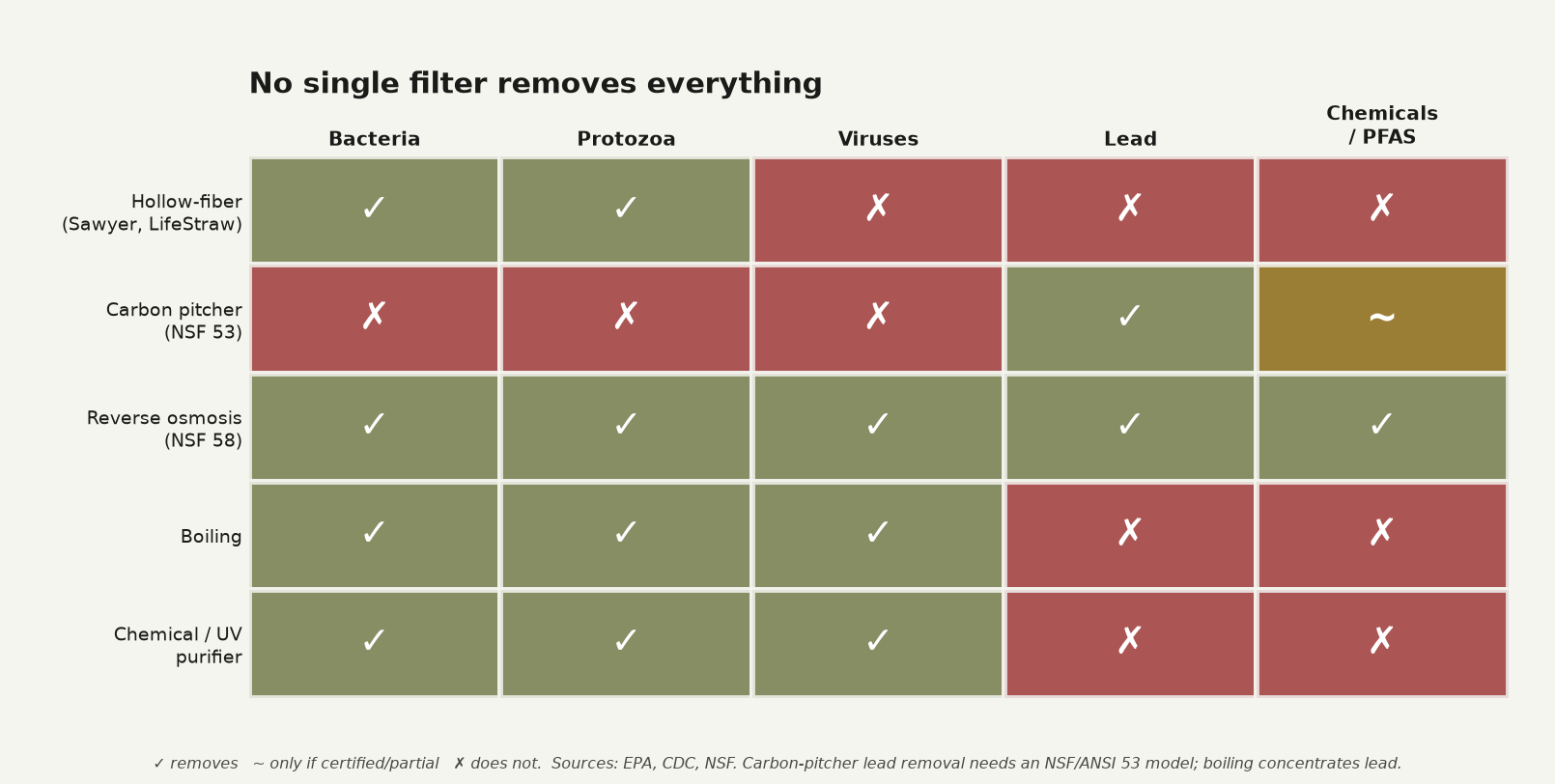
A filter built to catch one of those often does nothing at all for the others. The right question is never "is this a good water filter." It is "what is wrong with the water I am likely to be drinking, and does this device remove that specific thing."
Filter versus purifier: the virus trap
This is where good people buy the wrong thing. The famous emergency filters, the Sawyer Squeeze and the LifeStraw, are hollow-fiber filters. They are excellent, and they are misunderstood. A Sawyer strains water through fibers with pores around 0.1 micron, and at that size it removes well over 99.99 percent of bacteria and protozoa. For a backcountry stream or a Giardia-risk situation, it is close to perfect.
But a virus is smaller than the pore. Much smaller. So it sails straight through. A hollow-fiber filter does not remove viruses, and it does not touch lead, chemicals, or PFAS at all. That is not a defect. It is a filter, not a purifier, and the difference is the whole game.
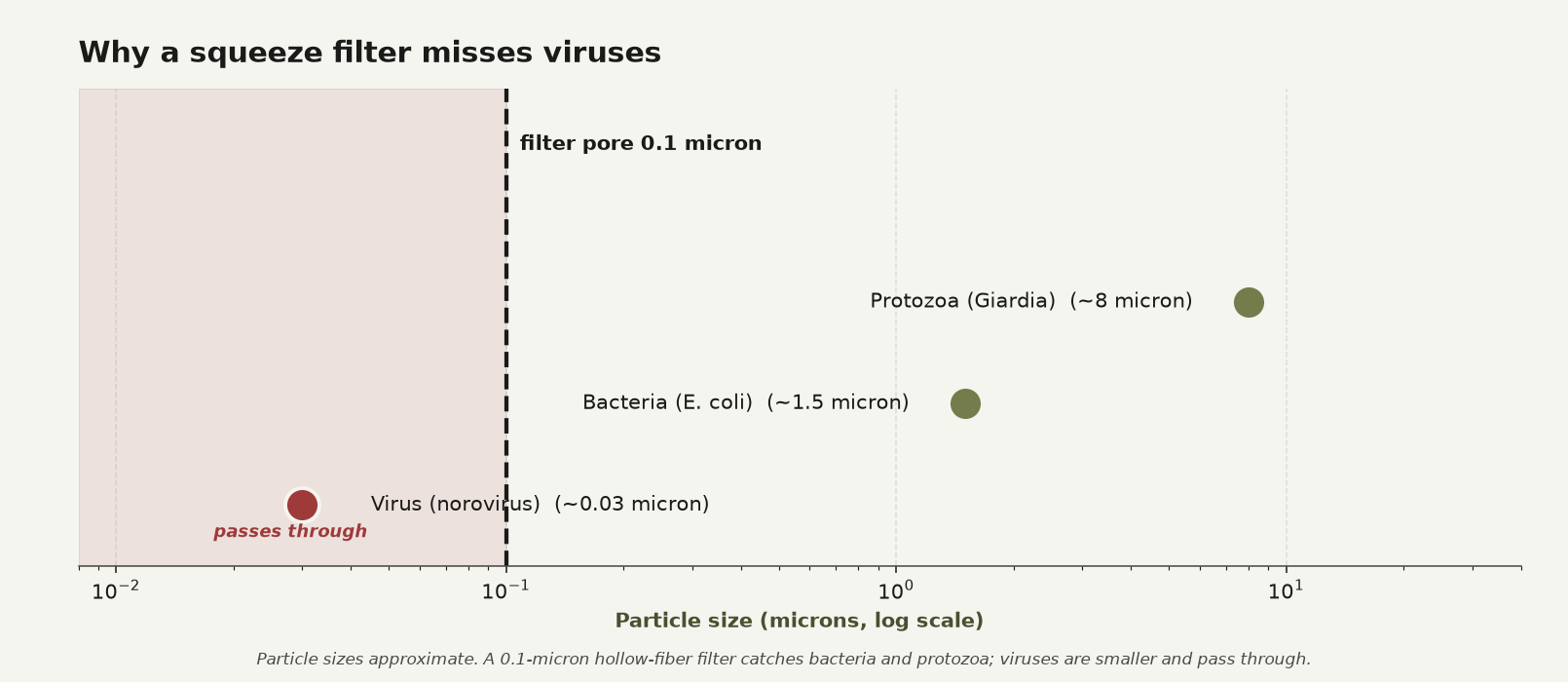
If your water might carry viruses, which means sewage-contaminated flood water or questionable water in much of the world, a straining filter alone is not enough. You need a purifier: a rolling boil, chemical tablets, a UV pen, or reverse osmosis. The label that certifies true virus removal is NSF P231. If a device does not make a microbiological-purifier claim, assume viruses get through.
The boiling myth that can actually poison you
Boiling is the oldest advice there is, and it is right up to a hard limit almost nobody mentions. A rolling boil for one minute (three minutes above about 6,500 feet) reliably kills bacteria, viruses, and protozoa. If living things are your problem, boiling solves it for free.
But boiling does nothing to lead, PFAS, or industrial chemicals, and with lead it makes the water worse, not better. As the water evaporates, the lead left behind becomes more concentrated. So the instinct to "just boil it" during a lead scare is exactly wrong, and the CDC and EPA both say so plainly. Boiling cannot make water with fuel, toxic chemicals, or lead safe. It is a microbe tool, full stop.
What to actually buy, by threat
Skip the aisle and buy for the specific problem.
If your worry is microbes (camping, backcountry, a boil-water notice, most disasters): a hollow-fiber squeeze or straw filter like the Sawyer Squeeze or the LifeStraw Peak personal filter is the cheap, rugged answer. Pair it with purification tablets or a plan to boil so you are also covered for viruses, which the filter misses.
If your worry is your own tap (lead from old pipes, chlorine taste): a carbon filter certified to NSF/ANSI 53 for lead, a pitcher or under-sink model. Read carefully here. A standard Brita reduces taste, not lead. Only the specifically lead-certified version, the Brita Elite filter, actually removes it. The certification, not the brand, is what matters.
If you want the broadest single answer at home (lead, PFAS, arsenic, and microbes all at once): a reverse osmosis system certified to NSF/ANSI 58, like the iSpring RCC7AK. It removes the most of anything, including viruses and PFAS. The tradeoffs are that it lives under a sink, wastes some water to brine, and is not something you carry.
The label rule that cuts through the marketing: ignore the brand's adjectives and look for the NSF/ANSI number that matches your threat. 42 means taste and chlorine only. 53 means real health contaminants like lead. 58 means reverse osmosis. P231 means it purifies viruses. And ignore "P473," an old PFAS protocol that was retired and folded into 53 and 58 years ago. A product still bragging about P473 is selling you yesterday's sticker.
One honest warning on the popular gravity systems. Berkey and similar countertop units claim to remove nearly everything, viruses and metals included, but the market leader carries no NSF certification for those claims, and its removal performance has been contested in independent testing. If you want a gravity filter, buy one that is actually NSF certified for the contaminants you care about, rather than trusting an uncertified claim.
The short list
Match the pick to your actual threat, not the scary picture in your head.
| Your threat | What to buy |
|---|---|
| Microbes on the trail or in a boil-water notice | Sawyer Squeeze or LifeStraw Peak personal filter |
| Viruses (sewage, flood water, sketchy travel water) | purification tablets or a rolling boil, on top of the filter |
| Lead from old pipes | Brita Elite, NSF-certified for lead |
| The broadest single answer at home (lead, PFAS, arsenic) | iSpring reverse osmosis, NSF/ANSI 58 |
TL;DR
There is no everything filter. Water fails in three separate ways, living things, metals, and chemicals, and each needs a different tool. Hollow-fiber filters like the Sawyer and LifeStraw crush bacteria and protozoa but miss viruses, lead, and chemicals entirely. Boiling kills microbes but concentrates lead and ignores chemicals, so never boil your way out of a lead problem. For your home tap, match the NSF number to the threat: 53 for lead, 58 for reverse osmosis, P231 for a true virus purifier. Buy the filter that removes your actual problem, on a normal day, before the plant floods.
The people who were fine in Jackson were not lucky. They had matched a boring device to a boring risk, months early, and then forgotten about it until the morning it was the only thing that mattered.
This is the filtration half of water prep. The other half, how much to store and how to make questionable water drinkable, is in storing water for emergencies. It also pairs with the power outage kit and preparing your home for a hurricane. Size your household's water needs at the Supply Calculator.
Sources
- ASCE 2025 Infrastructure Report Card, drinking water (C- grade, ~240,000 main breaks/year, 9.2M lead service lines): https://infrastructurereportcard.org/cat-item/drinking-water-infrastructure/
- NPR, Jackson, Mississippi water crisis, 2022 (~150,000 without safe water after plant failure): https://www.npr.org/2022/08/31/1120166328/jackson-mississippi-water-crisis
- Hanna-Attisha et al., American Journal of Public Health, elevated child blood lead in Flint (2.4% to 4.9%): https://pmc.ncbi.nlm.nih.gov/articles/PMC4985856/
- Texas Tribune analysis of TCEQ data, 2,457 boil-water notices in Texas in 2022: https://www.texastribune.org/2022/12/07/boil-water-notices-rural-texas/
- CDC, making water safe (filters under 1 micron remove parasites but not viruses; boiling 1 minute, 3 above 6,500 ft): https://www.cdc.gov/water-emergency/about/index.html
- CDC, lead in drinking water (boiling does not remove lead): https://www.cdc.gov/lead-prevention/prevention/drinking-water.html
- EPA, basic information about lead in drinking water (boiling does not reduce lead): https://www.epa.gov/ground-water-and-drinking-water/basic-information-about-lead-drinking-water
- EPA, PFAS national drinking-water limits and filters certified to reduce PFAS (carbon, reverse osmosis): https://www.epa.gov/water-research/identifying-drinking-water-filters-certified-reduce-pfas
- NSF, filtration standards 42, 53, and 401 explained: https://www.nsf.org/knowledge-library/nsf-ansi-42-53-and-401-filtration-systems-standards
- Sawyer, Squeeze filter specification (0.1 micron hollow fiber): https://www.sawyer.com/product/squeeze-water-filter-system