
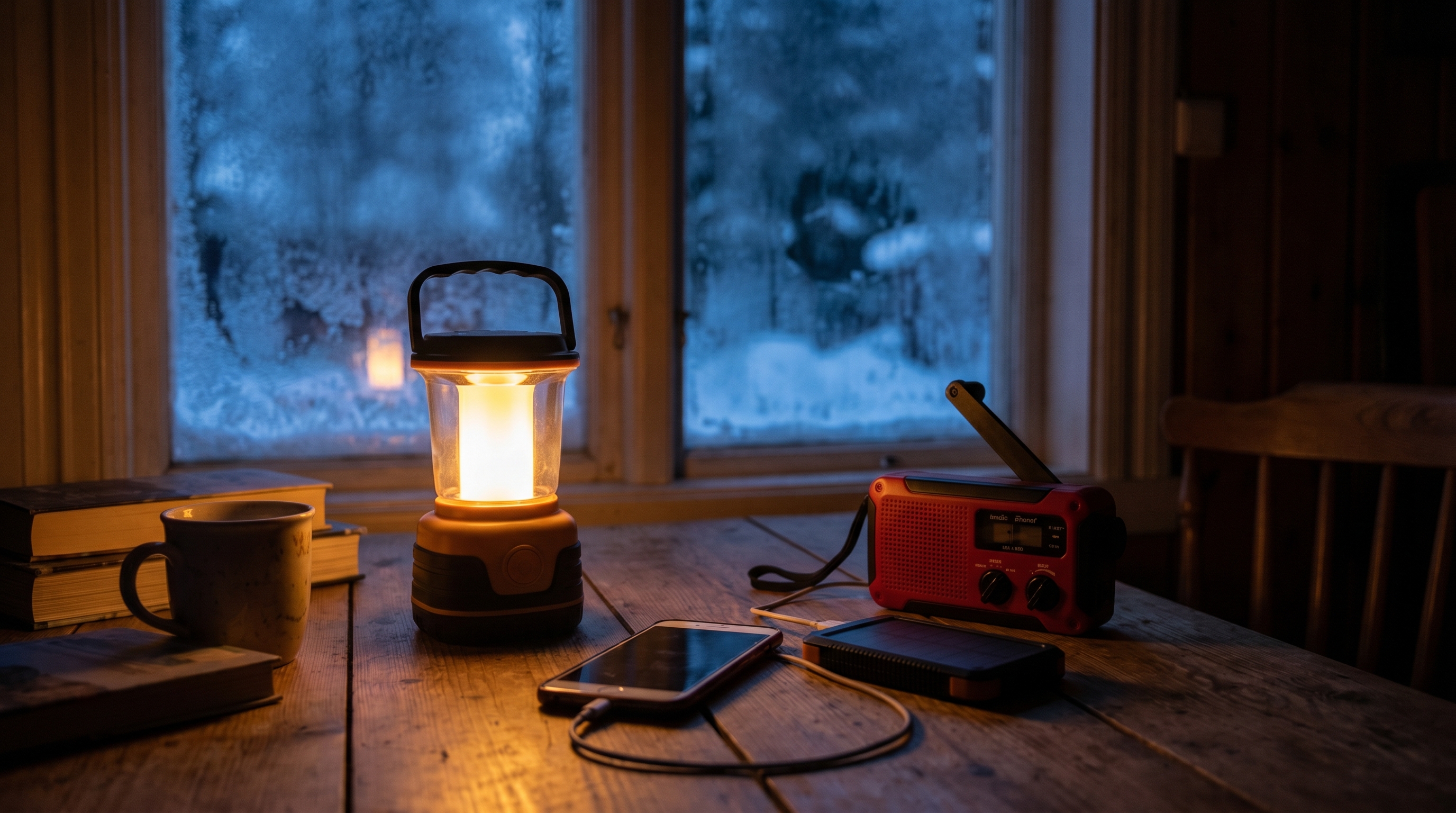
The ice storm that took our power in Raleigh did not knock it out for six minutes. It knocked it out for two days.
Disclosure: As an Amazon Associate, s1gma earns from qualifying purchases. Some links in this article are affiliate links — if you buy through them, s1gma may earn a small commission at no extra cost to you. It doesn't change what gets recommended.
The first night was almost fun. We lit a couple of candles, the kids decided it was an adventure, and Lauren made a joke about finally having an excuse to ignore her email. By the second morning the fun had worn off and the questions got practical and a little grim. How much longer is the food in the fridge actually okay. Is the stuff in the freezer already a loss. My phone is at 40 percent and I have no idea when the lights come back, so do I burn it checking the outage map or save it in case I need to call someone. The romance of a blackout lasts about as long as the first pot of coffee you cannot make.
A power outage is the most common real emergency most of us will ever face, and it is the one people prepare for the worst. Everyone has a flashlight in a drawer somewhere. Almost nobody has thought past hour thirty.
This is the kit that gets you through the long one. Not the apocalypse. The ice storm. The hurricane that parks over your county. The summer heat dome that overloads the grid and takes the AC down with it. Built in four layers, in the order that actually matters.
The number nobody at the utility wants you to dwell on
Outages are getting longer.
The U.S. Energy Information Administration tracks how many hours the average American spends without power each year, and the line has been bending the wrong way for over a decade. In a calm year it is a few hours. In a year with a major event, an ice storm, a hurricane, a heat wave that buckles the grid, the average blows past eight hours, and almost all of it is concentrated into a handful of brutal multi-day events rather than spread out in tidy ten-minute blips you sleep through.
Aging infrastructure, weather that keeps setting records, and a grid carrying loads it was never designed for all push in the same direction. The blip is becoming the event. And the kit that handles a ten-minute flicker, one flashlight and a shrug, is not the kit that handles two days with a fridge full of food and a phone running on fumes.
So you build in layers. Light, then power, then information, then the fridge. Each one solves a problem the one before it cannot.
Layer one: light, so the house stops being a cave
The first thing a long outage takes from you is not heat or food. It is the simple ability to see what you are doing. You will be amazed how fast a familiar house turns hostile in the dark, how a staircase you have walked ten thousand times becomes a genuine hazard with your hands full and a phone in your teeth.
The phone flashlight is fine for thirty seconds. It is a disaster as your actual light source, because the one device you need to ration is the one you are burning to find the bathroom.
| Item | Why it earns the spot |
|---|---|
| WUBEN L50 rechargeable flashlight | One per person, one per nightstand. Rechargeable so you are not hunting for batteries in the dark. The thing you grab first. |
| Samyoung magnetic LED worklight | Lights a whole room hands-free. This is the one that turns a dark kitchen back into a kitchen. |
| Collapsible LED lantern (4-pack) | Sits on the table while you eat, splits into four for the kids. Soft area light beats a harsh beam for living through hours, not minutes. |
The trick most people miss is the difference between a beam and a room. A flashlight points at one thing. For a two-day outage you mostly want ambient light, the kind that lets four people sit at a table and not feel like they are being interrogated. A worklight or a lantern does that. A flashlight in your teeth does not.
And skip the candles for general lighting. I know, the first night they feel cozy. But an open flame in a dark house full of tired people and pets is exactly how a bad night becomes a catastrophic one. Candles are for ambiance when the lights work. They are not your blackout plan.
Layer two: power, because the phone is everything now
Your phone stopped being a phone years ago. It is your flashlight, your map, your radio, your bank, your way of telling family you are alive, and the place you check whether the outage is your block or your whole region. It also has the battery life of a mayfly, and it dies at precisely the wrong moment.
Keeping it alive is the single highest-value thing you can do in a long outage, and it is the layer most people skip entirely.
| Item | Why it earns the spot |
|---|---|
| BLAVOR solar power bank | Charges a phone a couple times over, and tops itself back up in the sun. On day two, when the wall outlets are still dead, the sun is not. |
| Amazon Basics USB-C rechargeable AA batteries + charger | Everything that is not your phone runs on AAs. Recharge them off the same USB instead of praying the junk-drawer batteries still hold a charge. |
The power bank is the piece people wish they had at hour three. Buy one with solar so it is not just a finite battery you watch drain, but something that quietly refills on the windowsill while you go about your day. The math that matters is simple. A dead phone in a real emergency is not an inconvenience, it is a blindfold. A cheap power bank to never put that blindfold on is one of the better trades in all of preparedness.
If you want to know how much stored power, water, and food a multi-day outage actually calls for given your household size, run the numbers on the supply calculator before you buy anything. It will keep you from both under-buying and the more common sin, panic-buying a closet full of stuff you will never use.
Layer three: information, for when the screens go dark
Here is the part that surprises people who have never lived through a real one. In any widespread emergency, the cell network is one of the first things to choke, because everyone in the county reaches for their phone in the same five seconds. The grid wobbles, the towers go to backup power, and the bars on your phone become decorative.
When that happens, a radio is a small time machine back to when information had a source you could actually reach.
| Item | Why it earns the spot |
|---|---|
| FosPower NOAA emergency radio | Hand-crank and solar, so it never needs the grid that just failed. NOAA weather alerts wake you before the storm does. Also charges your phone in a pinch. |
The NOAA weather alert is the feature that earns the price. It is the difference between waking up to a tornado warning and waking up to a tornado. The hand crank is the part that matters in a long outage, because a radio that needs charging is just one more thing competing for your power bank. This one makes its own. Spin it for a minute, get an hour of news. That is the whole pitch, and it is a good one.
Layer four: the fridge clock, the part everyone gets wrong
This is the layer that separates people who have read an article from people who have actually sat through forty-eight dark hours, and it is the reason this piece exists.
The moment your power dies, a clock starts on the food in your kitchen, and most people have no idea what the numbers are. So here they are, straight from the food-safety people:
- A closed refrigerator keeps food safe for about four hours. Not a day. Four hours.
- A full freezer holds a safe temperature for about forty-eight hours. A half-full one, about twenty-four.
- The single most important rule is the one nobody follows in the moment: keep the doors shut. Every time you open the fridge to stare hopelessly into it, you spend minutes off that clock. Decide what you need, open once, close fast.
The play is straightforward once you know the clock. First few hours, eat from the fridge and leave the freezer sealed like a tomb. When you cross into hour four, move what you want to save into a cooler with ice, if you were smart enough to have ice, and let the freezer ride. Anything above 40 degrees for more than two hours, when in doubt, throw it out. A spoiled dinner is annoying. A foodborne illness in the middle of an outage, with no working stove and possibly no clean water, is a genuinely bad time.
This is also the argument for keeping some shelf-stable food that does not care about the fridge at all. You do not need a bunker pantry. You need enough food that does not depend on electricity to get your household through a few days without anyone being miserable. If you have never thought about that baseline, the supply calculator will give you a real number instead of a vague feeling.
What people get wrong
The generator in the garage. I cannot say this loudly enough, so I will just say it plainly. Never run a generator, a grill, or any fuel-burning thing inside a house, a garage, or anywhere near a window. Carbon monoxide is invisible, odorless, and it kills entire families every single year during outages, people who survived the storm and died from the thing they bought to get through it. Generators run outside, far from the house, period.
Counting on the phone. Covered above, but it bears repeating because it is the most common failure. The phone is the most powerful tool you own and the most fragile. Everything in the power layer is, in a sense, insurance on the phone. Treat it like the limited resource it becomes the second the lights go out.
No cash. When the power is out, the card readers are out too. The gas station down the road that still has fuel will happily sell it to you for cash and turn you away with a dead card. A few twenties in a drawer is a prep that costs nothing and weighs nothing.
Forgetting it gets cold, or hot. An outage in February is a heat problem. An outage in July is the opposite. Layers of blankets, or a plan to get somewhere cool, belong in the kit just as much as the flashlight does. The grid usually fails when the weather is already trying to kill you, which is not a coincidence.
For the gear you keep on your person for the small everyday version of all this, the stuff that rides in your pocket and your bag, that is its own subject, and I wrote it up separately in the everyday carry guide. The power outage kit lives in the house. The EDC lives on you. You want both.
TL;DR
Power outages are the most common real emergency, and they are getting longer. Build the kit in four layers. Light, so the house is not a cave, and skip the candles. Power, because keeping your phone alive is the highest-value move you can make, and a solar bank refills when the outlets are dead. Information, because the cell network chokes first and a hand-crank NOAA radio does not need the grid that just failed. And the fridge clock, four hours for the fridge and forty-eight for a full freezer, doors shut, when in doubt throw it out. Keep some cash and some food that does not need electricity. Never run a generator indoors. The storm is rarely what gets people. The hours after it are.
Sources
- U.S. Energy Information Administration, Electricity Reliability Metrics - the data behind average annual outage hours and why the trend is climbing.
- FEMA Ready.gov, Food and Water Safety During Power Outages - the official four-hour fridge and forty-eight-hour freezer guidance.
- CDC, Carbon Monoxide and Generator Safety - why the generator goes outside, every time.
- NOAA Weather Radio All Hazards - how the weather-alert system in the Voyager Pro actually works.