
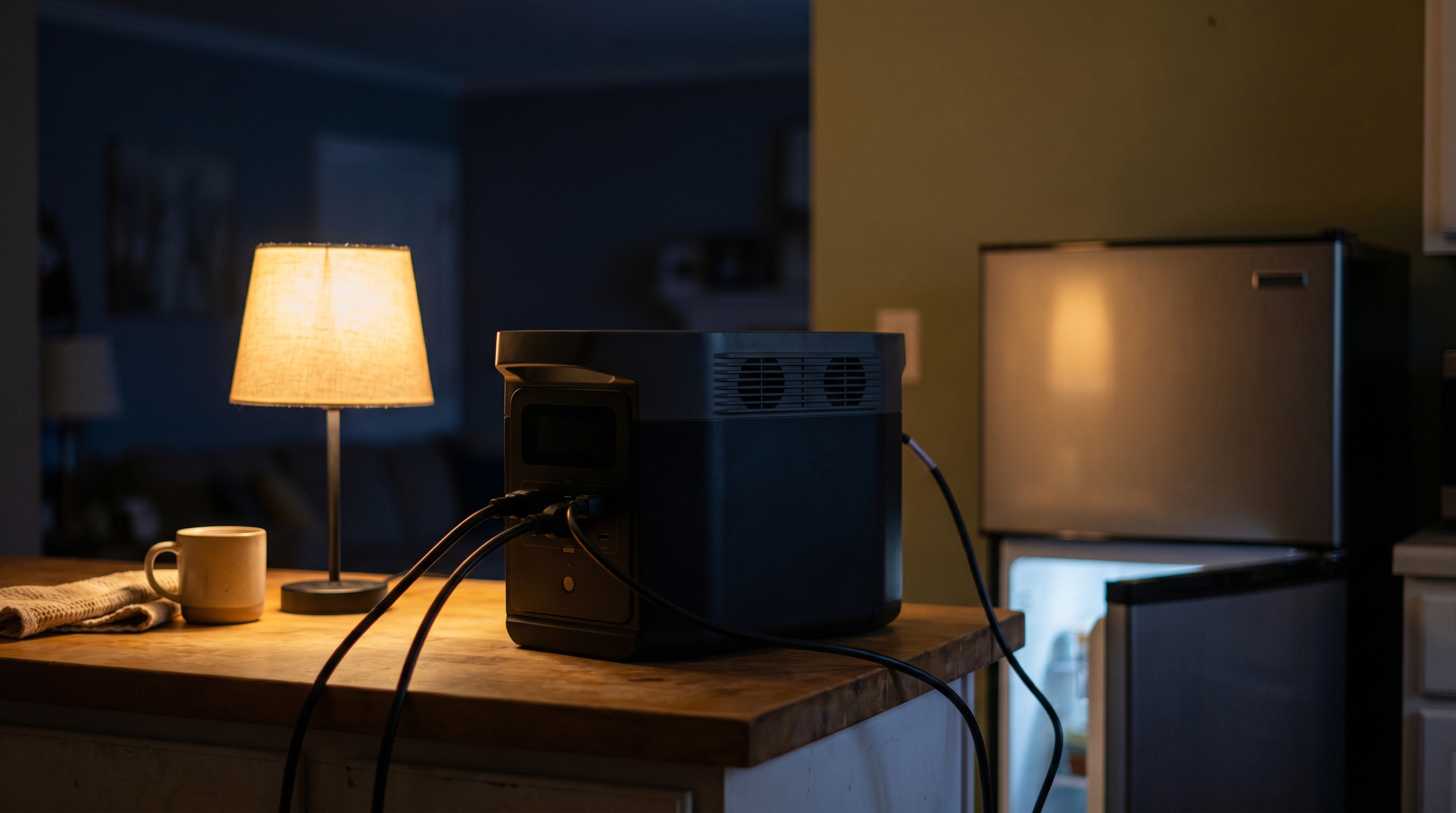
When the grid goes down it now goes down harder and longer. Here's how to actually keep your fridge, your phone, and your CPAP alive, minus the marketing math.
In July 2024, Hurricane Beryl knocked out power to more than two million Houston homes. A week later, in 100-degree heat, over 200,000 were still dark. At least two dozen people died, most of them older, many because the air conditioning and the medical equipment they depended on simply had no power. That is the modern version of a blackout: not a candlelit evening, but a slow, hot, dangerous week.
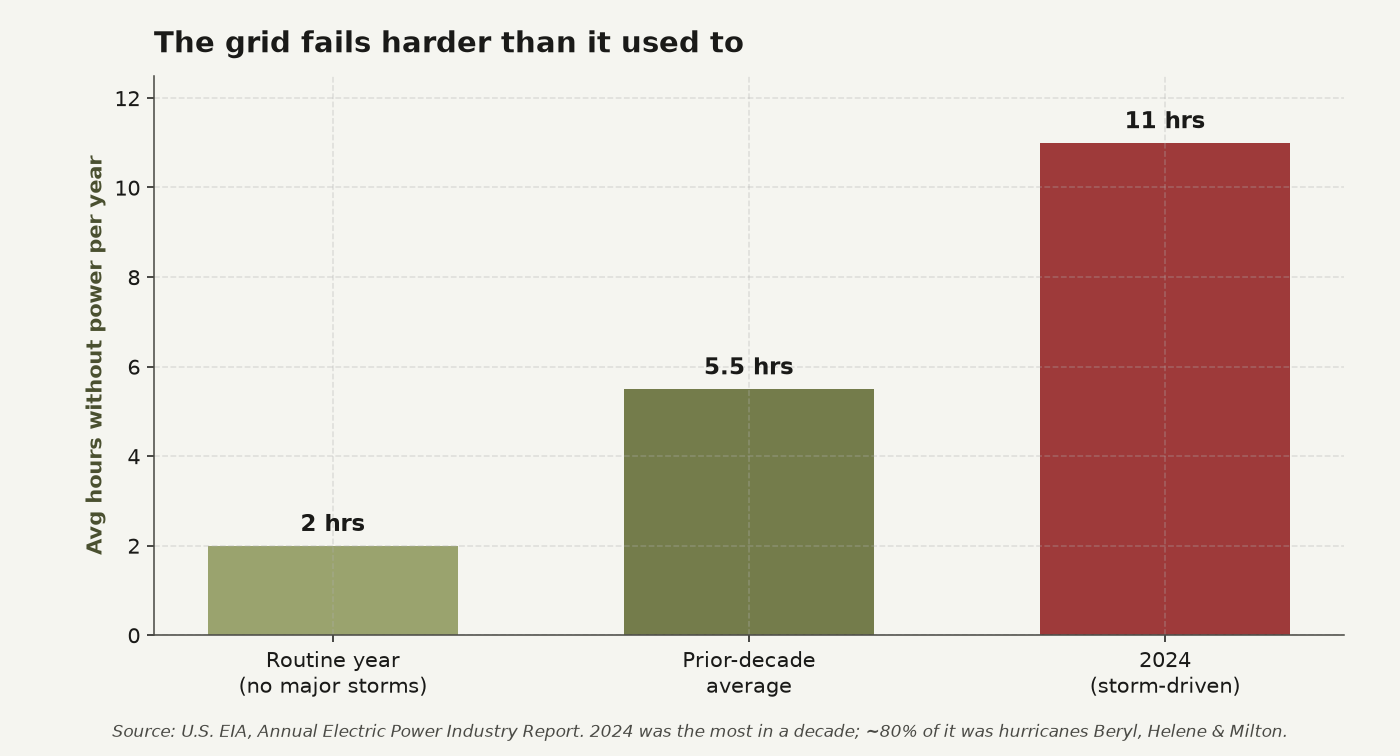
The grid still works fine most days. The problem is what happens on the bad ones. In 2024 the average American went about 11 hours without power, nearly double the prior decade's average and the most in ten years, per the U.S. Energy Information Administration. Here's the honest part most prep articles skip: roughly 80% of that was three hurricanes (Beryl, Helene, Milton), and in a normal storm-free year the figure sits at a flat ~2 hours. So the grid isn't rotting day to day. It's that when it breaks now, it breaks bigger and stays broken longer.
And the pressure is building. US electricity demand was flat for almost two decades, and it's now climbing again, driven by data centers and AI, electric vehicles, and heat pumps. The grid reliability watchdog, NERC, has flagged regions including Texas, the mid-Atlantic, and the Midwest at elevated-to-high risk of supply shortfalls this decade as demand outpaces new generation. (In fairness, some analysts argue NERC overstates the risk by counting data-center load that may not arrive on schedule.) Heat waves make it worse from both ends at once, spiking air-conditioning demand while frying transformers. And about 4.5 million Americans rely on electricity for medical equipment like oxygen concentrators, CPAP machines, and refrigerated medication. For them, a long outage is not an inconvenience.
That's the case for having your own backup power. Now the part nobody explains honestly: what to actually buy.
The three ways to keep a house running
There are exactly three, and the marketing blurs the real tradeoffs.
Gas or propane generator. The cheapest power per watt, runs as long as you can feed it fuel, and handles big loads. Consumer Reports pegs a strong 3,700W inverter generator around $600 versus roughly $3,000 for a battery of similar output. But the catch is lethal. Portable generators kill about 85 people a year from carbon monoxide, per the CPSC, and the CDC is blunt about the rule: run them outdoors only, at least 20 feet from any window, door, or vent, exhaust pointed away from the house. Opening the garage door is not enough ventilation. Add the noise, the fuel storage, and the maintenance, and a generator is a serious tool with a serious way to kill you.
Battery power station. A large lithium battery with outlets and an inverter built in. Silent, zero emissions, and genuinely safe to run in your kitchen. It switches on instantly, recharges from the wall, your car, or solar panels, and doubles as a UPS for your electronics. This is what people mean by a portable power station, and the names you've seen (Jackery, EcoFlow, Anker, Bluetti) are all this category. The downsides are capacity and cost: you pay several times more per watt-hour than a generator, and when it runs dry with no sun, you can't just pour in another gallon of gas.
Solar generator. A power station bundled with solar panels. In good sun it refills more or less indefinitely, which is the dream for a long outage. The reality is slower than the ads suggest, because panels only deliver full output for about five or six peak-sun hours a day, less under cloud, and the panels cost extra and need space.
One distinction almost no one explains: a normal grid-tied rooftop solar system shuts off during a blackout. By federal safety rule (anti-islanding, IEEE 1547), it cannot feed power while line workers are on the wires, so without a dedicated home battery, a roof covered in panels goes dark at the exact moment you need it. A portable solar generator dodges this because it's its own little island by design.
Why batteries now beat generators for most people
The reason power stations finally got good is the battery chemistry. The current standard is LiFePO4 (lithium iron phosphate, or LFP), and it's a real upgrade over the older lithium (NMC) found in phones and laptops. LFP is far more resistant to catching fire, and it lasts dramatically longer: roughly 3,000 to 4,000+ charge cycles to 70-80% capacity, versus 500 to 1,000 for NMC. EcoFlow rates its LFP units at 3,000 cycles, Jackery at 4,000. That's well over a decade of weekly use. LFP is a little heavier, which matters for backpacking and not at all for a box that lives in your closet. Every unit worth buying today uses it.
So for the household whose honest goal is "keep the fridge, the phone, the Wi-Fi, the CPAP, and a couple of lights alive through an outage," a battery beats a generator on every axis that matters: no carbon monoxide, no fuel, no noise, safe indoors, and automatic. The generator wins back the lead only when you need to run heavy equipment like a well pump or central AC for many days straight.
How to size one (the part the marketing hides)
Two numbers decide everything, and you need both.
- Watts (W) is how much it can push at once.
- Watt-hours (Wh) is how much it stores.
Picture a bucket of water. Watts is how fast it can pour, watt-hours is how big the bucket is. A giant bucket with a thin spout still can't run a microwave, and a wide spout on a tiny bucket runs that microwave for about ninety seconds. You need enough of both.
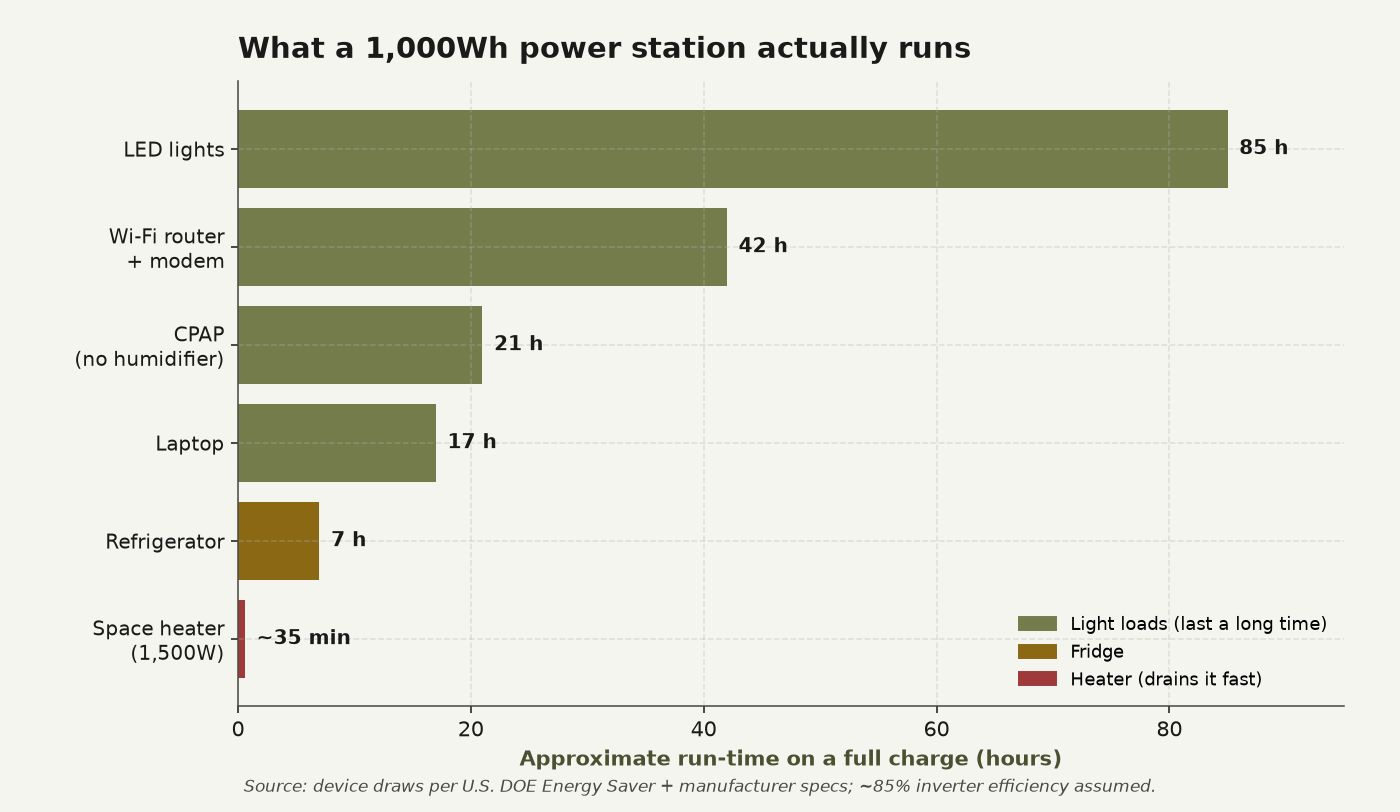
The run-time math is simple: usable watt-hours divided by the device's watts gives you roughly the hours, then knock off about 15% for inverter losses. A 1,000Wh unit running a steady 100W load lasts around eight to nine hours.
Now the trap that catches almost everyone: surge watts. A refrigerator might draw only ~120W while running, but the instant its compressor kicks on it slams 600 to 1,200W for a fraction of a second. If your power station's surge rating can't cover that spike, it trips offline, even though the running number looked fine. Sizing to running watts and ignoring the startup surge is the single most common mistake people make. Always check the surge (peak) figure, not just the continuous one.
And size for what you actually need to keep on, not the whole house. A realistic essentials load (router and modem ~20W, a laptop ~60W, two phones charging, a couple of LED lamps) is barely over 100W. The refrigerator is the one big recurring draw. Anything that makes heat (a 1,500W space heater, a hair dryer, a microwave) drains any battery fast, as the chart above shows. Plan around the fridge and your electronics, and treat heat appliances as brief luxuries.
What to actually look for on the spec sheet
- Capacity (Wh): how long it lasts.
- Continuous output (W): what it can run at once.
- Surge / peak (W): the brief burst for motor startup. Peak is not the same as continuous.
- Recharge: both AC charge time and max solar input (W).
- Expandable batteries: lets you bolt on capacity later instead of rebuying.
- LiFePO4 chemistry, cycle life, and warranty.
- Pure sine wave output: required for motors, medical gear, and sensitive electronics. Not optional for a CPAP.
- UPS / pass-through: a fast enough switchover (ideally under 20 milliseconds) that a desktop or a medical device doesn't blink off when the grid drops. Plenty of cheap units claim "UPS" and switch too slowly to count, so verify it.
The picks, by what you actually need
Disclosure: the links below are affiliate links. If you buy through them, s1gma earns a small commission at no extra cost to you. We picked these on specs and in-stock status, not on who pays — every unit here runs LiFePO4 and was checked against its live listing. Compare the watt-hours, the surge watts and the cycle life and you can judge any competing model the same way. For reference, the comparable EcoFlow Delta 2 holds ~1,024Wh and the Jackery Explorer 1000 about 1,070Wh, both sitting squarely in Tier 2.
Tier 1 — keep the lights and your CPAP on overnight (~$200–350). Small units, roughly 250–300Wh.
| Unit | Specs | Why it's here |
|---|---|---|
| Anker SOLIX C300 | 300W / 288Wh | Phones, Wi-Fi, lights and a CPAP through one night. The cheapest real start. |
| Jackery Explorer 240 v2 | 300W / 256Wh | Same overnight-essentials class, LiFePO4, and the lightest way in. |
Tier 2 — cover the fridge and essentials for hours (~$350–750). The sweet spot most households actually want, roughly 1,000–2,000Wh.
| Unit | Specs | Why it's here |
|---|---|---|
| EcoFlow Delta 3 | 1,800W / 1,024Wh | The value pick: enough to cycle a fridge plus essentials for hours. |
| BLUETTI Elite 100 V2 | 1,800W / 1,024Wh | The popular all-rounder, with a UPS switchover fast enough to matter. |
| Jackery Explorer 1000 v2 | 1,500W / 1,070Wh | Six times the reviews of anything else this size, and the lightest of them. |
| Anker SOLIX C1000 Gen 2 | 1,800W / 1,024Wh | Fast recharge and expandable. The fridge-plus-a-lot-more tier. |
Tier 3 — partial-home, multi-day with solar (~$1,500+). Large and expandable.
| Unit | Specs | Why it's here |
|---|---|---|
| Jackery Explorer 2000 v2 | 2,200W / 2,042Wh | Over 2kWh for partial-home, multi-day-with-solar backup. |
The marketing lies to ignore
- "Runs your whole house." It doesn't. A portable unit backs your essentials. Real whole-house battery backup is a different, professionally installed product that runs $10,000–20,000+. Even a generator should power the fridge and the furnace, not the whole panel.
- "Recharges in X hours of sun." That assumes flawless peak sun. Cloud cuts solar output by 60–80%. Treat solar recharge as a slow trickle, not a fast refill.
- "Indoor-safe generator with proper ventilation." There is no such thing. Only battery power stations are genuinely safe indoors. A generator in the garage with the door open still kills.
- The big watt number on the box. That's usually the brief surge, not what the unit sustains. Buy on continuous watts and confirm the surge covers your fridge.
The honest recommendation
If you just want your phone, your internet, your CPAP, and a couple of lights to survive a night, a small $200–300 unit does the job. If you want the fridge cycling and the essentials running through a typical multi-hour outage, the 1,000–2,000Wh middle (the AC180, R1500 LITE, S2000 Pro, or AC200L) is where most people should land. If you're backing up medical equipment or want partial-home, multi-day capability, go large and expandable and pair it with solar. And if you genuinely need to run a well pump or central air for days on end, that's the one job a generator still does better, run outdoors, twenty feet out, with a carbon-monoxide detector inside.
Backup power isn't about the apocalypse. It's about the ordinary Tuesday when a transformer blows in a heat wave and the fridge full of insulin has eight hours to live. Buy for that Tuesday.
TL;DR
- The grid mostly works, but the bad days are getting worse: 2024 averaged ~11 hours out, double the decade, almost all of it storm-driven (EIA). About 4.5M Americans depend on power for medical gear.
- Three options: generator (cheap, powerful, but carbon monoxide kills ~85/yr, never indoors), battery power station (silent, indoor-safe, instant, the right call for most), solar generator (off-grid but sun-dependent). Rooftop solar shuts off in an outage without a battery.
- Buy LiFePO4. Size on both watts (what it runs) and watt-hours (how long), and check the surge rating against your fridge.
- Plan for the fridge + phone + router + CPAP + lights, not the whole house. Heaters drain any battery fast.
- Small (~$200): overnight essentials. Mid (~$400–750, 1–2kWh): fridge + essentials, where most people should buy. Large (~$1,500+): partial-home and medical, expandable.
Sources
- EIA — Average annual electricity interruption (2024 = ~11 hrs, double the decade) · NERC — 2025 Long-Term Reliability Assessment
- CPSC — portable generator CO fatalities · CDC — carbon monoxide / generator safety
- Consumer Reports — power stations vs inverter generators · DOE Energy Saver — appliance energy use
- Enphase / IEEE 1547 — why grid-tied solar shuts off in an outage · EcoFlow — LFP cycle-life spec
- Texas Tribune — Hurricane Beryl outages · NPR — 4.5M Americans on power-dependent medical equipment