
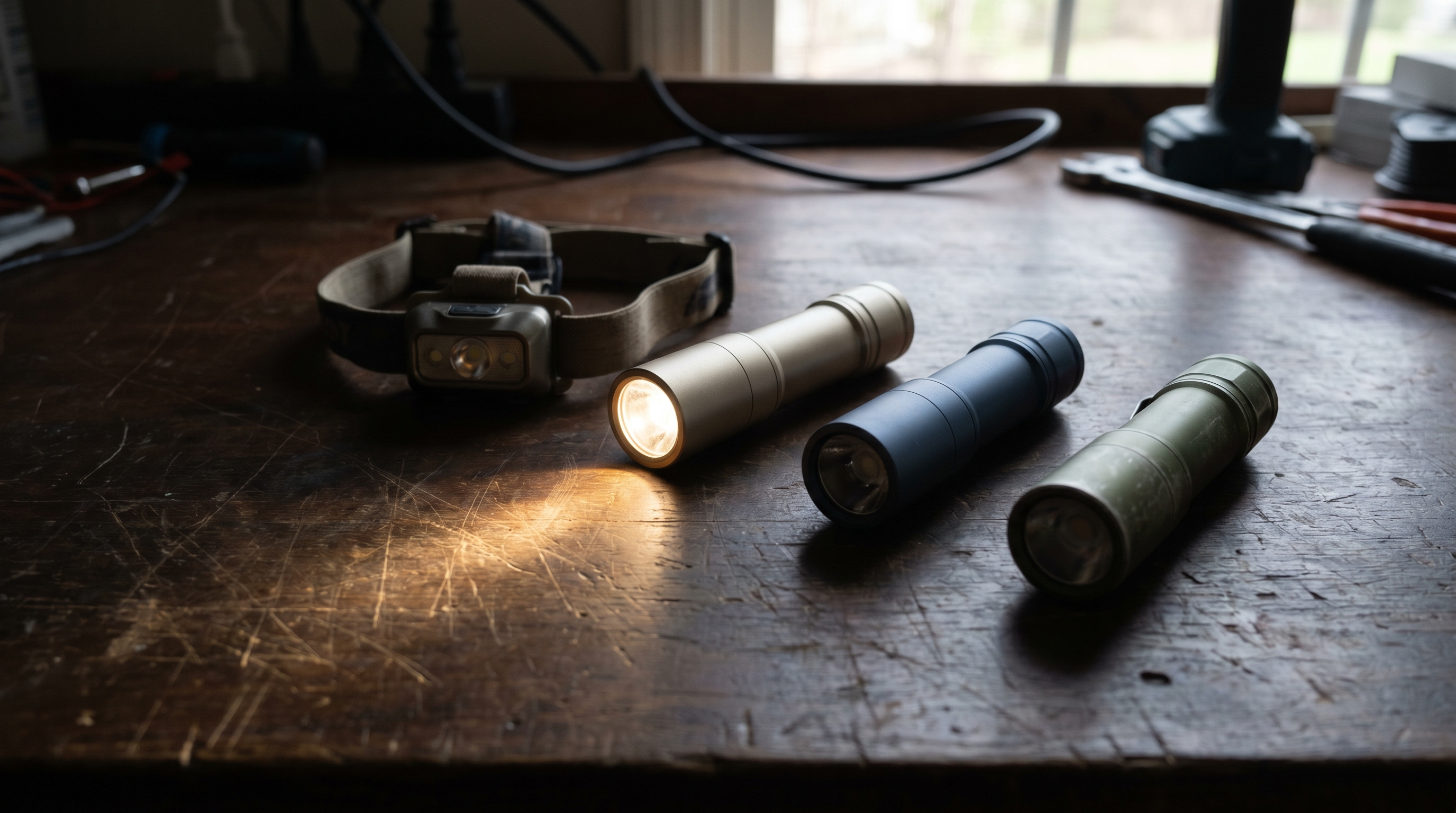
I was on my back in the crawlspace under the house in Raleigh, chasing the smell of a slow leak, holding my phone in my teeth so I could use both hands. The phone light did two things. It lit a perfect circle about the size of a dinner plate, and it got warm enough that I started to worry about it before I found the pipe. Twenty minutes later I climbed out, ordered an actual flashlight, and have never gone back under there with a phone since.
Disclosure: As an Amazon Associate, s1gma earns from qualifying purchases. Some links in this article are affiliate links. If you buy through them, s1gma may earn a small commission at no extra cost to you. It doesn't change what gets recommended.
The phone flashlight is the reason a lot of people think they do not need a flashlight. It is fine for finding a keyhole. It is genuinely bad for anything that takes more than thirty seconds or more than one hand, and it burns the battery on the one device you actually need to keep alive in an emergency. A real light is one of the highest-value, lowest-cost upgrades in all of preparedness, and the market for them is drowning in nonsense numbers. So let us cut through the numbers first.
The lumen myth
Walk into the flashlight aisle and every package screams a lumen count, each bigger than the last, as if light were sold by the pound. Lumens measure total light output, and more is not better past a point. Here is what the box does not tell you.
Lumens trade against runtime. A light blasting 2,000 lumens might do it for ninety seconds before it has to step down to keep from melting itself. The honest spec is not the peak number, it is the lumens-at-a-given-runtime, which is exactly what the industry's own ANSI/PLATO FL1 standard was created to measure: output, runtime, throw distance, impact resistance, and water resistance, tested the same way so you can compare across brands.
Lumens are not throw. Total brightness and how far the beam reaches are different things. A floody 1,000-lumen lantern lights a room. A focused 1,000-lumen thrower lights a tree across a field. Neither is better, they are for different jobs.
What you actually want for most real use is not the biggest number. It is a light that turns on every time, runs long enough to matter, survives being dropped, and does not die in the rain. Brightness you can buy. Reliability is the thing worth paying for.
Tier one: the EDC light you carry every day
The light that solves the most problems is the one that is on you, which means small, pocketable, and rechargeable so you are never hunting for a dead battery. This is the workhorse, the one you will use weekly for the boring stuff and reach for first when the lights go out.
| Item | Why it earns a spot |
|---|---|
| Blukar EDC keychain flashlight | Genuinely pocket-sized and USB-C rechargeable, bright enough for the nightly boring stuff and for an outage, and it clips to your keys so it is always on you. The one you actually carry. |
| WUBEN L50 tactical flashlight | The step up in throw. A full-size 1,200-lumen tactical light with a tail switch and a real beam, still cheap, for when you want to reach across a yard and not just find a keyhole. A real light beats no light. |
Tier two: the headlamp, the most useful light nobody buys
Here is my actual hill to die on. A headlamp is more useful than a handheld flashlight for almost everything that matters, because it points where you look and leaves both hands free. Working under a sink, changing a tire in the rain, walking a dark trail, doing anything during an outage. The only reason headlamps lose to flashlights is that they look dorky, and dignity is a poor reason to work one-handed in the dark.
| Item | Why it earns a spot |
|---|---|
| Black Diamond Storm 450 headlamp | 500 lumens, USB-C rechargeable, waterproof, hands-free, from a brand climbers actually trust. The do-everything household and outage headlamp. If you buy one light off this page, the argument for it being this one is strong. |
| Black Diamond Spot 400-R headlamp | 400 lumens, light and low-profile enough to run or hike in, with a red night-vision mode that saves your eyes in the dark. For anyone who actually spends time outdoors, not just in the garage. |
Tier three: light for a whole room or a whole problem
When the power is out, you do not want a beam, you want a room. Area light that sits on a table and lets four people exist without pointing a flashlight at the ceiling. This overlaps with the power outage kit, and for good reason.
| Item | Why it earns a spot |
|---|---|
| Samyoung magnetic LED worklight | Lights an entire room hands-free. The thing that turns a dark kitchen back into a kitchen during an outage. |
| Collapsible LED lantern (4-pack) | Soft area light that splits into four, one for each kid or each room. Soft light beats a harsh beam for living through hours. |
When you want the absurd amount of light
Sometimes the job really does call for turning night into day, search and rescue, a big dark property, spotting something far off. This is where the giant lumen numbers earn their keep, with the honest caveat that they run hot and drain fast at full tilt.
| Item | Why it earns a spot |
|---|---|
| TrixHub high-lumen flashlight (2-pack) | A super-bright, USB-C rechargeable tactical light that ships as a pair. Genuinely turns night into day in a burst. Overkill for finding a keyhole, perfect when you need to light up a whole backyard. |
A word on batteries
The single best upgrade after the light itself is getting off disposable batteries. USB-C rechargeable lights, like most on this page, are the move because in an outage you recharge them off the same power bank that keeps your phone alive. For everything that still runs on AAs, the radio, the kids' stuff, a backup light, do this:
| Item | Why it earns a spot |
|---|---|
| Amazon Basics USB-C rechargeable AA batteries + charger | Recharge off USB instead of praying the junk-drawer batteries still hold a charge. The unglamorous piece that keeps everything else running. |
What people get wrong
Chasing the lumen number. The brightest light on the shelf is usually the one that runs hottest and dies soonest at full power. Buy reliability and runtime, not bragging rights.
Owning one light. You want a light on you, a light in the house, and a light in the car, for the same reason you carry the small stuff in layers. The best light is the one within reach, and "in the other room" is not within reach at 2am.
Skipping the headlamp out of vanity. Already covered, still true. Both hands free is worth looking slightly silly.
Forgetting the light is half of everyday carry. The small stuff you keep on you, including the EDC light, is its own subject, and it is in the everyday carry guide.
TL;DR
Ignore the lumen wars. Total brightness trades against runtime and is not the same as throw, and the spec that matters is reliable output over real runtime, which the ANSI FL1 standard exists to measure honestly. Carry a small rechargeable EDC light every day. Own a headlamp, which beats a flashlight for almost everything because it frees your hands. Keep area light, a worklight or lantern, for outages when you want a room and not a beam. Reserve the giant-lumen monsters for when you genuinely need to light up a field. Get off disposable batteries so you can recharge off the same power bank that saves your phone. And own more than one, because the best light is the one within arm's reach when it suddenly goes dark.
Sources
- ANSI/PLATO FL1 standard - the flashlight industry's testing standard for lumens, runtime, beam distance, impact, and water resistance, the only honest way to compare lights across brands.
- Ready.gov, Build A Kit - where lighting fits in the broader emergency kit.