
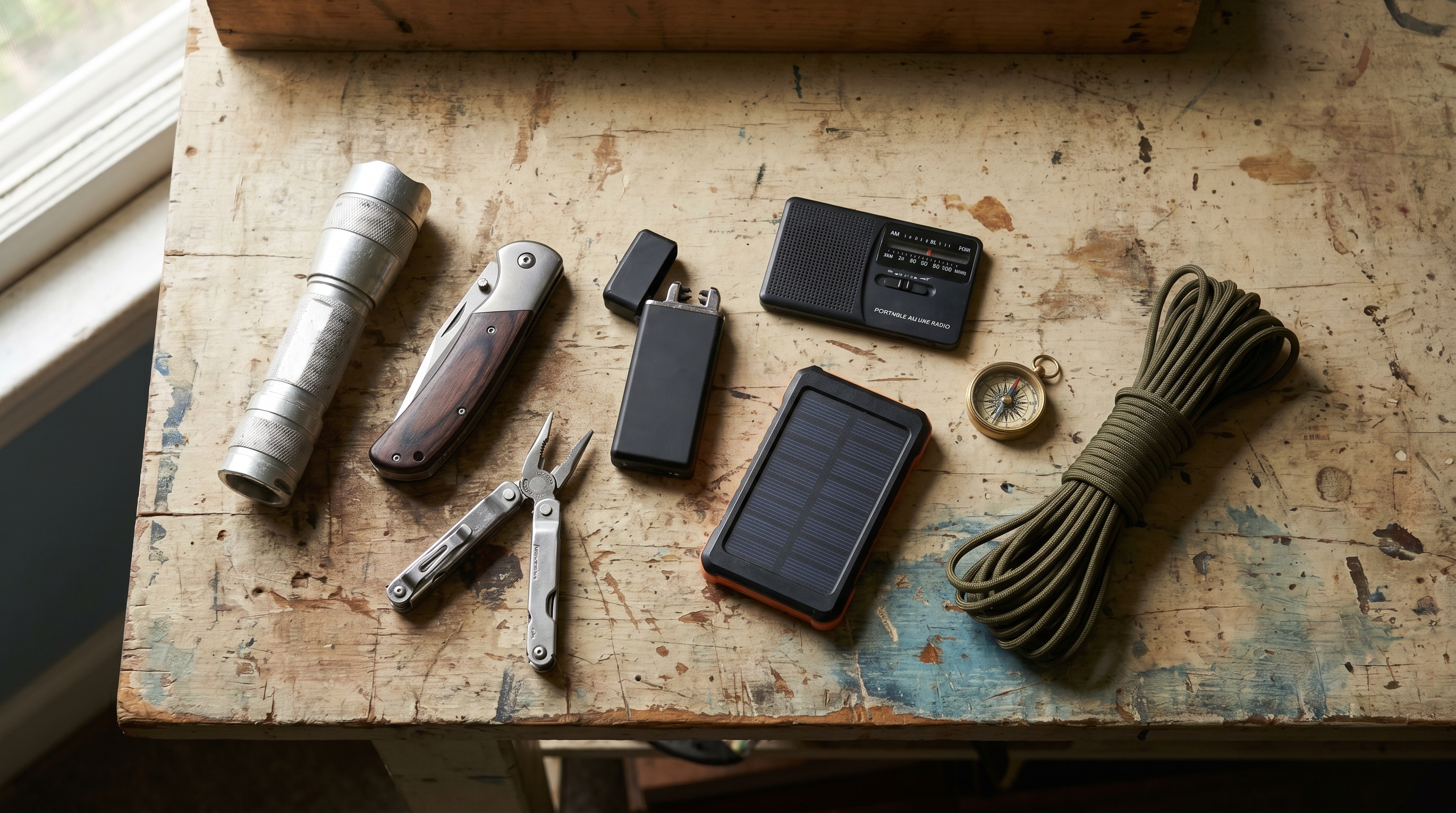
It is a Tuesday in October and the power has been out for six minutes when I realize my daughter has never seen the inside of our house without electricity. She is four. She stands in the hallway in Raleigh holding a juice box, completely still, waiting for the lights to do the thing they have always done. They do not do the thing.
Disclosure: As an Amazon Associate, s1gma earns from qualifying purchases. Some links in this article are affiliate links — if you buy through them, s1gma may earn a small commission at no extra cost to you. It doesn't change what gets recommended.
I pulled a small flashlight out of my pocket. Clicked it on. She laughed, because now it was a game instead of a problem, and that is the entire point of everyday carry. Not the tactical fantasy. Not the bug-out daydream. Just the difference between a four-year-old laughing in a hallway and a four-year-old deciding the dark is something to be afraid of.
Everyday carry, or EDC, is the small set of things you keep on your body or within arm's reach every single day. That is the whole definition. People have turned it into a hobby with a thousand subreddits and a gear-acquisition problem the size of Texas, but underneath the photos of titanium spinning tops and $400 knives, the real idea is boring and useful: a handful of objects that solve the small emergencies that actually happen.
Not the apocalypse. The Tuesday.
What earns a spot
Here is the filter I use, and it kills about ninety percent of the stuff the internet tells you to carry. Would I actually reach for this in a normal bad day, more than once a year? A flashlight passes. A tourniquet, for most people, does not live in the pocket. It lives in the car, which we will get to.
The other filter is weight against regret. The things worth carrying are the ones where the gap between having it and not having it is enormous and the cost of carrying it is almost nothing. A light weighs an ounce. Being stuck in a stairwell during a blackout with only your phone at 8 percent weighs a lot more.
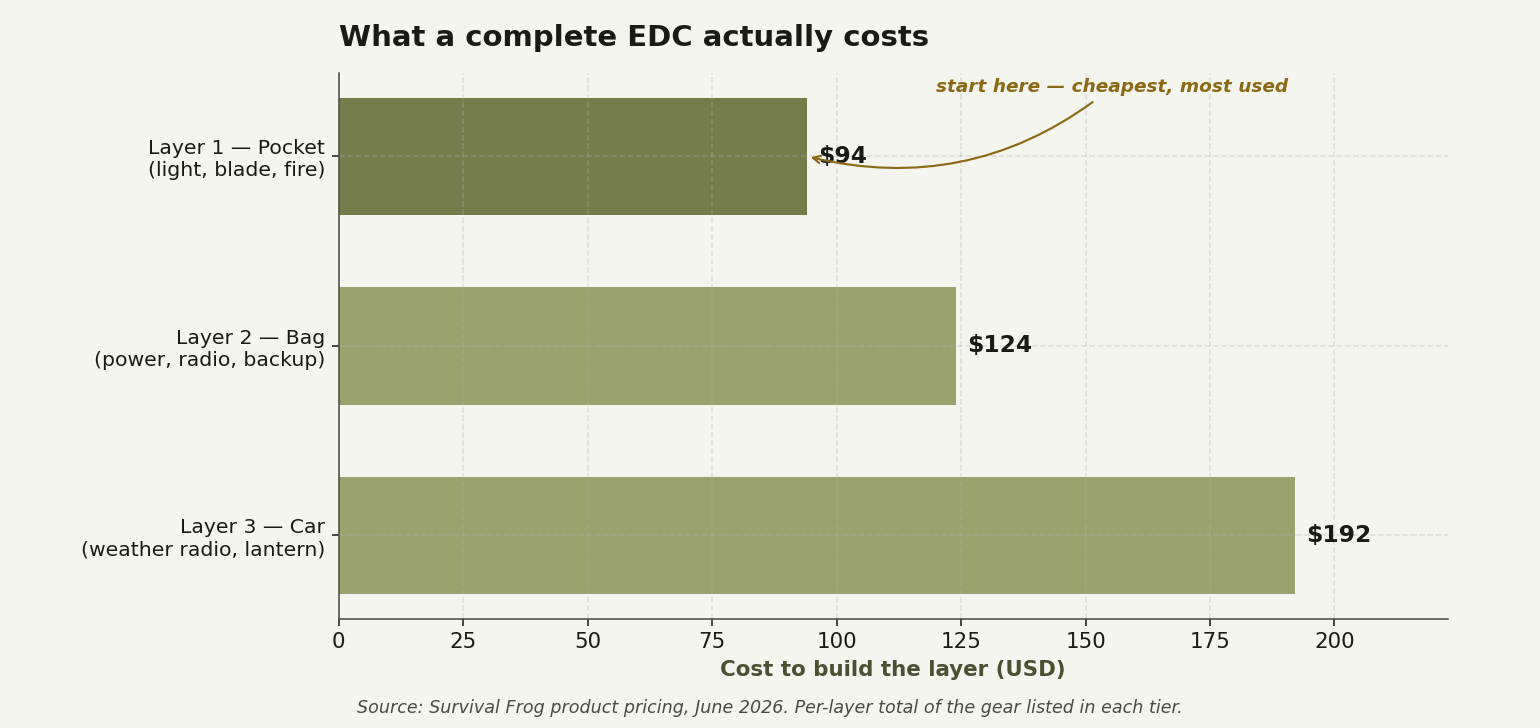
I carry in three layers. What is on my body. What is in the bag I take to work. What lives in the Tacoma. Each layer trades convenience for capability, and you build them in that order, because the stuff closest to you is the stuff you will actually have when something goes sideways at 11pm in a parking garage.
Layer one: the pocket
This is the non-negotiable tier. If you carry nothing else, carry these, because they fit in the same pocket as your keys and you will use them constantly.
A light. A blade or multitool. A way to make fire. That is the entire foundation, and humans have carried some version of those three things for about forty thousand years for a reason.
| Item | Why it's in the pocket |
|---|---|
| Blukar EDC keychain flashlight | USB-C rechargeable, clips anywhere, throws real light. The one thing you reach for most. |
| Victorinox Huntsman Swiss Army Knife | Blade, screwdrivers, pliers, the works. Replaces the four separate things you keep losing. |
| Scotte plasma arc lighter | Electric arc, no butane, windproof, rechargeable. Lights in wind that kills a Bic. |
| Gerber Truss multitool | Seventeen tools on one clip — pliers, drivers, blade. Opens bottles, boxes, and the occasional crisis. |
The light is the workhorse. I have used mine to find a dropped contact lens, read a menu in a restaurant that thought candlelight was ambiance, check a tire at night, and yes, turn a blackout into a game. The fancy EDC crowd will tell you that you need 2000 lumens and a sub-penny titanium body. You need a light that turns on when you press the button and survives going through the wash, because it will go through the wash.
On the blade: a lot of people get weird about knives, and I get it. But ninety-five percent of what a pocket knife does is open packages, cut zip ties, and slice an apple for a kid in the back seat. The Kershaw Blur pocket knife is bright red specifically so you stop losing it in the leaves, which tells you something honest about how these actually get used.
Layer two: the bag
The bag is where capability lives. This is the backpack or sling I take to work, and it carries the things that are too bulky for a pocket but too useful to leave at home. If the pocket layer handles the small Tuesday, the bag handles the longer Tuesday. The drive home that takes four hours instead of forty minutes. The storm that knocks the grid out while you are still at the office.
| Item | Why it's in the bag |
|---|---|
| BLAVOR solar power bank | Charges your phone a couple times over, tops itself off in the sun. The phone is your map, flashlight, and lifeline, and it dies at the worst moment. |
| Panasonic RF-P50D pocket radio | Credit-card sized AM/FM. When the cell network is jammed and everyone is refreshing a dead app, the radio still tells you what is happening. |
| bayite ferro rod fire starter | Works wet, works cold, works after the lighter dies. The backup to the backup. |
| LuxoGear emergency whistle | 100 decibels from one puff. Your voice gives out in about an hour of yelling. This does not. |
The power bank is the piece most people skip and then desperately wish they had. Your phone is not a phone anymore. It is your flashlight, your map, your radio, your bank, and the thing that tells your wife you are okay. It also has the battery life of a mayfly. A solar power bank in the bag means the single most important tool you own does not turn into a glass brick at hour three.
The radio is the sleeper. We have gotten so used to information being infinite and instant that we forget how fast that disappears. During the 2024 data-center disruption in northern Virginia, the grid wobbled and the first thing that gets congested in any real emergency is the cell network, because everyone reaches for their phone at the same second. A two-band radio the size of a credit card is a strange little time machine back to when information had a source you could actually reach.
The phone is the most powerful tool you carry and the most fragile. Everything in the bag is, in some way, insurance on the phone.
Layer three: the car
The Tacoma carries the stuff that is genuinely too much for a bag but that you want within reach of wherever you actually are, which, if you are honest about your life, is usually somewhere near your vehicle. This is the layer where you can stop apologizing for size and weight.
| Item | Why it lives in the truck |
|---|---|
| FosPower NOAA emergency radio | Hand-crank, solar, NOAA weather alerts that wake you before the storm does. The grown-up version of the pocket radio. |
| Collapsible LED lantern (4-pack) | Lights a whole room or a whole campsite. Hands-free, unlike a flashlight you have to hold in your teeth. |
| SUUNTO A-10 baseplate compass | Glows in the dark, needs no batteries. Works when the GPS satellites are busy or your phone is dead. |
The Voyager Pro is the one piece of "prepper gear" in this whole list that looks like prepper gear, and it earns it. The NOAA weather alert is the feature that matters. It is the difference between waking up to a tornado warning and waking up to a tornado. In a part of the country where the sky turns green a few times a year, that is not paranoia. That is just paying attention.
And the compass is in here as a joke that is also completely serious. It glows in the dark, needs no batteries, and does one thing that your $1,200 phone cannot do once its battery is gone: tell you which way is north. Carry the simple thing that does the one thing.
The bundle, if you want to skip the thinking
If reading three tables made your eyes glaze, here is the shortcut: grab the pocket layer first — a light, a blade, a lighter — and add the rest as you go. It is the "I do not want a hobby, I just want to be slightly less helpless" option, and there is zero shame in that. Most people who buy individual pieces over two years end up with roughly this anyway, minus the two years.
Skipping the learning curve is a fair trade. The learning curve is fun if you are into it. If you are not, grab the three pocket items, put them in the truck, and get on with your life.
What people get wrong
Here is the part the gear photos never show you. The most important things in your everyday carry are not things.
Knowing your exits matters more than any flashlight. Having a place your family agrees to meet matters more than any radio. The habit of glancing at the weather before you leave the house matters more than the fanciest NOAA receiver in the world. Gear is the easy part because gear is something you can buy, and buying feels like doing. The skill is the hard part because the skill is free and requires you to actually practice.
I watched a guy at a campsite last summer with a backpack that probably cost two thousand dollars in gear, and he could not get a fire going in a light drizzle. Meanwhile my neighbor, who carries almost nothing, had a small flame inside of three minutes because he had done it four hundred times. The bag is the prep. The hands are the actual skill. Do not confuse the two, which is exactly what the entire EDC industry would prefer you do.
Carry the light. Carry the blade. Carry a way to make fire and a way to charge your phone and a way to hear the world when the screens go dark. Then go practice using all of it on a normal Saturday, in your backyard, while the lights are still on and your daughter still thinks the dark is a game.
That is the whole thing. Everything else is just shopping.
TL;DR
Everyday carry is the small set of tools that solve the small emergencies that actually happen, not the apocalypse you are imagining. Build it in three layers: the pocket (light, blade, fire), the bag (power, radio, backup fire), and the car (weather radio, lantern, compass). Spend your money on the pocket layer first, because it is the stuff you will actually have on you. Then spend your time, which is free and worth more, on knowing how to use all of it. The gear is easy. The habit is the prep.
Sources
- FEMA — Build A Kit — the federal baseline for emergency supplies, and a sane starting point before the rabbit hole.
- NOAA Weather Radio All Hazards — how the weather-alert system in the Voyager Pro actually works and why it is worth having.
- NERC Incident Review, large load loss (Jan 2025) — the July 2024 northern Virginia grid event referenced above, for anyone who wants to know why "the network gets congested first" is not hypothetical.