
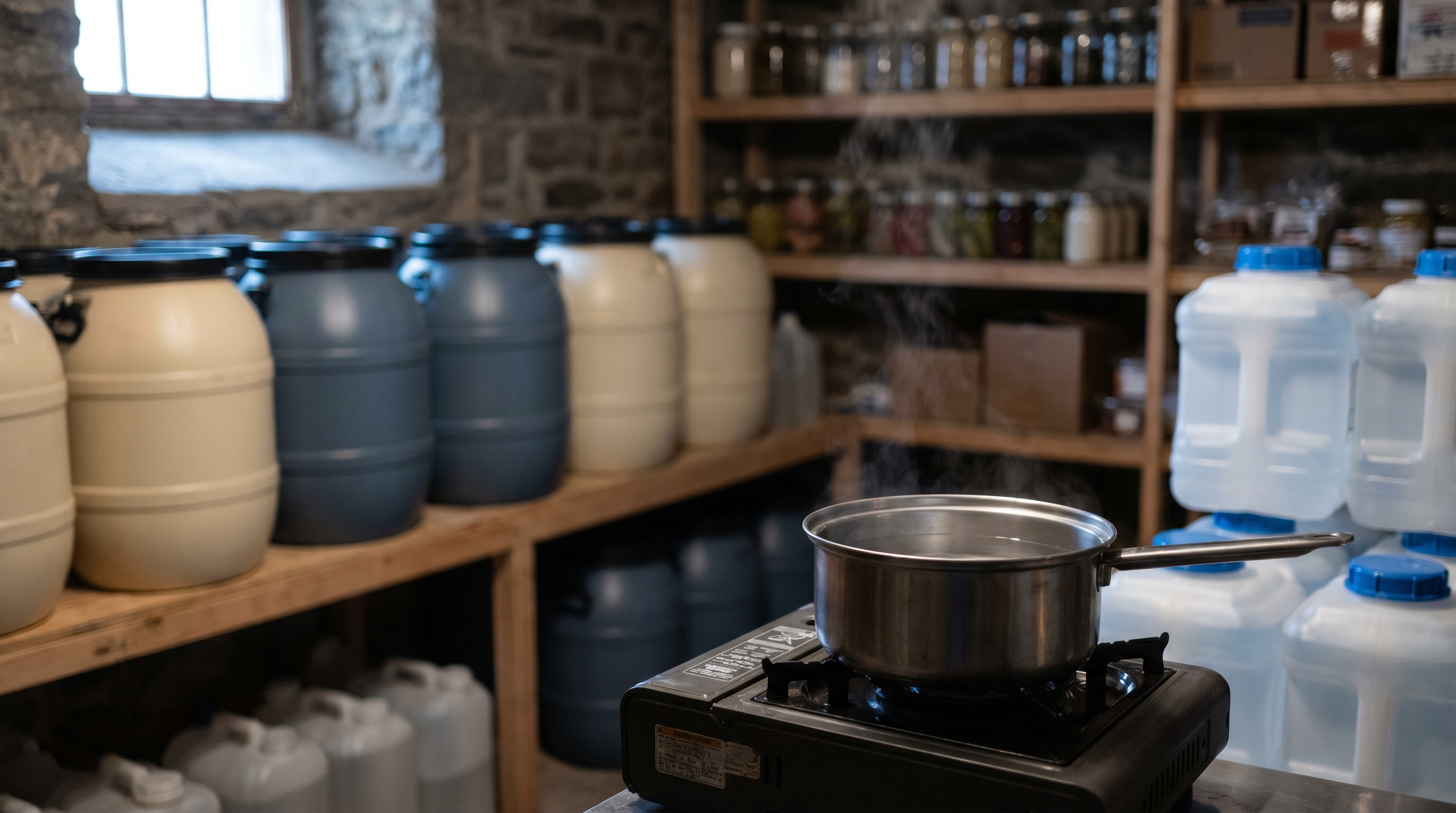
The text came through at 6.40 in the morning, the kind of official all-caps that means a person typed it in a hurry. BOIL WATER ADVISORY IN EFFECT. A main had broken overnight a few miles from us in Raleigh, pressure had dropped, and just like that the thing that comes out of every tap in the house was a question mark instead of an answer. Lauren was already filling the kettle before I had finished reading it, which tells you which of us is the actual prepper in this marriage.
Disclosure: Some links in this article are affiliate links. If you buy through them, s1gma may earn a small commission at no extra cost to you. It doesn't change what gets recommended.
Here is the uncomfortable truth about water. You can go about three weeks without food and you will be miserable but alive. You can go about three days without water and you will be dead. It is the single most important thing to have squared away, it is the heaviest and most annoying to store, and it is the first thing that vanishes from every shelf in the county the moment anything goes wrong. Which is exactly why you do not want to be in that aisle when it happens.
The good news is that water prep is the cheapest prep there is. Most of what matters here costs nothing but a little space and ten minutes of thought.
How much, by the actual guidance
The number is not a guess. Both Ready.gov and the CDC say the same thing: store at least one gallon per person per day. Half of that is for drinking, the other half for cooking and basic hygiene.
The now-familiar split applies. Three days is the bare evacuation minimum. Two weeks is the at-home target. For a family of four that is fifty-six gallons, which is a real amount of space and the reason most people quietly skip it. A few honest adjustments straight from the guidance:
- Children, nursing mothers, and anyone sick need more.
- Hot weather can roughly double the requirement. A Carolina July is not a Carolina January.
- Do not forget the pets. The dog drinks too.
If you want the exact number for your household instead of doing the multiplication in your head, the supply calculator does it for you, water and food in one shot.
How to store it without it becoming a science project
There are two kinds of stored water and they have different rules.
Store-bought sealed bottled water is the easy mode. Unopened, kept cool and dark, it lasts essentially indefinitely. The expiration date on the bottle is about the plastic and taste, not safety. Buy a few cases, slide them under a bed, forget about them.
Water you bottle yourself from the tap is fine to store but follow the CDC rules: use clean food-grade containers, and replace it every six months. Keep all of it somewhere between 50 and 70 degrees, away from direct sunlight, and away from gasoline, pesticides, or anything else whose fumes can migrate through plastic over time.
A couple of practical notes the official pages do not stress enough. Split your storage across more than one location so a single flooded closet is not your entire supply. And keep some of it in smaller, actually-liftable containers, because a 55-gallon drum of water is wonderful right up until you need to carry some of it up a flight of stairs in the dark.
| Item | Why it earns a spot | Price |
|---|---|---|
| Roll-Top Waterproof Dry Bag | Not for storing water, for keeping the things water ruins dry. Documents, a phone, matches, meds during a flood or leak. Ten bucks of cheap insurance. | $9.97 |
| Solar Shower Bag, 5 Gallon | Five extra gallons of capacity that doubles as a way to stay clean when the taps are dry. Hygiene is morale, and morale is a real prep. | $19.97 |
When the stored water runs out: making questionable water safe
This is the part that turns a two-week supply into an open-ended one, because the moment you can safely treat water you find, you stop counting jugs.
If water is cloudy, let it settle and filter it through a clean cloth or coffee filter first. Then pick a method. Straight from the CDC and EPA:
Boiling is the best method, full stop. It kills everything that matters, including the parasites that shrug off chemicals. Bring it to a rolling boil for one minute, or three minutes if you are above 6,500 feet of elevation. Let it cool. Done. The only thing you need is heat and a way to make it.
| Item | Why it earns a spot | Price |
|---|---|---|
| UCO Stormproof Match Kit with Case | Boiling water requires fire, and fire requires ignition that works when it is wet. Two dollars. The cheapest link in the whole chain, and the one people forget. | $1.99 |
Bleach is the backup when you cannot boil. Use regular unscented household bleach, the 5 to 9 percent kind, nothing with added scent or cleaners. The CDC ratio is 8 drops, a little under one-eighth of a teaspoon, per gallon. If the water is cloudy or very cold, double it to 16 drops. Stir, then wait at least 30 minutes before drinking. It should have a faint chlorine smell. If it does not, repeat the dose once.
One honest limitation worth knowing: bleach and most chemical treatments do not reliably kill Cryptosporidium or Giardia, two parasites that will absolutely ruin your week. Boiling does. A proper filter does too. A cheap personal filter like the LifeStraw Peak personal filter drops to 0.2 microns, handles bacteria, protozoa, and microplastics, and is small enough to live in any bag. Chemicals are the third-best option, which is still infinitely better than drinking it raw.
What people get wrong
Storing only drinking water and forgetting sanitation. When the taps are dry, you still need water to flush, wash hands, and clean a wound. That gray-water need is why the gallon-a-day rule is half for everything-else. Do not drink your way through your toilet budget.
Assuming the filter on the fridge or the pitcher counts. Those are taste filters. They are not built to make contaminated water safe, and treating them like they are is how people get sick.
Trying to treat pool or saltwater by boiling. Boiling concentrates salt and pool chemicals, it does not remove them. Saltwater needs distillation, which is a different and harder problem. Know the difference before you are thirsty.
Having water and no way to heat it. If the power is out, your electric stove is a paperweight. The power outage kit covers the off-grid way to boil, and your stored emergency food is the other half of this same equation, since most of it needs water to become a meal.
TL;DR
Store one gallon per person per day, three days minimum, two weeks if you can. Store-bought sealed water lasts indefinitely, water you bottle yourself gets swapped every six months and kept cool and dark. When it runs low, boiling is the best way to make found water safe, one minute at a rolling boil or three above 6,500 feet. Bleach is the backup at 8 drops of plain unscented bleach per gallon, doubled if cloudy, wait 30 minutes, but know that chemicals do not kill Crypto or Giardia and boiling does. Keep some sanitation water on top of your drinking water, split your storage across rooms, and make sure you actually have a way to make fire. The cheapest prep on the whole list is also the one most likely to keep you alive.
Sources
- Ready.gov, Water - the one-gallon-per-person-per-day standard and storage basics.
- CDC, How to Create and Store an Emergency Water Supply - amounts, container rules, the six-month replacement and 50-to-70-degree storage guidance.
- CDC, How to Make Water Safe in an Emergency - boiling times and the bleach ratio, and why chemicals miss Crypto and Giardia.
- EPA, Emergency Disinfection of Drinking Water - the federal disinfection guidance behind the bleach method.