
The Friday before the hurricane was supposed to hit, I stood in the bread aisle of the Harris Teeter in Raleigh and watched a man take the last case of bottled water out from under a woman's hand. Not aggressively. Just faster. She had reached, he had reached, and physics sorted it out. The shelves looked like a photograph of a store rather than a store. Bare metal where the water had been. A single sad loaf of cinnamon raisin bread that nobody panics for.
Disclosure: Some links in this article are affiliate links. If you buy through them, s1gma may earn a small commission at no extra cost to you. It doesn't change what gets recommended.
I had what I needed at home, so I was mostly there for the spectacle, and the spectacle was this. Several hundred otherwise reasonable adults discovering at the exact same moment that "I'll just grab some stuff if something happens" is not a plan. It is a hope. And the thing about a hope is that everyone in your county has the same one, and they all act on it in the same eight-hour window, which is precisely when the supply chain you are counting on falls over.
The fix is boring and it works. You decide how much food and water your household actually needs before the sky turns the wrong color, you buy it once, on a normal Tuesday, and then you never stand in that bread aisle again. The only real question is the number. So let us do the number, by the actual guidance, not by vibes.
The three-day lie
Here is the thing almost everyone gets wrong, and it is not their fault, because the messaging has been muddy for years.
You have probably heard "have three days of food and water." That number is real, but it is not the home number. FEMA's own Ready.gov guidance splits it in two, and the split matters enormously:
- Three days of non-perishable food is the evacuation number. It is what goes in the bag you grab when you are leaving. Portable, no cooking, no fuss.
- Two weeks is the shelter-in-place number. It is what FEMA actually recommends you keep at home, because the disasters that keep you home, the ice storm, the hurricane aftermath, the regional grid event, do not politely resolve in seventy-two hours.
Three days became the famous number because it is easy to say and easy to sell, and somewhere along the way people started treating the evacuation floor as the home goal. It is not. Three days of food at home is the bare minimum the government suggests for the road, mistaken for a plan. Two weeks is the baseline that actually keeps you off the cinnamon-raisin shelf.
Water first, because it is the one you cannot improvise
Before food, water, because you can go weeks without food and about three days without water, and water is heavy, bulky, and the thing every panic-buyer clears out first.
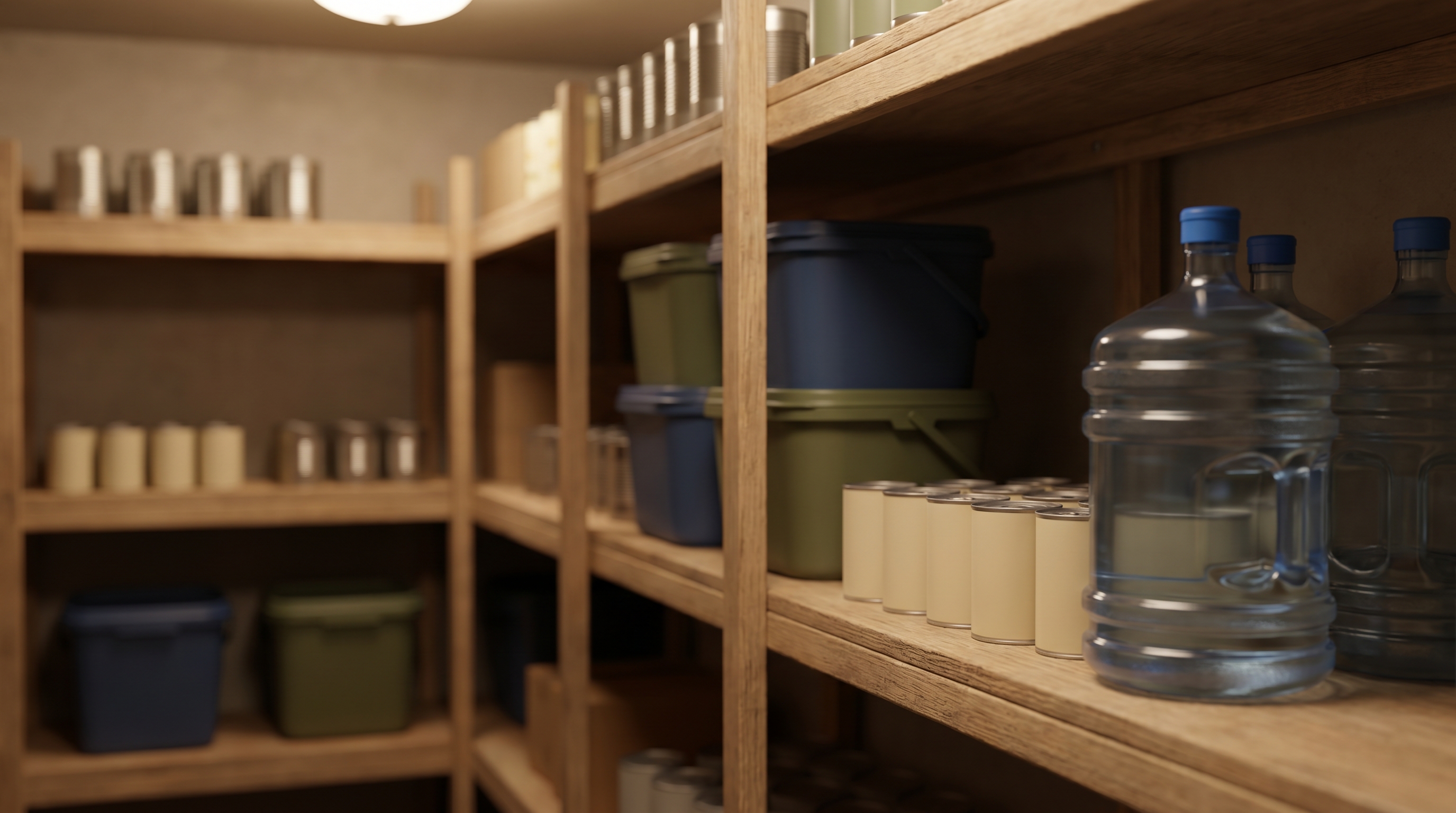
Ready.gov is specific: store one gallon per person per day. Half for drinking, half for everything else, cooking, basic hygiene, keeping a wound clean. That is the floor, and the same evacuation-versus-home split applies. Three days for a grab bag, two weeks at home. For a family of four, two weeks at a gallon a day is fifty-six gallons. That is a real amount of space, which is exactly why people skip it and then fight over a case at the Harris Teeter.
A few honest adjustments to the gallon-a-day rule, straight from the guidance:
- Children, nursing mothers, and anyone sick need more.
- Hot climate roughly doubles it. A two-week supply in a Carolina August is not a two-week supply in a Carolina January.
- Pets count. A dog needs water too, and "I forgot about the dog" is a genuinely common failure.
Store-bought sealed water keeps essentially indefinitely if you keep it cool and dark. Water you bottle yourself should be swapped every six months or so. None of this is exotic. It is just volume, and volume is the part people underestimate.
The two-week baseline, in food you will actually eat
Now the home food supply. The principle from Ready.gov is simple: store non-perishable, easy-to-prepare food that needs no refrigeration, little or no cooking, and little or no water. The closer your emergency food is to food you already eat, the more likely you are to rotate it instead of letting it fossilize in the basement.
There are two honest ways to hit two weeks. Build it from the grocery store, or buy it as a kit. Both are fine. The kit costs more per calorie and saves you the assembly and the math.
| Option | What it covers | Price |
|---|---|---|
| ReadyWise Favorites Bucket (100 servings) | One person, roughly a month, or two people for two weeks. The clean way to clear the FEMA home baseline in one purchase. | $399.97 |
| ReadyWise Favorites Bucket (100 servings) | A bucket of just-add-water entrees with a long shelf life. Stackable, sealed, and it is real meals, not just calories. | $449.97 |
The thing nobody mentions about freeze-dried kits is that they need water to reconstitute, which is the whole reason the water section comes first. A pantry full of dehydrated lasagna and no stored water is a cruel joke you play on your future self.
The one-month tier, for when you want a real buffer
Two weeks is the recommendation. A month is where it stops feeling like prepping and starts feeling like simply not being fragile. If you live somewhere that loses power for real, or far enough out that the store is a trip rather than a corner, the extra buffer is cheap insurance and it lets you ride out the days when everyone else is panicking.
| Option | What it covers | Price |
|---|---|---|
| ReadyWise Favorites Bucket (100 servings) | Breakfasts plus entrees, roughly a month for one person with variety that keeps you sane. | $749.97 |
| ReadyWise Favorites Bucket (100 servings) | The serious buffer. A full quarter for one person, or a month for a small family. This is the ceiling for most normal households. | $999.97 |
A note on calories, since "servings" is a slippery word the food-kit industry loves. The standard planning figure is about two thousand calories per person per day. Check the kit's total calorie count against the number of days you actually want it to cover, because a "30-day kit" at 1,200 calories a day is a 30-day diet, not a 30-day supply. The supply calculator does this math for you against your real household size, and it is the single most useful five minutes you can spend before buying anything on this page.
Protein is the gap in almost every kit
Here is the thing the freeze-dried buckets quietly skip. They are heavy on carbs, rice, pasta, oats, the cheap-per-calorie stuff, and light on protein, because protein is expensive to dehydrate and sell. Two weeks of just-add-water carbs will keep you alive and absolutely miserable.
Shelf-stable canned protein fixes the gap for not much money, and it is the thing I would actually add first to any kit.
| Item | Why it earns the spot | Price |
|---|---|---|
| All-Natural Canned Meat Variety Pack | A cheap way to try canned beef, chicken, and pork before committing to a case. Real protein with a 25-year shelf life. | $69.97 |
| All-Natural Canned Meat Variety Pack | The full stock-up once the sampler proves you will eat it. Cooked, canned, lasts decades, no freezer required. | $259.97 |
Shelf life and the FIFO habit that keeps it from rotting
A pantry you buy once and forget is a pantry you will throw away in three years. The fix is one boring habit borrowed from every restaurant kitchen: FIFO. First in, first out. New cans go to the back, old cans come to the front, and you eat from the front during normal life. Your emergency food and your regular food become the same shelf, just deeper.
Rough shelf lives so you know what you are working with:
- Commercial freeze-dried and canned emergency kits: often 25 years sealed. These are the buy-and-store tier.
- Regular canned goods from the grocery store: typically two to five years, and fine well past the printed date if the can is not bulging, rusted, or dented at a seam.
- Dry staples like rice, pasta, and oats: years if kept cool, dry, and sealed against pests.
The long-shelf-life kits are for the deep buffer you genuinely do not touch. The grocery-store layer is the one you rotate. Most sane households run both: a couple of sealed buckets in the closet for the real event, and a deeper-than-normal pantry of regular food they actually cook.
What people get wrong
Buying food they hate. The freeze-dried stroganoff you will choke down once is not a supply. Buy a sampler, find what you would actually eat, then stock that. Morale is a real variable on day nine.
Forgetting the can opener, the water, and the stove. Canned food needs an opener. Freeze-dried food needs water and usually heat. A pantry without the means to open and prepare it is a still life, not a meal. If the power is out, see the power outage kit for the light and the way to boil water that makes the food section actually function.
Storing it all in one place. A single shelf in a flood-prone basement is one bad day from being your entire supply turning to mush. Split it. Some in the pantry, some in a closet, some in a tote in the truck.
Treating it as a one-time purchase. It is a habit, not an event. Buy the buffer once, then keep the rotating layer alive by simply eating and replacing. The day you stop thinking about it is the day it starts expiring.
TL;DR
Three days of food is the evacuation number, not the home number. FEMA actually recommends two weeks of non-perishable food and one gallon of water per person per day for sheltering at home, and a month is the buffer that makes you genuinely not fragile. Water comes first because you cannot improvise it and freeze-dried food needs it to function. Buy protein separately because the kits skimp on it. Run two layers, a sealed long-shelf-life buffer you do not touch and a deeper everyday pantry you rotate with FIFO. Do the calorie math against your real household on the supply calculator instead of trusting "servings." And buy it on a boring Tuesday, so you are never the person reaching for the last case of water at the same second as everyone else.
Sources
- Ready.gov, Food - FEMA's guidance on emergency food supply, the three-day evacuation versus two-week home split, and what to store.
- Ready.gov, Water - the one-gallon-per-person-per-day standard and adjustments for children, illness, and hot climates.
- Ready.gov, Build A Kit - the full federal baseline for an emergency supply kit.
- FoodSafety.gov, Food Safety During a Power Outage - how long stored and refrigerated food stays safe when the grid goes down.