
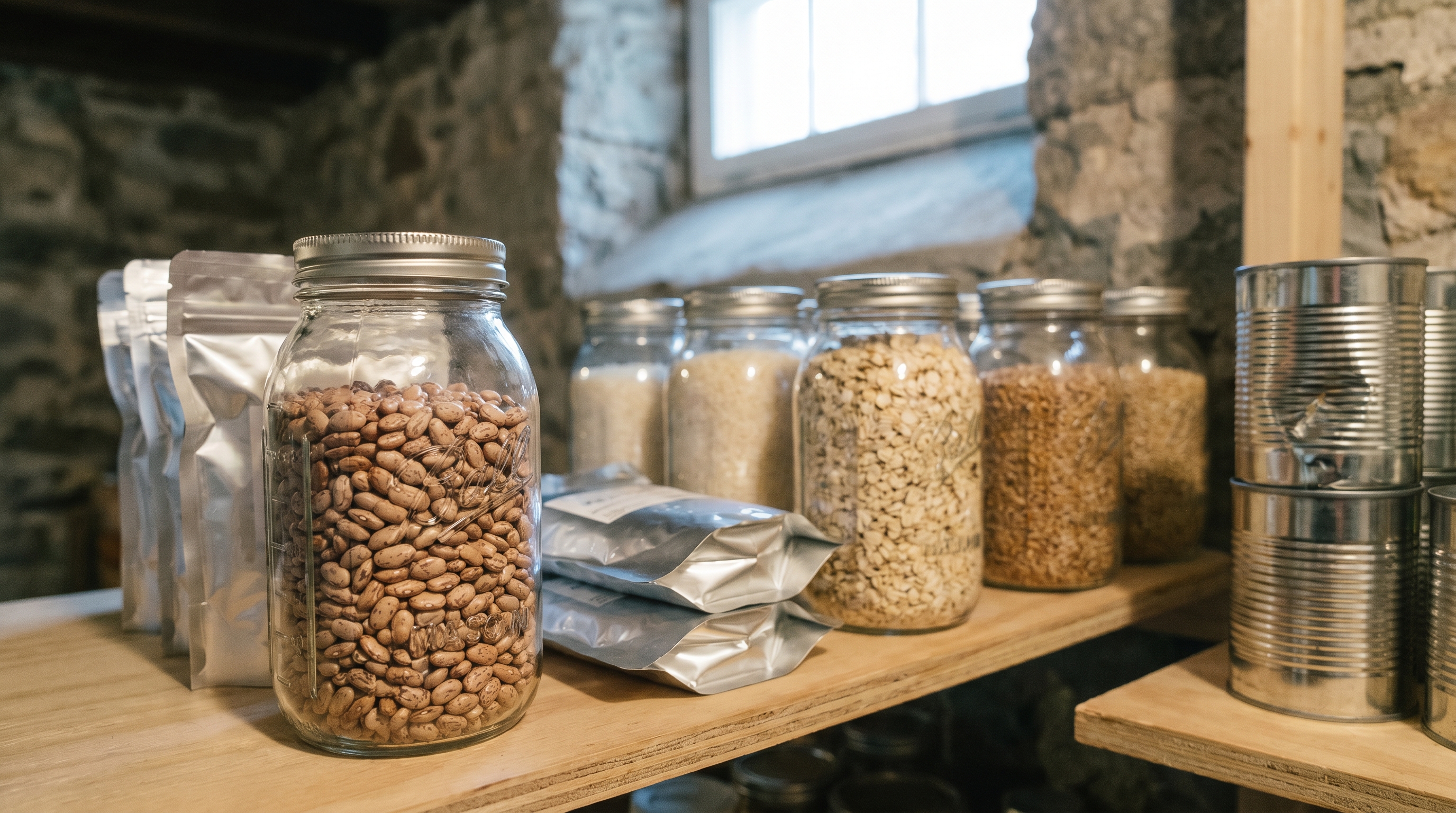
The "30-year shelf life" is real. The fine print under it is where most pantries quietly fail.
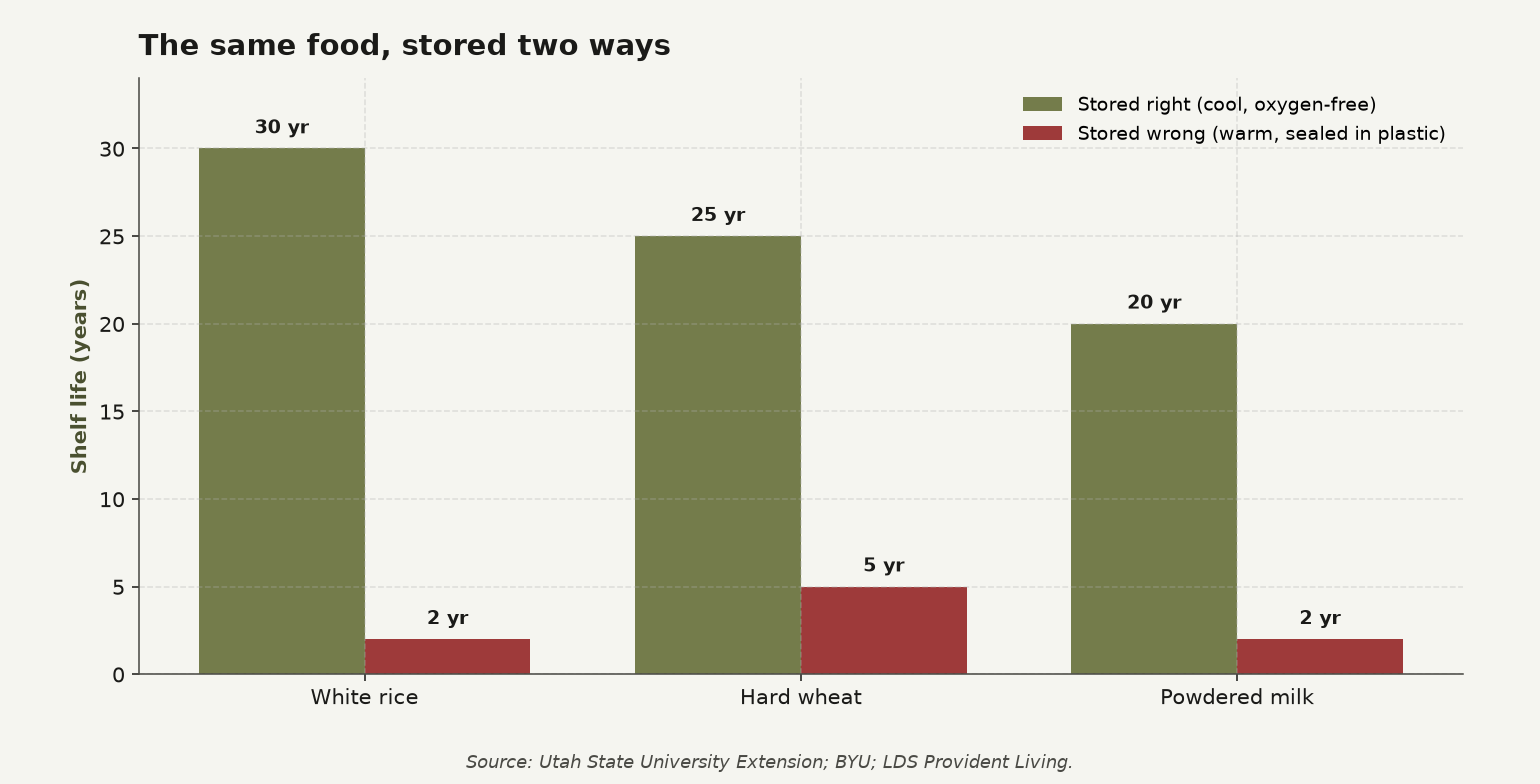
Somewhere right now there is a five-gallon bucket of rice in a hot garage, and the person who filled it believes they're set for three decades. The number they read was real. The garage is the problem. Stored cold, hard wheat keeps acceptable quality for about 25 years. The same wheat in a hot attic is done in roughly 5. That is the entire subject in one sentence: the food matters less than where you put it.
Most "how long does it last" lists hand you a single number per food. That number is a best case, achieved only under specific conditions, and almost nobody's pantry meets them. So this is the honest version, sorted into what genuinely lasts, what quietly rots, how to store it so the big numbers actually apply, and the one storage method that can kill you if you get it wrong.
General guidance, not a substitute for current USDA/NCHFP canning instructions, which you should follow exactly for anything you can at home.
First, the asterisk on every "30 years"
Those decades-long shelf lives come from a narrow set of conditions: oxygen removed, moisture under about 10%, and cool storage, usually in a #10 can or a sealed Mylar pouch. Utah State University's own numbers make the gap brutal. White rice sealed in a container at a 70°F basement lasts about 2 years before quality drops. The same white rice, oxygen-free and cool, lasts 30. Same grain. The packaging and the temperature did all the work.
Keep that ratio in your head as you read every number below. The shelf life is a promise the storage has to keep.
The five things that destroy stored food
Utah State and LDS Provident Living, the two bodies that have actually run multi-decade storage trials, name the same culprits: oxygen, moisture, heat, light, and pests.
- Heat is the big one. Aim for 40 to 70°F, lower is better, and keep it under 75°F whenever you can. Every step toward 40°F roughly multiplies shelf life; every step toward a hot garage divides it. (You'll see the "shelf life halves for every 18°F" rule repeated everywhere. It's a fair rule of thumb rooted in basic chemistry, but no food-storage authority actually publishes that exact figure, so treat it as a guide, not a law. The 25-years-versus-5 wheat data is the real evidence.)
- Moisture has to stay low, with dried staples at about 10% moisture or less. Above that, mold and bacteria wake up.
- Oxygen drives the chemical reactions that turn fats rancid. It's handled by packaging, not location.
- Light speeds deterioration of both the food and its container. Direct sunlight is the enemy.
- Pests are why you store off the floor and in hard containers. (Storing off concrete also matters because concrete can leach into food and cans.)
That's what "cool, dark, dry" actually means: under 70°F, no sunlight, low humidity.
What actually lasts (stored right)
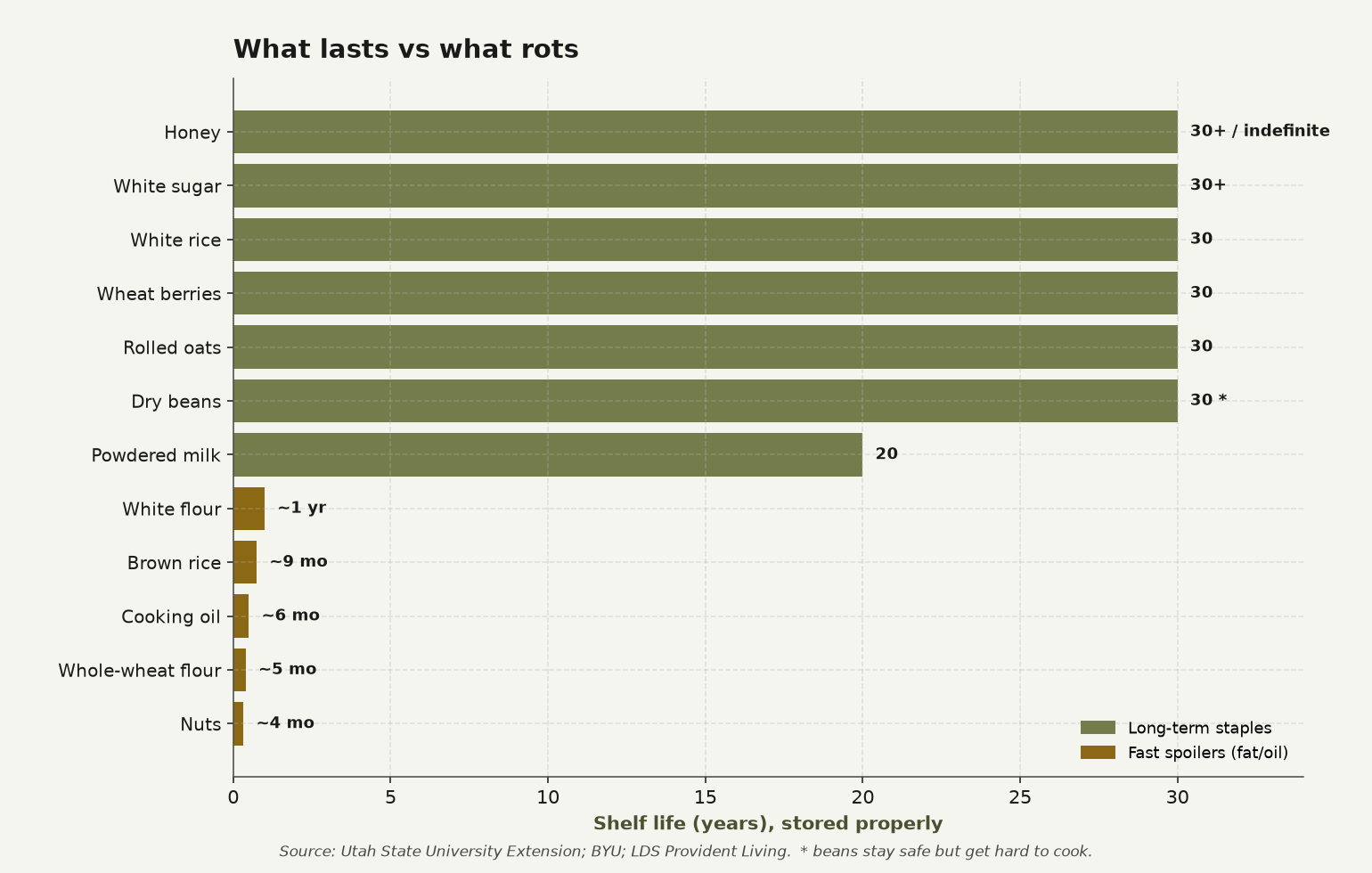
These are the long-term staples, in an oxygen-free container, kept cool. Numbers are from the LDS Provident Living storage table and USU/BYU research.
| Staple | Shelf life (oxygen-free, cool) |
|---|---|
| White rice | 30+ years |
| Hard wheat berries | 30+ years |
| Rolled oats | 30 years |
| Dried pasta | 30 years |
| Dry beans / legumes | 30 years (safe, but see the catch below) |
| White sugar | 30+ years (effectively indefinite if dry) |
| Salt | Indefinite if dry |
| Honey | Effectively indefinite |
| Non-fat powdered milk | 20 years |
| Dehydrated apple slices | 30 years |
| Freeze-dried foods | 25–30 years |
The catch on beans is the one nobody mentions. They stay safe for decades, but they develop what food scientists call the hard-to-cook defect. As USU puts it, aging beans need longer and longer soaking and cooking, and eventually they simply will not rehydrate and have to be ground into flour. Safe at 30 years, genuinely pleasant to eat for maybe the first one or two. Plan to actually rotate your beans.
What quietly rots (and why)
The fast spoilers all share one trait: fat. Oxygen attacks the unsaturated oils in food, and the more fat, the faster it goes rancid. USU is blunt about it: cracked or whole-grain products "do not store well," and rancidity sets in at a rapid rate.
| Food | Realistic shelf life | The problem |
|---|---|---|
| Brown rice | ~6–12 months | Oil-rich bran and germ (white rice has them milled off) |
| Whole-wheat flour | ~3–6 months | Germ oils oxidize; white flour gets ~1 year |
| Nuts | ~3–4 months pantry | High polyunsaturated fat |
| Cooking oils | ~6 months opened | Oxidation, accelerated hard by heat |
The fix is a mindset shift: store the grain, not the flour. Wheat berries last 30 years; the moment you grind them into flour you start a six-month clock. Buy a hand mill and grind as you need it. The same logic picks white rice over brown for the long-term shelf, and keeps oils and nuts as a small, fast-rotating layer rather than the backbone of your storage.
How to store it so the big numbers apply
The decades-long figures depend entirely on getting oxygen out and keeping it out.
- Mylar bags + oxygen absorbers are the DIY gold standard for dry staples. The aluminized film is essentially impermeable to oxygen and light, and the absorber mops up what's left inside. Use 5 to 7 mil thickness for long-term storage. Thin 3–4 mil bags puncture and slowly leak, so they're a short-term option only. The aluminum layer is what actually blocks oxygen, which is why cheap un-foiled "mylar" fails.
- Food-grade buckets (HDPE #2) are great against rodents and crushing, but here's the trap: plastic is not an oxygen barrier. As Utah State puts it plainly, oxygen permeates plastic over time, so an oxygen absorber dropped into a bare bucket slowly loses the fight as fresh oxygen seeps back through the walls. Line the bucket with a Mylar bag. The bucket is the armor, the bag is the seal.
- Vacuum sealing extends life but is not a preservation method on its own, and on moist or low-acid food, pulling the oxygen out can actually raise botulism risk. Good for dry goods and the freezer, not a safety guarantee.
Oxygen absorbers themselves are just iron powder that rusts on purpose, consuming the oxygen around it. Two rules decide whether they work. They only function inside an oxygen-barrier container (a metal can, glass jar, PETE bottle, or Mylar), because in a permeable bag the oxygen just keeps diffusing back. And they need that 10%-or-less moisture. As a sizing guide, figure roughly 300–500 cc of absorber per gallon of food: about 200–500 cc for a #10 can, around 2,000 cc for a Mylar-lined five-gallon bucket. One more thing BYU found: in hot storage, around 85°F, absorbers can't stop the food browning anyway. Heat beats chemistry. Keep it cool.
The canned-food date myth
Here is the most freeing fact in this whole article. The "best by," "sell by," and "use by" dates on canned and shelf-stable food are quality dates, not safety dates. USDA is explicit that dating is about peak quality, and the only food the federal government requires to be dated at all is infant formula.
In practice, commercially canned high-acid foods (tomatoes, fruit, pickles) hold best quality for about 12 to 18 months, and low-acid foods (meats, vegetables) for 2 to 5 years. A sealed, undamaged can is usually safe well past that.
What tells you a can is genuinely dangerous is its condition, not its date. Throw out, without tasting, any can that is bulging, leaking, spurting when opened, rusted through, or dented along a seam. A swollen can is gas from bacteria. When in doubt, it goes in the trash, not on a spoon.
The one that can actually kill you
Home canning is where wrong information is lethal, so read this part twice.
Everything hinges on acidity, the pH 4.6 line. High-acid foods (fruit, pickles, jams, most tomatoes with added acid) can be safely processed in a boiling water bath. Low-acid foods (all vegetables, meats, poultry, seafood) must be pressure canned. This is not a preference. It's the rule that keeps people alive.
The reason is Clostridium botulinum. Its spores survive boiling water. Killing them takes 240 to 250°F, and a pot of water only reaches 212°F, so it physically cannot get hot enough. A pressure canner at 10 to 15 PSI can. Seal a low-acid food in a moist, oxygen-free jar without that step and any surviving spores grow and produce botulinum toxin, where, as the National Center for Home Food Preservation warns, even a taste can be fatal. The toxin often leaves no smell, no bulge, no visible sign at all. Home-canned vegetables are the number-one cause of botulism outbreaks in the United States, per the CDC.
Two hard rules, then: pressure-can anything low-acid, and as a backstop the CDC recommends boiling home-canned low-acid food for 10 minutes (more at altitude) before eating, because heat destroys the toxin even though it won't kill the spores. And vacuum-sealing or adding oxygen absorbers does not make low-acid food shelf-stable. It makes it more dangerous.
Freeze-dried vs dehydrated
People use these interchangeably. They're not. Freeze-dried food removes about 98–99% of the water and lasts 25 to 30 years. Dehydrated food removes less, leaving roughly 2–10% moisture, and generally lasts a good deal less, though it varies enormously by food and packaging. The difference is just residual moisture: less water means less for microbes and enzymes to work with.
Freeze-drying also keeps more of the original structure, color, and nutrients, and rehydrates closer to fresh, because it doesn't cook the food with heat the way dehydrating does. Both still need an oxygen barrier and cool storage to reach those headline numbers. An open bag of freeze-dried anything is not a 30-year food.
The myths, graded
- "Rice and beans last forever." Half true. Safe for decades, yes. But beans slowly become impossible to cook (see above). Rotate them.
- "An expired date means it's unsafe." Myth. On shelf-stable food it's a quality date. Judge the can, not the calendar.
- "Honey never spoils." True. Edible honey has been pulled from 3,000-year-old Egyptian tombs. Its low water content, acidity, and a peroxide-producing bee enzyme make it hostile to microbes. It only crystallizes (warm it gently) and only spoils if water gets in.
- "Salt and sugar last indefinitely." True, if dry. Both fail only by absorbing moisture and clumping.
- "You can store flour long-term." Myth for whole-wheat. It goes rancid in months. Store wheat berries instead.
- "Freeze it and it lasts forever." Overstated. Frozen food stays safe indefinitely at 0°F, but its quality keeps degrading. Freezing pauses the clock. It doesn't reverse it, and it doesn't sterilize.
The realistic plan
Strip away the romance and a serious store is two layers.
The long-term layer is a small set of cheap, calorie-dense staples you seal up and don't touch: white rice, wheat berries, oats, dry beans, pasta, sugar, salt, honey, and powdered milk, packed in #10 cans or Mylar with oxygen absorbers, under 10% moisture, kept under 70°F. LDS guidance puts the base at roughly 25 pounds of grains and 5 pounds of beans per adult per month. That's your buried backup.
The rotating layer is everything with fat or a shorter life: canned goods, oils, nuts, flour. This is the tier you actually eat from, first in, first out, replacing as you go.
The mistakes that wreck a pantry are all avoidable. Absorbers without a barrier container do nothing. Oxygen-sealing moist or low-acid food invites botulism. Storing flour instead of berries starts a six-month timer on a thirty-year food. And a hot garage quietly undoes all of it. Get the temperature and the oxygen right and the food mostly takes care of itself, which is the strange lesson under all of this: long-term food storage is barely about food. It's about the box, and the room you keep it in.
TL;DR
- The "30-year" numbers assume oxygen removed, under 10% moisture, and cool (under 70°F). The same food warm and sealed in plastic can last a fiftieth as long.
- Lasts decades: white rice, wheat berries, oats, pasta, beans (safe, but they get hard to cook), sugar, salt, honey, powdered milk.
- Goes rancid fast: brown rice, whole-wheat flour, nuts, oils. Store the grain, not the flour.
- Storage: Mylar (5–7 mil) + oxygen absorbers inside an oxygen barrier. A bare bucket is not a barrier.
- Cans: "best by" is quality, not safety. Toss any can that bulges, leaks, or is rusted/seam-dented.
- Lethal rule: low-acid foods (vegetables, meat) must be pressure canned, never water-bathed. Botulism leaves no smell or sign.
Sources
- USU Extension — Storage Conditions, Food Storage in the Home, Storing Dry Beans, Food Storage Packaging
- LDS Provident Living — Longer-Term Food Supply and BYU oxygen-absorber study
- USDA FSIS — Food Product Dating and Freezing and Food Safety
- NCHFP (UGA) — Ensuring Safe Canned Foods and CDC — Home-Canned Foods and Botulism
- McGill Office for Science and Society — the honey that never spoiled