

The night the remnants of Hurricane Helene came through Raleigh in September 2024, my phone did the thing where it shows full bars and moves nothing. No texts out. No weather app. Lauren wanted to know if her sister two neighborhoods over still had power, and I stood in the kitchen holding a $900 device that had, for the moment, become a flashlight.
That is the whole reason people start looking at radios. Not zombies. Just the ordinary, boring failure of the network you assumed would always be there.
And then they hit a wall of jargon. FRS, GMRS, MURS, CB, ham, HF, simplex, repeaters, Technician licenses. The GMRS vs ham vs FRS debate alone has a thousand contradictory forum threads, and every box on the shelf promises a range number that turns out to be a polite fiction. So let me do the thing nobody selling you a radio wants to do: cut it down to what actually matters.
Three questions decide everything
Forget the alphabet soup for a second. When you strip it back, choosing a radio comes down to three questions, in this order:
- Do I need a license, and is there a test?
- How far will it actually reach?
- Can I upgrade the antenna or hit a repeater? (This is the one that quietly 10x's your range.)
That third question is the secret. A handheld talking directly to another handheld is limited by the horizon and whatever hills and houses sit between you. Bounce that same signal off a repeater on a water tower, and suddenly two people 40 miles apart are having a normal conversation. The radio barely changed. The path did.
The services, worst to best for a normal household
Here is the honest ladder. I am ranking these by how useful they are to someone with a family, a mortgage, and no interest in becoming a hobbyist.
FRS is the blister-pack walkie-talkie you already own. No license, capped at 2 watts, and the antenna is glued on, so you can never improve it. Fine for keeping track of kids at a campground. Not a comms plan.
MURS is the underrated one. Also license-free, also low power, but it runs on VHF and you are allowed to bolt on a better antenna. In wooded or hilly country, VHF often sneaks through where the higher-frequency stuff dies. Almost nobody uses it, which can be a feature.
CB is the trucker band. No license, been that way since 1983. It is bulky and old-fashioned, but on a good day it does a few miles, and once in a while the atmosphere does something strange and you hear someone three states away.
GMRS is where most people should stop reading and just buy something. The license is $35, good for ten years, covers your entire immediate family, and there is no test. In exchange you get up to 50 watts on a mobile rig, the right to use repeaters, and real antennas. A handheld does 5 to 10 miles in the open. Put a mobile unit in the truck and hit a repeater and you are looking at 25 to 50 miles.
Ham radio is the deep end, and I mean that as a compliment. The Technician license needs a 35-question exam, which sounds scarier than it is (a weekend of study, a $15 test fee). What you get is the widest range of frequencies, the largest hardware catalog, repeaters everywhere, and an actual community of operators who run emergency nets when the grid goes down. A Technician already gets a slice of HF on the 10-meter band, and going one license further to General opens up the workhorse shortwave bands that skip off the ionosphere and cross continents without a single repeater in between.
Then there is the odd one out. A satellite messenger like a Zoleo or a Garmin inReach is not a radio in the walkie-talkie sense. It is a little box that talks to the Iridium satellite network, which means it works from the bottom of a canyon or the middle of the ocean, nowhere near a cell tower. You pay a subscription, and in return you can text your family or fire an SOS from literally anywhere. When every terrestrial option has failed, this is the one that still gets a message out.
How far each one actually reaches
Here is the part the packaging lies about. That "36 MILE RANGE!" printed on the FRS two-pack assumes mountaintop-to-mountaintop with clear air and nothing in between. In your suburb, with houses and trees and the curve of the Earth, a UHF handheld might do a mile.
So I plotted the realistic numbers. This is open, flat terrain, best case, measured from where you are standing:
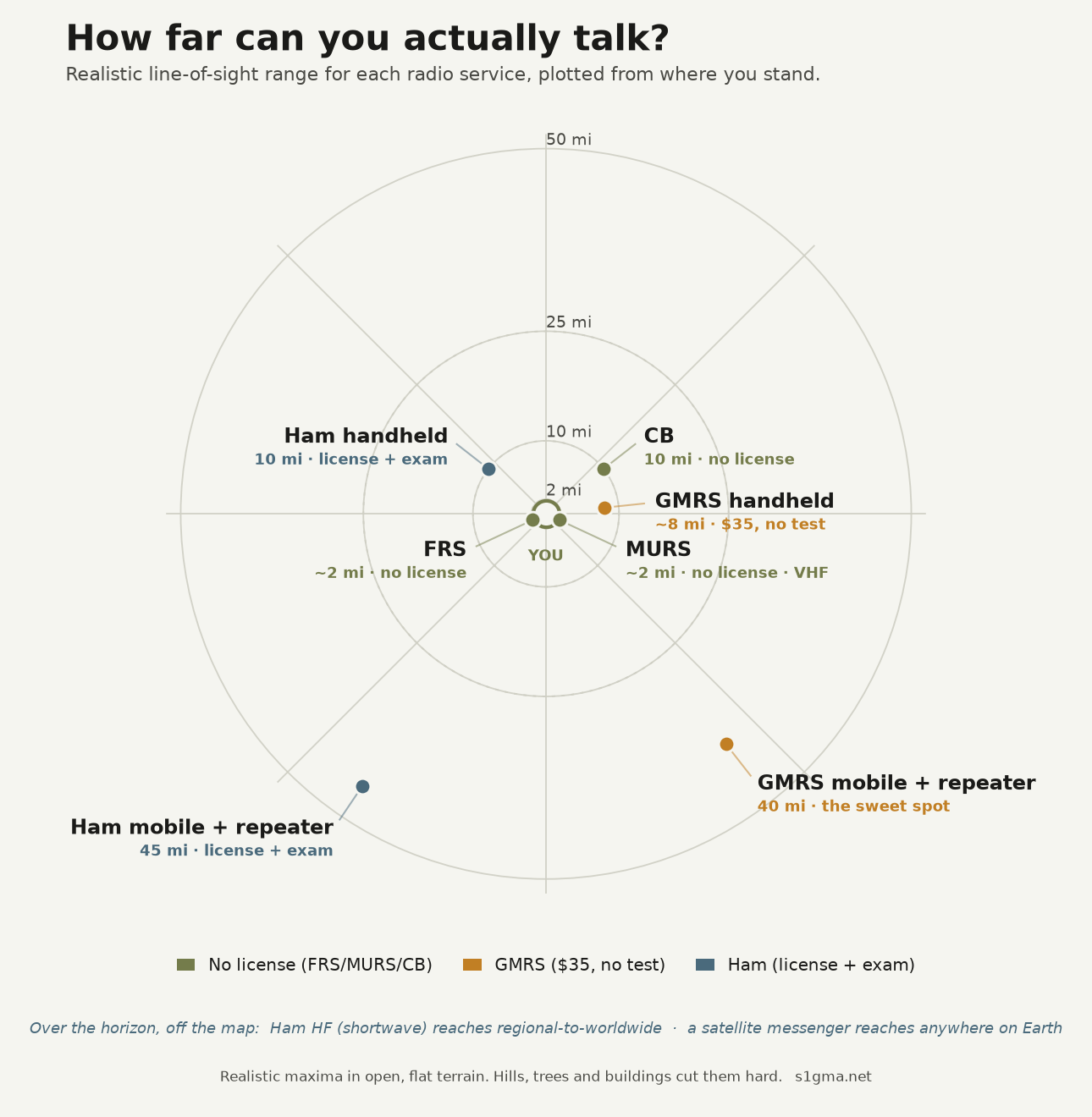
Look at the middle of that chart. FRS and MURS are a tiny cluster hugging your house. Now follow the amber dot out to the edge: GMRS with a mobile radio and a repeater reaches nearly to the rim of the map. Same family of technology. Twenty times the distance. That gap is the entire argument for getting a license and an antenna instead of a bubble-pack toy.
The two services that broke my chart are Ham HF and satellite. They are off the map on purpose, because their range is measured in hundreds or thousands of miles, and putting them on the same scale as a 2-mile handheld would make everything else invisible.
So which one do you actually need?
For maybe eight out of ten families, the answer is GMRS. It is the sweet spot, and it is not close. Thirty-five dollars, no test, the whole household on one license, real range, repeater access, and radios a normal person can operate without a manual. If you read this far and do nothing else, buy a pair of GMRS handhelds and register for the license. Done.
Get into ham if you will actually do the homework. The capability ceiling is much higher and the community is genuinely useful in a real emergency. But a ham radio in a drawer that you never learned to program is worth less than a GMRS radio your spouse can pick up and use. Be honest about which person you are.
And everyone, regardless of the above, owns a hand-crank NOAA radio. Full stop. It is $50, it needs no license and no skill, and when the power is out and your phone is dead, it is the thing that tells you whether the water is safe and where the shelter is. It is the cheapest peace of mind in the entire category.
One honest caveat before the shopping. A lot of people buy a cheap Baofeng ham handheld and start transmitting without a license because it is easy and nobody is watching. Transmitting on the ham bands without a license is illegal, and it makes you the person stepping on the emergency net when it matters. Listening is always legal. Talking requires the ticket. Get the ticket.
The kit, in tiers
Buy the tier that matches where you are, not the whole list at once. Each tier is useful on its own, and you can climb the ladder over a year as it makes sense. Prices are ballpark and move around, so treat them as rough.
Every link below is what I would actually put in the cart. If you want to see how comms fits alongside water, power, and food, our supply calculator does the boring math for you.
Tier 0: Information (everyone, about $50)
The one everybody needs before anything with a transmit button. If you want the full breakdown of receive-only radios, we go deep on them in the best emergency radio guide.
| Item | Why it earns the shelf space | Price |
|---|---|---|
| Midland ER310 hand-crank weather radio | The tested benchmark. A minute of cranking buys roughly nine minutes of radio, and it monitors NOAA channels and sounds alerts on its own. | ~$60 |
| FosPower NOAA emergency radio | Cheaper hand-crank-plus-solar option if the Midland is out of stock. Does the same core job for less. | ~$30 |
| Kaito KA500 Voyager (shortwave add-on) | Same emergency features but adds shortwave, so you can pull in broadcasts from the other side of the planet when local stations go quiet. | ~$50 |
Tier 1: Family comms, zero license (about $80)
The honest starting point if you do not want paperwork yet.
| Item | Why it earns the shelf space | Price |
|---|---|---|
| A decent FRS two-pack | Ignore the range on the box. Good for the yard, the trailhead, the campsite, keeping tabs on kids. Everyone should have a pair in a drawer. | ~$40 |
Tier 2: GMRS, the real answer (about $150)
Where most people should actually live. Register the $35 FCC license first (it covers your whole family).
| Item | Why it earns the shelf space | Price |
|---|---|---|
| Midland GXT1000 GMRS pair | The workhorse. Strong output, weather alerts, water-resistant, and simple enough that everyone in the house will actually use it. | ~$90 |
| A GMRS mobile/base radio | This is the piece that reaches the far edge of the range chart. Repeater-capable, mounts in the truck or on a shelf with an antenna. | ~$80 |
Tier 3: Ham entry (about $60, plus a weekend)
For the person who will study. Note the model choice below, it matters.
| Item | Why it earns the shelf space | Price |
|---|---|---|
| Baofeng 5RM (10-watt) | The one to get now. It roughly doubles the classic model's power and cleans up the audio for about the same money. Buy two. | ~$30 |
| Baofeng UV-5R (the classic) | Still the most-supported, most-documented cheap handheld on Earth. If you want the model every tutorial was written for, this is it. | ~$25 |
| Nagoya NA-771 whip antenna | The single cheapest upgrade that improves range. The stubby antenna these radios ship with is the weakest link. | ~$20 |
Tier 4: The off-grid lifeline (about $150 and up)
When there is no tower and no repeater, this is what still reaches your family.
| Item | Why it earns the shelf space | Price |
|---|---|---|
| Zoleo satellite communicator | Best value. Runs on Iridium, gives you a real phone number people can text, and pairs with your phone for full-keyboard messaging. Needs a subscription. | ~$150 + plan |
| Garmin inReach Mini 3 | The premium pick. Smaller, standalone, faster satellite comms, the gold standard for backcountry SOS. Also subscription-based. | ~$400 + plan |
What people get wrong
A few things I wish someone had told me before I bought my first radio.
- Range on the box is fantasy. Assume a third of it in the real world, less in a city. The chart above is already the optimistic number.
- The antenna matters more than the radio. A $20 upgrade antenna beats a $100 radio with the stock stubby. Every time.
- A radio you cannot operate is a paperweight. Program it, label the channels, and make your spouse use it once before you need it. The emergency is a bad time for the tutorial.
- Two radios is not a plan. Comms is a family or neighborhood thing. Get your people on the same service and the same channels, and agree on a time to check in when things go sideways.
FAQ
Do I need a license to use a GMRS radio?
Yes, but there is no test. A GMRS license from the FCC costs $35, lasts ten years, and covers your entire immediate family under one registration. You fill out a form and pay. That is the whole process.
What is the difference between GMRS and ham radio?
GMRS is a small, family-friendly service: cheap license, no exam, limited channels, great for local family and neighborhood comms. Ham radio requires passing a written exam but opens up far more frequencies, far greater range (including worldwide HF), and a large operator community. GMRS is the easy 80% answer. Ham is for people willing to learn.
How far can a handheld radio actually reach?
In open, flat terrain, expect roughly 5 to 10 miles for a GMRS or ham handheld talking directly to another handheld. In a dense suburb or hilly ground, it can drop to a mile or two. To reach farther you use a repeater or a higher-power mobile radio with a proper antenna, which can stretch range to 25 to 50 miles or more.
Is it legal to transmit on a Baofeng without a license?
No. Listening (receiving) is always legal, but transmitting on the ham bands requires at least a Technician license. Buying the radio is legal. Talking on it without the license is not.
What radio works when there is no cell service at all?
A satellite messenger like a Zoleo or Garmin inReach, which uses the Iridium satellite network instead of cell towers and works essentially anywhere on Earth. For terrestrial radio, ham HF (shortwave) can cover hundreds or thousands of miles without any infrastructure, if you have the license and the gear.
TL;DR
For most families, buy GMRS. A $35 FCC license (no test, covers the whole household) plus a pair of handhelds gets you real 5-to-10-mile range, and a repeater-capable mobile radio pushes that past 25 miles. Get a ham license only if you will actually study, because the ceiling is much higher but so is the effort. And regardless of what else you do, own a $50 hand-crank NOAA radio, because when the power and the phone are both dead, it is the thing that still tells you what is happening.
The radio range printed on the box is marketing. The number that keeps your family in touch is the one you get after the hills, the houses, and the curve of the Earth take their cut. Plan for that number, not the fantasy one.