
The ice storm that took our power out in Raleigh a few winters back did a thing I didn't expect. It didn't just kill the lights. About two hours in, my phone dropped to one bar and stayed there, and every text to Lauren's mother took four tries to send. The towers weren't down. They were just swamped, half the county trying to reach the other half at the same time.
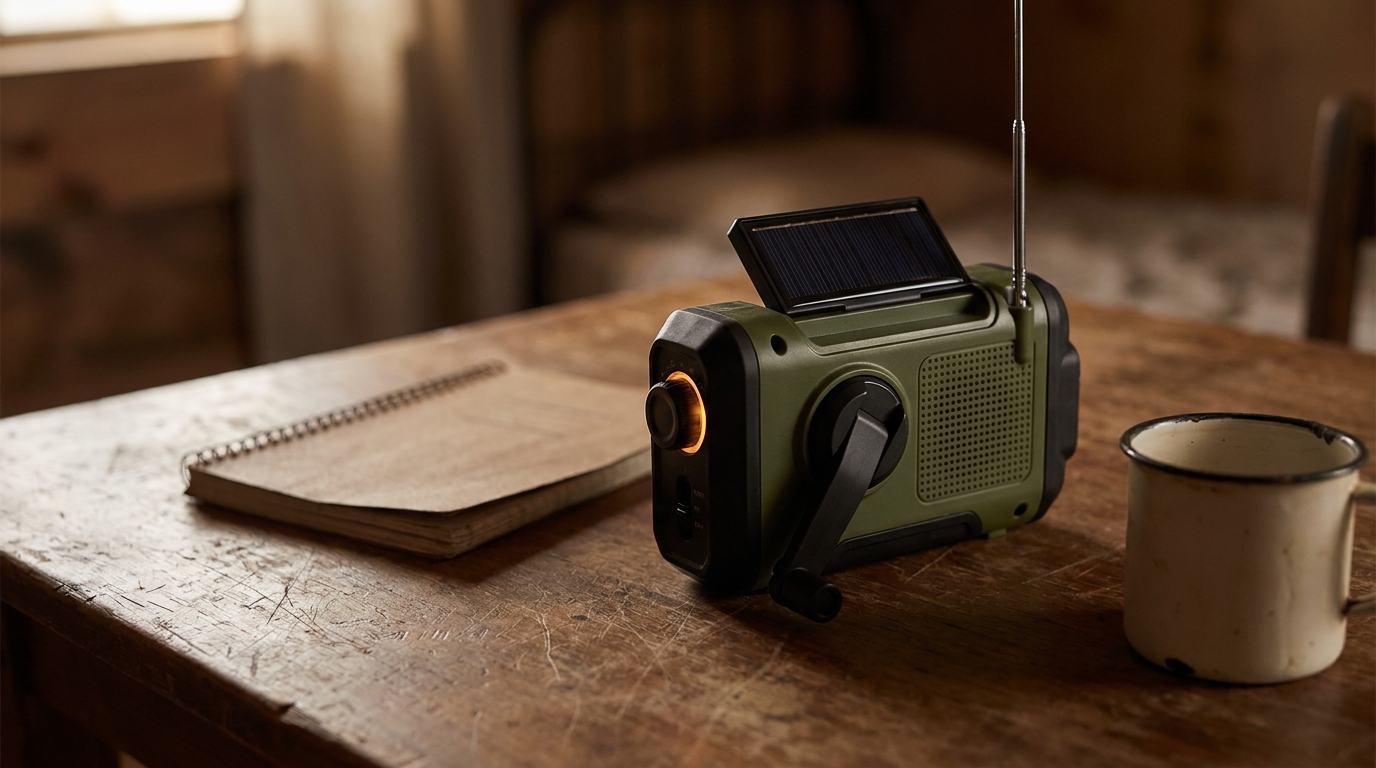
That was the night the little crank radio in the kitchen drawer stopped being a gimmick and started being the only thing in the house still telling me what was going on outside.
People hear "emergency radio" and picture a doomsday prop. It isn't. It is the one piece of gear that keeps feeding you information when the part of the world you rely on, the cell network, quietly taps out. This piece is about that radio: the one that listens. If what you want is to talk back to your family across town, that is a different device, and I will point you to the right guide for it below.
Disclosure: As an Amazon Associate, s1gma earns from qualifying purchases. Some links below are affiliate links. If you buy through them, s1gma may earn a small commission at no extra cost to you. It doesn't change what gets recommended.
Why bother, when everyone has a phone
Here is the honest version, because the doomer version is wrong and you'll catch me if I fake it.
Your phone does not become a brick in a disaster. Wireless Emergency Alerts, the ones that buzz your screen for a tornado warning or an AMBER alert, ride a separate channel from regular calls and texts, and FEMA built them specifically so they get through even when the network is jammed. So you'll still get the official "take shelter now" ping. That part is fine.
What degrades is everything else. The FCC says it straight: mobile networks get overwhelmed in emergencies, and calls and data are the first casualties. That ice storm proved it in my kitchen. You can lose the ability to call out, to load a map, to check whether the road you'd take is flooded, long before you lose the phone itself.
A radio sidesteps the whole problem. Broadcast radio and NOAA Weather Radio are one-to-many transmissions. A thousand people tuning in doesn't congest anything, because nobody is transmitting back. The signal just arrives. And if the radio runs on a hand crank or a solar panel, it keeps arriving after your phone battery is a memory. That independence is the entire point.
The listening radio, done right
This is the one almost nobody should skip. It picks up AM/FM, often shortwave, and the part that actually matters in an emergency: the NOAA Weather Radio network.
NOAA Weather Radio is run by the National Weather Service, broadcasts 24 hours a day, and carries far more than weather. They call it "All Hazards" for a reason. Tornadoes and earthquakes, yes, but also chemical spills, 911 outages, and AMBER alerts. It runs on seven VHF frequencies, all of them between 162.400 and 162.550 MHz, and a plain car radio cannot reach them. You need a receiver built for it.
The feature to look for is SAME, Specific Area Message Encoding. Without it, one transmitter covers a big region and your radio shrieks at three in the morning for a flood warning two counties over. Program your SAME code for your county and the radio stays quiet until something is actually coming for you. Skip it and the thing ends up in a drawer by week two, which is where most weather radios go to die.
The resilience features that earn their keep:
- Hand crank and solar. Batteries die exactly when you need them. A crank means the radio's power source is your own arm.
- A USB-out port. Some of these will trickle-charge a phone off the crank. Slow, but in a long outage, slow beats nothing.
- A flashlight built in. Not why you buy it, but you'll use it.
Real options that have been around long enough to trust:
| Radio | Bands | Shortwave | Power sources | Notable |
|---|---|---|---|---|
| Midland ER310 | AM/FM + 7 NOAA | No | crank, solar, rechargeable, AAA | NOAA auto-alert, USB-out, flashlight |
| Eton / Red Cross FRX3 | AM/FM + NOAA | No | crank, solar, rechargeable, AAA | USB-out, flashlight, the Red Cross name |
| Kaito Voyager KA500 | AM/FM + 7 NOAA | Yes | crank, solar, rechargeable, AAA, USB | shortwave pulls signals from much farther |
Pick the Kaito if shortwave matters to you, the Midland if you want the cleanest NOAA auto-alert, the Eton if you just want a known name in the drawer. On the cheaper end, a FosPower crank NOAA radio does the same core job for less. Any of them is a fine first radio, and a first radio is the one almost nobody should skip.
Shortwave: hearing past the blackout
Here is the piece most emergency-radio lists skip. AM and FM are line-of-sight-ish and local. When a regional event knocks your local stations off the air, or you simply want to know what the rest of the world is saying about what is happening to you, shortwave is how you hear it. The signals bounce off the ionosphere and travel thousands of miles, which is why a radio in Raleigh can pull in a broadcast from another continent at night.
You do not need a separate device for it. The Kaito KA500 already has shortwave built in. If you want a genuinely good portable shortwave receiver rather than a crank radio that happens to include it, the C.Crane CC Skywave 2 is the one people keep in the bag. Shortwave is receive-only and needs no license, because you are only ever listening.
When you need to talk back, not just listen
A weather radio listens. It cannot say a word. The moment you want to reach your spouse across town or your kid at the far end of a property when the phones are jammed, you have left receive-only territory and you are into two-way radios: FRS, GMRS, and ham. That is a whole decision of its own, with licensing, real range numbers, and which handheld to actually buy.
Rather than cram a thin version of it in here, I wrote the full breakdown separately. If talking back is your goal, start there:
→ GMRS vs Ham vs FRS: How Far Each Radio Actually Reaches (and the Kit to Buy)
The short version: for most families the answer is GMRS, a $35 license with no exam that covers the whole household. But read the guide before you buy, because the range on the box is a fantasy and the antenna matters more than the radio.
So what do you actually buy
For the listening radio, the decision is short.
| If you are... | Get | Commitment |
|---|---|---|
| Anybody with a house | A crank NOAA weather radio with SAME alerts (Midland ER310, Eton FRX3, or a budget FosPower) | Cheap, buy it once |
| Someone who wants to hear past the local blackout | A radio with shortwave built in (Kaito KA500) or a dedicated C.Crane Skywave | A little more money, no license |
| Trying to talk to your own people | Not a weather radio at all — see the two-way radio guide | A different device (and maybe a $35 license) |
Start at the top. The crank weather radio is the one that pays for itself the first time the grid hiccups, and it asks nothing of you but a SAME code and a place in the drawer.
The mistakes worth not making
- A NOAA radio can't transmit. It is a receiver. If your whole plan is a weather radio, your plan is "listen," not "talk." For talking, you want a two-way radio, which is a different purchase.
- No SAME code, no peace. A weather radio without a programmed SAME county code alarms for events an hour away and gets muted or unplugged within a week. Spend the five minutes.
- Batteries die on schedule, and the schedule is "right now." The crank and the solar panel are not features. They are the reason the radio is in your kit instead of a dead AM/FM clock radio.
- A car radio is not a weather radio. The NOAA channels sit on VHF frequencies your dashboard cannot tune. You need a receiver built for the band.
TL;DR
The best emergency radio for most people is a receive-only, hand-crank NOAA weather radio with SAME alerts (the Midland ER310, Eton FRX3, or Kaito KA500). It keeps feeding you information when the cell network is swamped, with no battery, no cell tower, and no subscription. Add shortwave if you want to hear past a regional blackout. And if your goal is to actually talk back to your family, that is a two-way radio, a different device covered in the GMRS vs ham vs FRS guide. The hand crank, not the brand, is the feature that matters.