
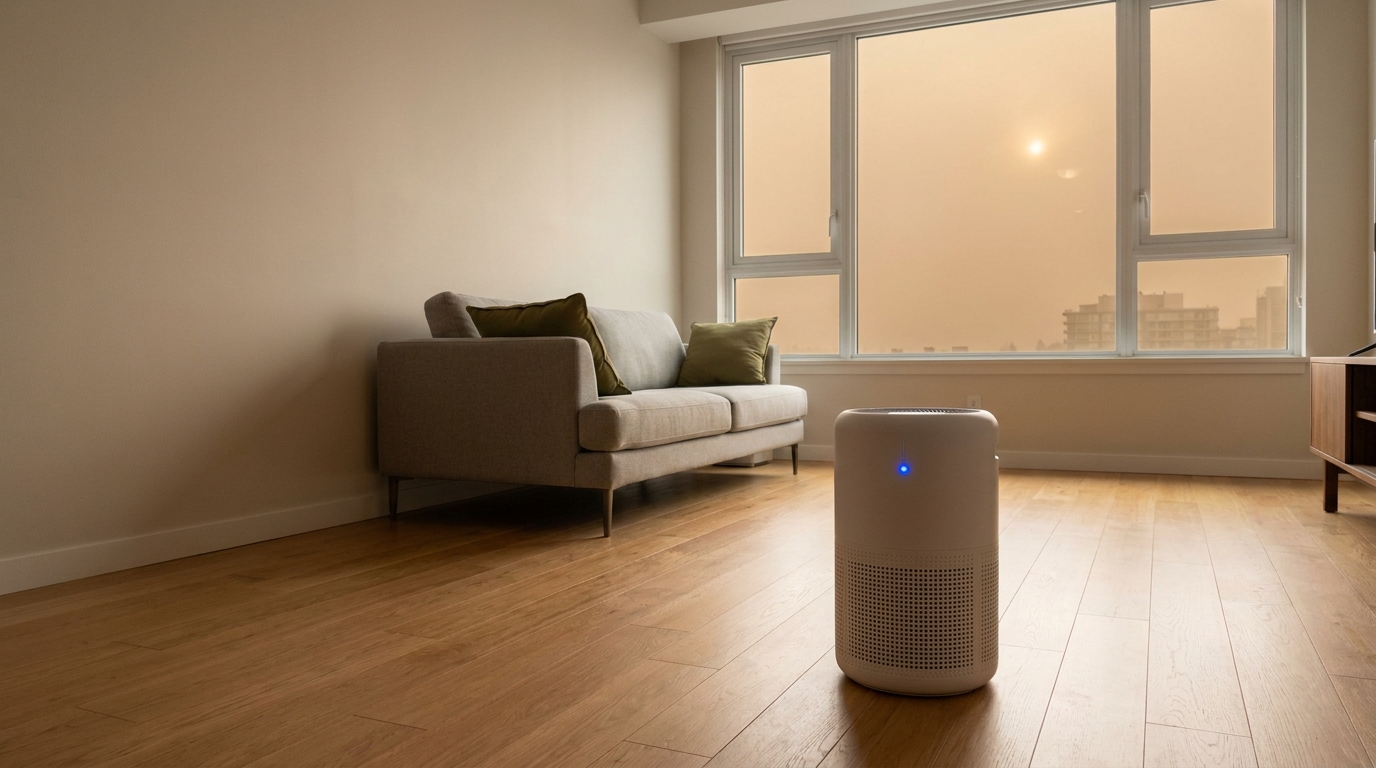
on june 7, 2023, the sky over new york city turned orange. not metaphorically. a deep, wrong, sepia orange, the sun a dim disc you could look straight at. the fires were not in new york. they were not in new york state. they were hundreds of miles north in canada, and the smoke had simply traveled, the way weather does, and settled over tens of millions of people who had never in their lives thought of wildfire as their problem.
that afternoon new york had the worst air quality of any major city on earth. real-time monitors read in the mid-400s on the air quality index, a number the official scale just labels "hazardous" and then stops. around 128 million americans were under air-quality alerts. new york made a million n95 masks available.
that is the shift worth understanding. wildfire used to be a western evacuation story, a thing that happened to other people near the flames. it is now an everyone, indoors, breathing story, and the small decision that separates a rough couple of days from a genuine health event is what you have running in your living room.
This is not a western problem anymore
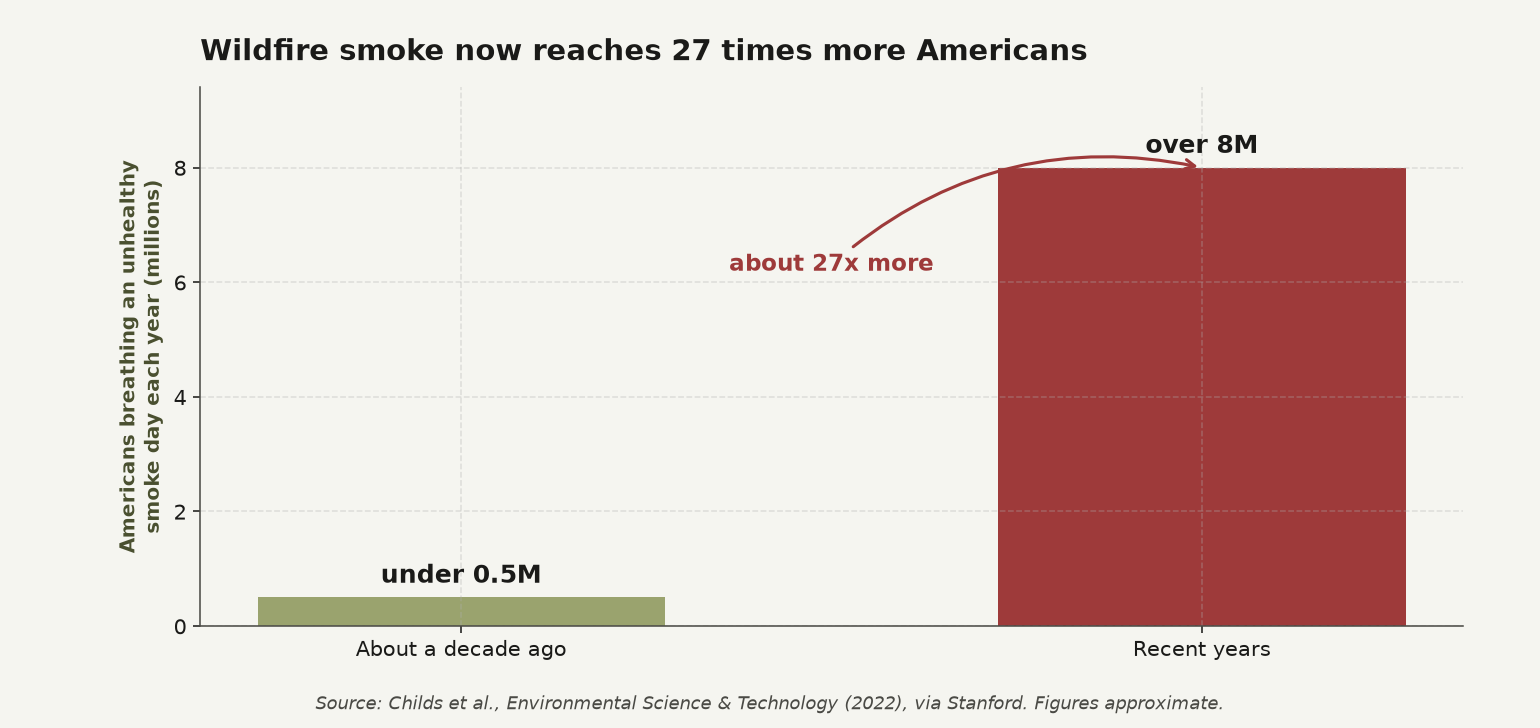
It is tempting to call 2023 a freak year. The trend says otherwise. Stanford researchers found that the number of Americans who breathe at least one day of smoke-caused "unhealthy" air each year grew roughly 27-fold in about a decade, from under 500,000 people to more than 8 million. Since 2016, wildfire smoke has slowed or reversed decades of air-quality gains in 35 states.
Two things are driving it. Fires are bigger: since 2000 the US has averaged about 7 million acres burned a year, more than double the 1990s average, even as the raw number of fires fell. And smoke travels. A fire in one state is an air emergency three states away. There is a quiet regulatory twist here too. Because wildfire smoke is classified as an "exceptional event," the fine particles it dumps on your city are largely unregulated. Nobody is cleaning this up for you.
What smoke actually does to you
The danger is not the smell. It is a specific particle called PM2.5, soot fine enough to measure 2.5 microns or less, tens of times thinner than a human hair. Particles that small do not stop at your nose and throat. The EPA is blunt about it: they get deep into your lungs, and some pass into your bloodstream.
Once there they do real damage, and not only to the people you would expect. The EPA links PM2.5 exposure to aggravated asthma, decreased lung function, irregular heartbeat, nonfatal heart attacks, and premature death in people with heart or lung disease. It hits children, older adults, and anyone with a heart or lung condition hardest. This is not theoretical discomfort. During the June 2023 smoke, New York's health department found that asthma-related emergency-room visits rose across the affected region. The orange sky sent people to the hospital.
Know your number: the AQI
You do not have to guess how bad it is. The Air Quality Index turns the particle count into one number from 0 to 500, and the free AirNow app or your phone's weather app will show it for your exact location.
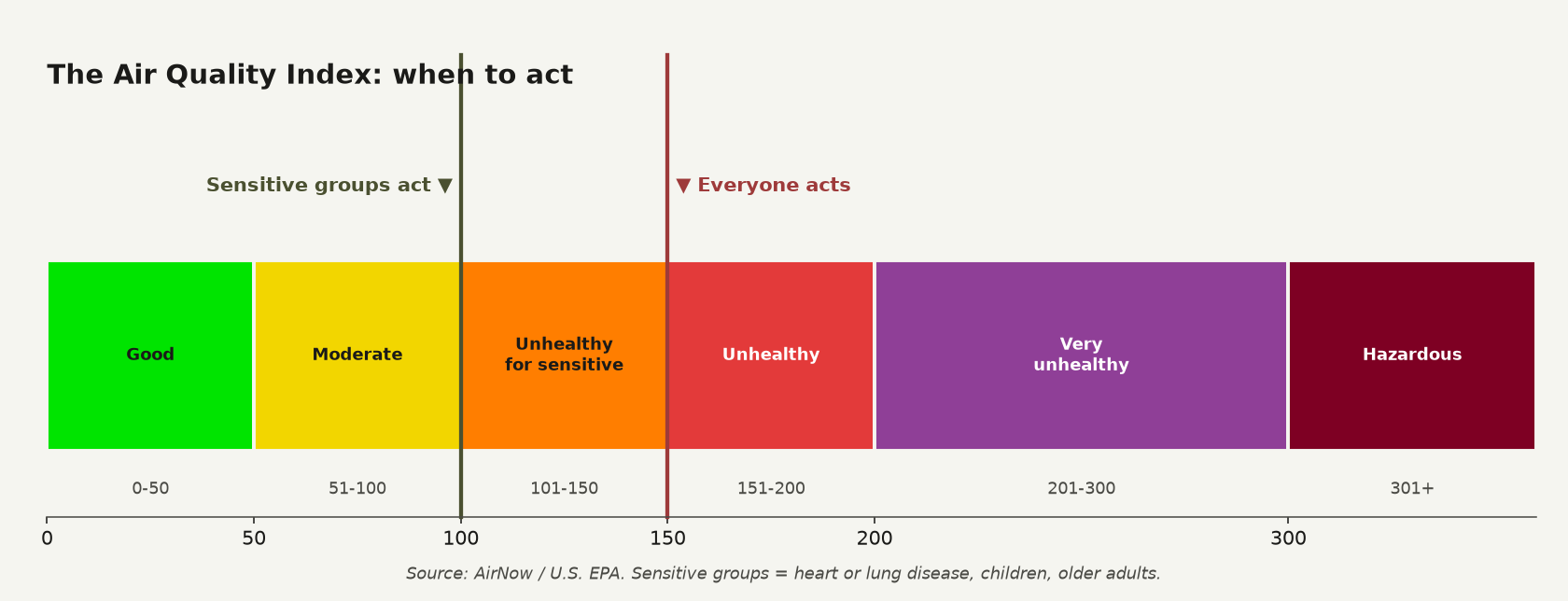
The rule that matters: at an AQI of 101 and above (the orange band), sensitive groups, meaning anyone with heart or lung disease, kids, and older adults, should cut back on time and exertion outdoors. At 151 and above (red), everyone should. By 301 the scale calls it hazardous and treats it as an emergency for the whole population. When the number climbs, the game moves indoors, and indoors is where you can actually win.
The reframe: you cannot filter the sky, you can filter one room
Here is the mental shift that makes this cheap and doable. You are not trying to clean the outdoor air, or even your whole house. You are trying to keep the particles out of the air in the one or two rooms where your family actually spends the smoky days. That is a small, solvable problem.
It has two halves: stop new smoke from getting in, and clean the air that is already inside. Do both in one room and you have a genuine refuge.
Seal and recirculate
First, stop the inflow. Close the windows and doors, which sounds obvious and is the step people skip because the house gets stuffy. If you have central heating or air conditioning, set it to recirculate mode, or close the fresh-air intake damper, so it is not actively pulling smoke in from outside. Upgrade the filter in that system to a MERV-13 rating, or as high as your unit will physically take, because a cheap furnace filter does nothing for smoke.
Then stop making it worse. During a smoke event the EPA says avoid anything that adds particles to indoor air: no smoking or vaping, no gas, propane, or wood stoves, no aerosol sprays, no frying or broiling food, no candles or incense, and no vacuuming unless the vacuum has a HEPA filter. You would be surprised how much of your own indoor air you are quietly ruining. Pick one room, ideally a bedroom with few windows, and make it the clean room.
The machine: what actually cleans the air, and the $30 version
Sealing keeps smoke out. To pull out the particles already inside, you need a mechanical filter, and this is where an air purifier earns its place. Two rules cut through the marketing.
Buy real HEPA, not "HEPA-type." A true HEPA filter captures 99.97 percent of particles at 0.3 microns, which is the hardest particle size to catch, so it does even better on everything larger and smaller. But the EPA warns there is no enforced definition of "HEPA" on a box, so "HEPA-type" and "HEPA-like" labels can mean much less. Look specifically for "True HEPA, 99.97% at 0.3 microns."
Size it to the room, or do not bother. Every purifier has a CADR, a Clean Air Delivery Rate, that says how much clean air it actually pushes. The appliance-testing group AHAM puts the general rule of thumb at a CADR of at least two-thirds of the room's floor area in square feet, and for smoke specifically, the finest particle to catch, they say size up toward the full square footage. So for a 150-square-foot bedroom during a smoke event, aim for a CADR around 150, not 100. An undersized purifier in a big room is a comfort object, not a solution. Run it on high, near where people sit or sleep.
And here is the part the purifier companies will not tell you. You can build something that works about as well for a fraction of the price. A Corsi-Rosenthal box is a common box fan with four MERV-13 furnace filters taped into a cube, fan blowing out the top. It costs roughly 60 to 100 dollars in parts, and UC Davis researchers measured it moving clean air at a rate that rivals purifiers costing five to ten times more, cutting indoor wildfire particles comparably. Two safety notes: use a newer box fan, made in the last decade or so, because the motors are thermally protected against overheating, and do not leave it running unattended for days. It is not pretty. It works.
One thing to actively avoid: ozone generators and "ionizers" sold as air cleaners. The EPA says ozone generators should never be used in occupied homes. They produce a gas that irritates and can damage your lungs, and worse, they do not even remove particles from the air. For smoke you want boring mechanical filtration, HEPA or the box fan, and nothing that claims to work by making a smell.
A word on masks
If you have to go outside in it, the mask matters and most masks are theater. A cloth mask, a bandana, or a surgical mask does close to nothing against PM2.5, because they neither seal to your face nor filter fine particles. A properly fitted N95 or KN95 does, cutting your exposure by around ten times. The catch is fit. The EPA notes that a poorly sealed respirator protects about as well as no respirator at all, so it has to actually seal against your skin, no gaps, no beard in the way. A snug N95 with head straps beats a loose KN95 with ear loops.
TL;DR
Wildfire smoke is now a national, indoor problem, not a western evacuation problem, and it reaches people hundreds of miles from any fire. The harm comes from PM2.5, particles fine enough to enter your bloodstream and trigger asthma and heart trouble. Watch the AQI: sensitive groups act at 101, everyone at 151. When it is smoky, you cannot clean the sky, so clean one room instead: close up, set HVAC to recirculate with a MERV-13 filter, avoid indoor smoke sources, and run a real HEPA air purifier sized to the room (CADR about two-thirds of the square footage). A 60-to-100-dollar Corsi-Rosenthal box fan works nearly as well as machines that cost far more. Skip ozone generators, and if you mask outdoors, wear a well-sealed N95, not a cloth mask.
The people who spent June 2023 comfortable indoors were not lucky. They had one boring appliance running in one sealed room, bought on a clear day, for exactly the kind of orange afternoon nobody used to think they would get.
FAQ
Do I need an air purifier if I live far from wildfires?
Yes. In June 2023, smoke from Canadian fires pushed hazardous air over cities more than 500 miles away, including New York and much of the US East Coast. Smoke travels with the weather, so a fire in one region becomes an air emergency in another. If you have never seen a fire near you, you can still get the smoke.
What size air purifier do I need for my room?
Match the purifier's CADR (Clean Air Delivery Rate) to the room. The appliance-testing group AHAM recommends a CADR of at least two-thirds of the room's floor area in square feet as a general rule, and closer to the full square footage for wildfire smoke, which is a finer particle. So for a 150-square-foot bedroom, aim for a CADR of roughly 100 to 150, sizing up for smoke. An undersized unit in a large room does very little, so size up rather than down.
Does a cloth or surgical mask protect me from wildfire smoke?
No. Cloth, bandana, and surgical masks do not seal to your face or filter fine PM2.5 particles, so they offer almost no protection from smoke. Only a well-fitted N95 or KN95 respirator meaningfully reduces exposure, and only if it seals with no gaps.
Are ozone generators or ionizers good for smoke?
No. The EPA says ozone generators should never be used in occupied homes: the ozone they produce irritates and can damage the lungs, and it does not remove particles from the air. Use mechanical HEPA filtration instead, either a true-HEPA purifier or a DIY box-fan filter.
Does running my air conditioner clean smoke out of the air?
Only if you set it to recirculate mode and fit a high-efficiency MERV-13 filter. On a fresh-air-intake setting, an HVAC system pulls outdoor smoke into the house. Recirculate plus a good filter helps; fresh-air intake during smoke makes it worse.
This is the shelter-in-place companion to wildfire evacuation, and it pairs with preparing for a heat wave (smoke and heat often arrive together) and knowing your water filter. Size your household's wider needs at the Supply Calculator.
Sources
- Childs et al., "Daily Local-Level Estimates of Ambient Wildfire Smoke PM2.5," Environmental Science & Technology (2022), via Stanford (27-fold rise, 35 states): https://news.stanford.edu/stories/2022/09/wildfire-smoke-unraveling-decades-air-quality-gains
- National Interagency Fire Center / Congressional Research Service, wildfire acreage statistics: https://www.congress.gov/crs-product/IF10244
- EPA, health and environmental effects of particulate matter (PM2.5): https://www.epa.gov/pm-pollution/health-and-environmental-effects-particulate-matter-pm
- New York State Dept. of Health, asthma-related ER visits during the June 2023 wildfire smoke: https://www.health.ny.gov/press/releases/2023/2023-08-24_study_asthma_related_er_visits.htm
- AirNow (EPA), Air Quality Index basics and categories: https://www.airnow.gov/aqi/aqi-basics/
- EPA, guide to air cleaners in the home (CADR, sizing): https://www.epa.gov/indoor-air-quality-iaq/guide-air-cleaners-home
- AHAM, air-filtration standards and the CADR-to-room-size rule (two-thirds general, full area for smoke): https://ahamverifide.org/ahams-air-filtration-standards/
- EPA, what is a HEPA filter (99.97% at 0.3 microns): https://www.epa.gov/indoor-air-quality-iaq/what-hepa-filter
- EPA, on unstandardized "HEPA-type" labels: https://www.epa.gov/indoor-air-quality-iaq/does-epa-certifyregister-or-provide-lists-acceptable-air-cleaners-or
- UC Davis, the Corsi-Rosenthal box for wildfire smoke: https://aghealth.ucdavis.edu/news/corsi-rosenthal-box-diy-box-fan-air-filter-covid-19-and-wildfire-smoke
- EPA, ozone generators sold as air cleaners (do not use): https://www.epa.gov/indoor-air-quality-iaq/ozone-generators-are-sold-air-cleaners
- EPA, wildfires and indoor air quality (seal, recirculate, MERV-13, clean room): https://www.epa.gov/indoor-air-quality-iaq/wildfires-and-indoor-air-quality-iaq
- EPA / CDC-NIOSH, masks and respirators for wildfire smoke (N95 fit, cloth masks ineffective): https://www.epa.gov/wildfire-smoke-course/strategies-reduce-exposure-outdoors