
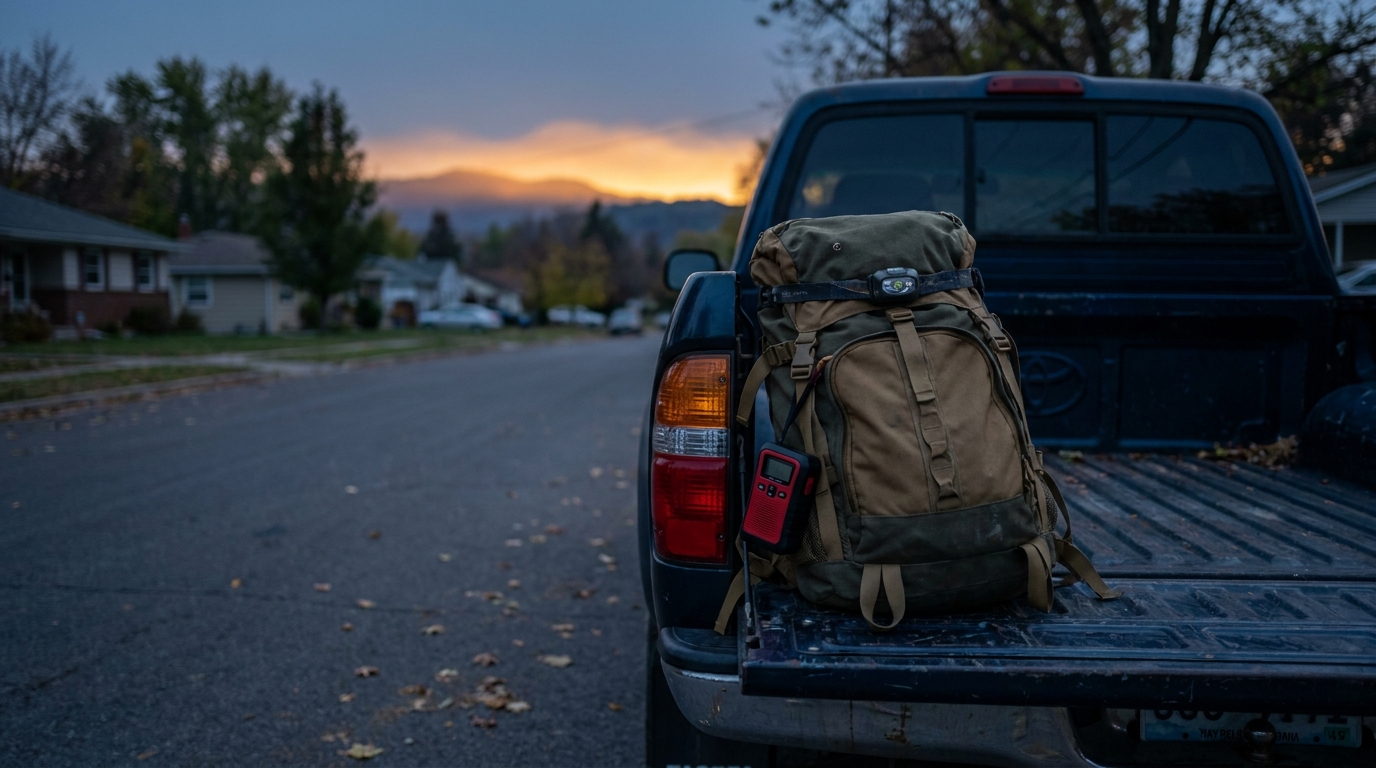
It is eleven at night in Raleigh and Lauren is folding laundry on the couch while I scroll the news on my phone. Seventeen thousand people in Southern California just got told to leave their houses. Not in the abstract. Not next week. Tonight. By the time they read the alert they already had less time to decide what mattered than I take to pick a sock match.
Disclosure: Some links in this article are affiliate links. If you buy through them, s1gma may earn a small commission at no extra cost to you. It doesn't change what gets recommended.
Raleigh does not burn the way California does, which is the comfortable lie I tell myself most weeks of the year. The truer thing is that we get hurricanes, ice storms, the occasional grid event, and a tornado season that has nothing to apologize for. The bag I keep in the hall closet does not care which one shows up. That is the whole point of the bag.
What follows is what is actually in mine, why each thing is in there, and the data I keep going back to when I am tempted to leave half of it behind.
The number that should bother you
In 2024, the United States recorded 64,897 wildfires that burned 8.9 million acres, plus 4,552 structures destroyed and 2,406 homes lost. That last number is the one nobody quotes, and it is the only one that converts an abstract fire into a family on a curb at 3 a.m.
The eleven-year picture is more interesting than any single year. Pull the National Interagency Fire Center data back to 2015 and the count of fires hovers in a tight band between 50,477 and 77,850 per year. The acres burned, on the same axis, swing between 2.7 million and 10.4 million. Same baseline of fires. Wildly different damage.
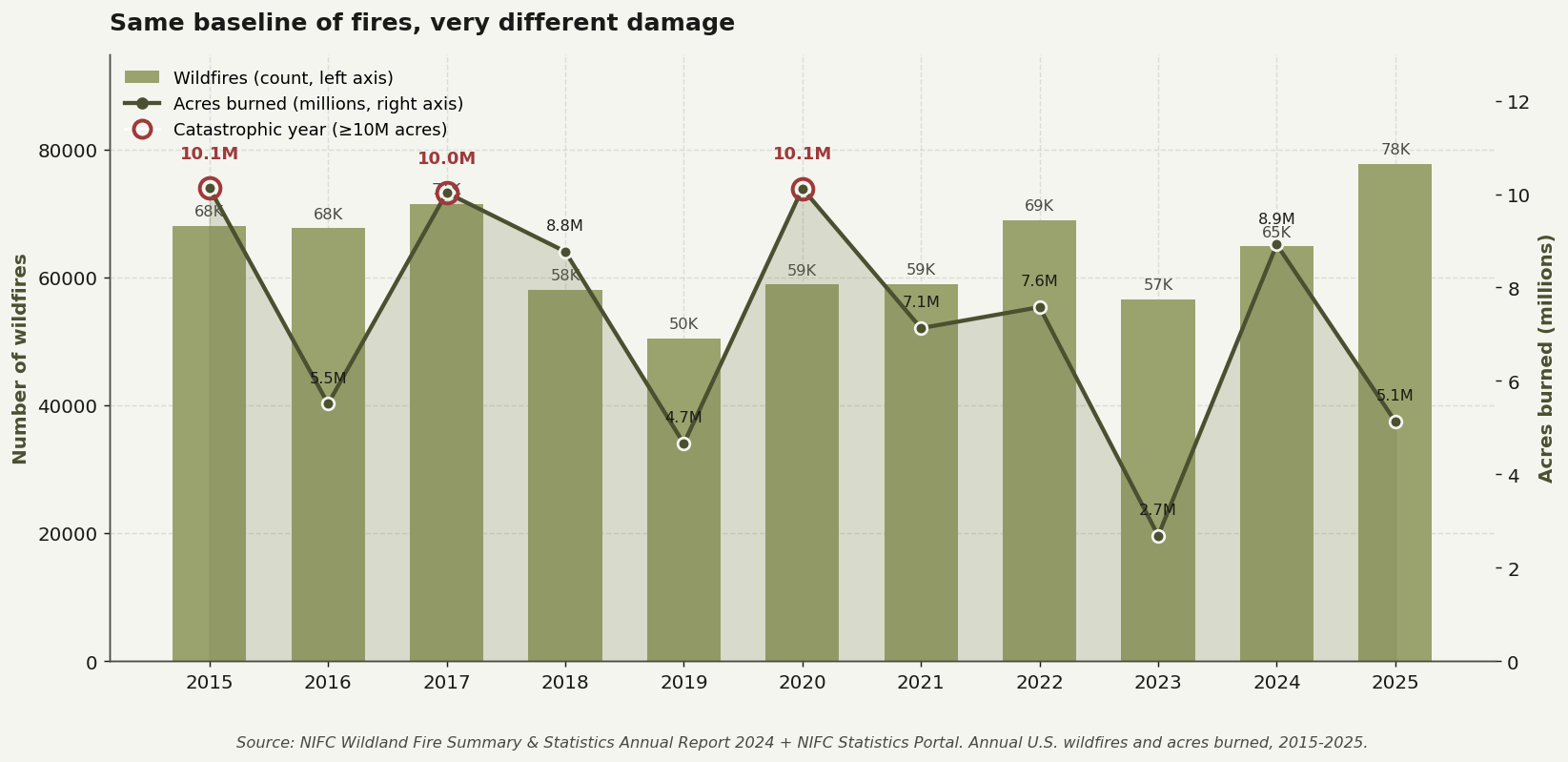
Three of the last eleven years burned over ten million acres each. There is no obvious pattern. You cannot look at January and call which year is going to be the bad one. The honest planning posture is: assume any given year could be 2020.
Where the fires actually happen
This is the part of the conversation most people get wrong. Wildfires are not a California problem with some opinions about Oregon. They happen across the whole country, and the geographic story has two halves that contradict each other.
On the count side, the Southern Area — Texas, Oklahoma, the Gulf states, Florida — runs 45% of all U.S. wildfires by count. The Eastern Area runs another 18%. Together they are nearly two-thirds of every fire reported in the country. Most are grass fires, small, brief, knocked down fast.
On the acres side it inverts. The Northwest burns the most ground — 23% of all U.S. acres in 2024. Southern Area is second at 22%, Great Basin at 13%, Rocky Mountain at 9%, Alaska at 8%. The Eastern Area, which had 18% of the fires by count, accounts for 2% of the acreage.
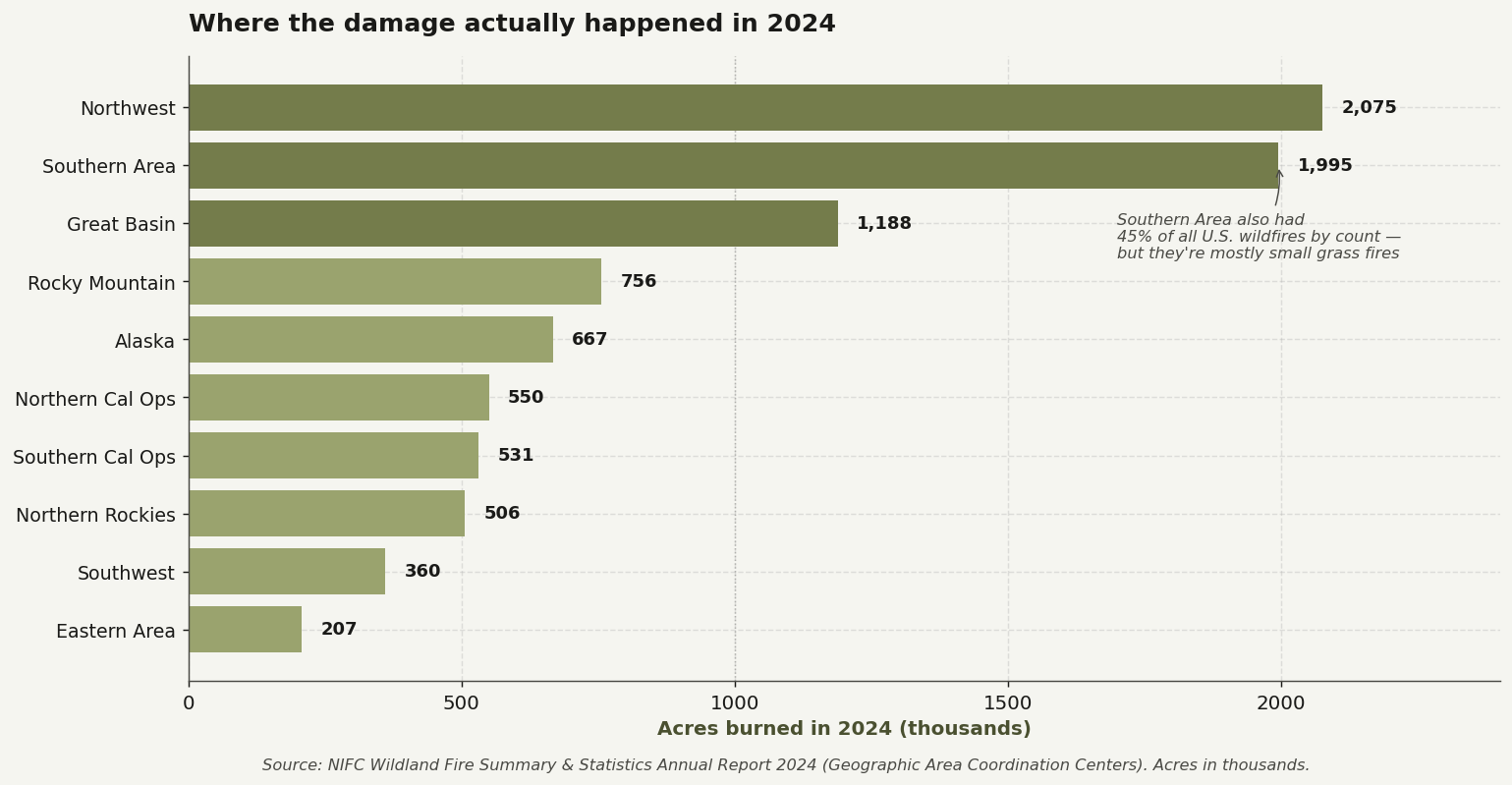
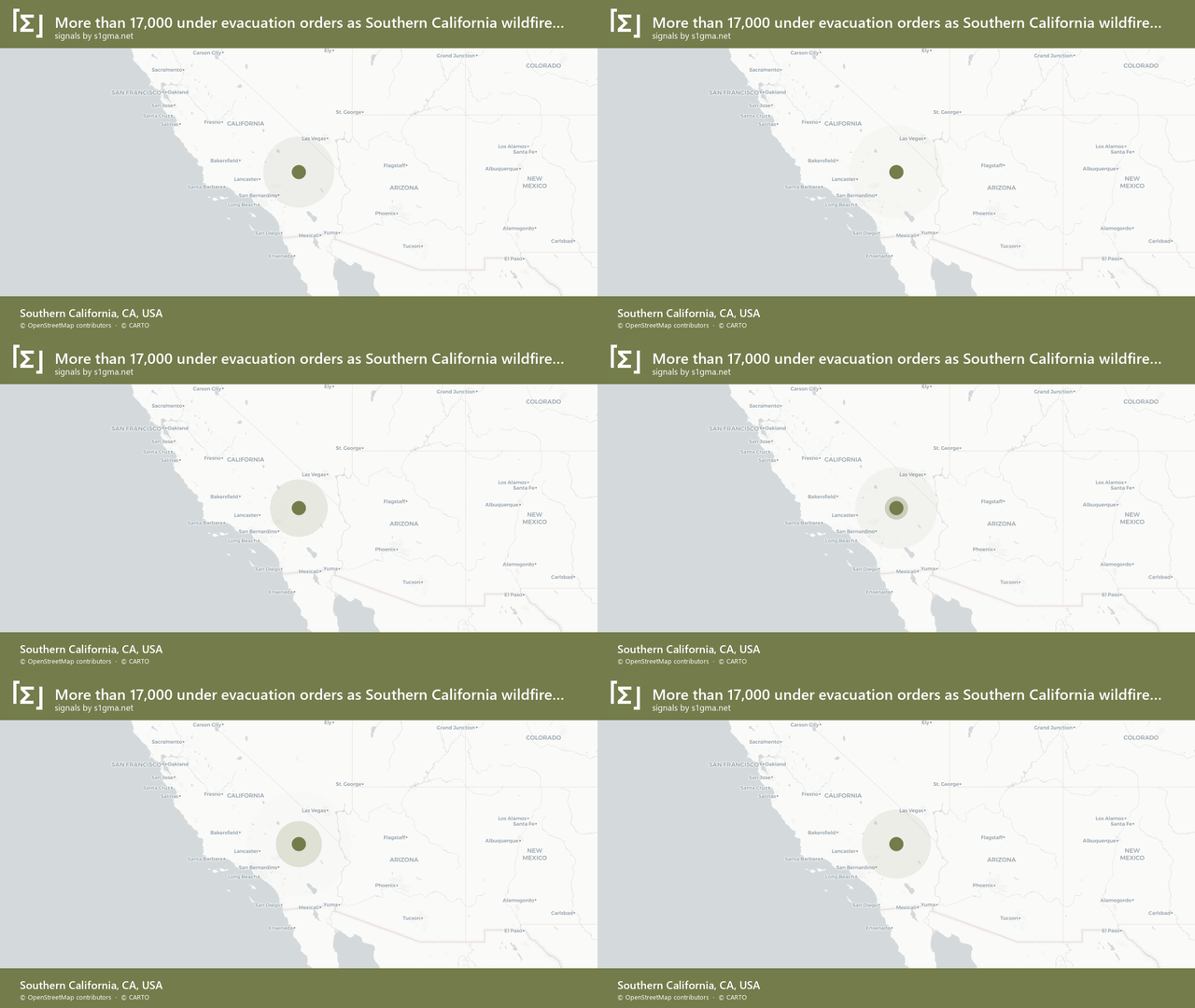
They have many small fires; the West has fewer fires that grow into catastrophes. The Southern California signal that pulled 17,000 people out of their homes this week is the visible tip of that pattern. The map below is where it happened.
If you live in the Northwest, the Great Basin, anywhere in the Rockies, the Southwest, or Alaska — this is your weather. If you live east of the Mississippi, you get small grass fires, smoke events that close schools, and supply chain effects that make the gas station shelves weird for a week. Both still need the bag.
The prep argument that survives the eye-roll
Most preparedness writing falls apart the moment a normal person tries to picture themselves using it. Mine fell apart for years on the basic question of when would I actually need this stuff. Here is the answer that finally got me to keep the bag packed:
- A wildfire evac kit is also a hurricane evac kit. Same bag.
- A wildfire evac kit is also an ice storm kit. Same bag.
- A wildfire evac kit is also a grid-down kit for a week without power. Same bag.
- A wildfire evac kit is also the bag you grab when the upstairs neighbor's apartment catches fire and you cannot go back in for the rest. Same bag.
The bag is the most generalizable preparedness item that exists. It works for the disaster you actually get, not the one you spent the year mentally rehearsing.
My bag, by the numbers
Thirteen items, three tiers, about $1,500 if you bought all of it at once and approximately $0 if you build it one item at a time over six months. I built mine over a year and a half. The list below assumes one adult; double the sleeping bags and burn dressings if you have kids in the house.
The 4 you grab in 60 seconds
| Item | Why it's in the bag | Price |
|---|---|---|
| Dry Bag Waterproof Backpack - 30L | The bag the bag goes in. 30L is enough for one person's evac essentials without being so big you can't run with it. Waterproof matters because evacuations turn into rain events more often than people expect. | $69.97 |
| Kaito KA600L Voyager Pro Radio | When the cell towers go down and the local AM stations are the only thing telling you which road is closed, this is the radio that still works. Hand crank, solar, NOAA alerts, charges your phone. Single most underrated prep item in the bag. | $149.97 |
| Hands-Free High-Lumen LED Rechargeable Headlamp - with 3*… | Two hands free is the whole game. You're loading the truck in the dark, you're not holding a flashlight in your teeth. 2000 lumens is overkill on purpose. | $47.80 |
| North American Rescue CAT Gen 7 Combat Application Tourni… | A tourniquet for the one scenario nobody trains for: catastrophic bleeding before the ambulance arrives. The CAT Gen 7 is what every US combat medic carries. If you've never used one, watch the Stop the Bleed five-minute video tonight. | $34.95 |
The 4 you load if you have 10 minutes
| Item | Why it's in the bag | Price |
|---|---|---|
| Sierra Madre Emergency Thermal Bivy Sack | If the evac center is full or you bail to a national forest road, you sleep in this. Under a kilo, fits inside the dry bag, sets up in two minutes. The alternative is a hotel room you couldn't book. | $104.90 |
| Traverseon Emergency Survival Sleeping Bag *4 pieces - Sl… | Four mylar-based bags for the price of one real sleeping bag. One per family member. Not luxury — survival floor for an overnight stuck in a parking lot. | $42.90 |
| Traverseon Gas Camping Stove – 3800W Portable Windproof O… | Windproof matters in fire-season weather. 3800W boils a kettle for instant noodles or coffee in under three minutes. The morale boost of a hot drink in an evacuation parking lot is genuinely real. | $89.90 |
| 240 Serving Breakfast & Entree Package by Legacy Food Sto… | Family-of-four, one-month supply, 25-year shelf life. You don't carry this in the bag — you store it in the garage and grab it on the way out. Wildfire evacuations regularly stretch from 'a few days' to 'two weeks.' | $749.97 |
The 5 cheap things that punch above their weight
| Item | Why it's in the bag | Price |
|---|---|---|
| Collapsible LED Lantern (4-pack) | Backup light. Two is one and one is none. Fits in the change pocket of your jeans. | $19.97 |
| Gerber Truss 17-in-1 Multitool | Pliers, blade, screwdriver, can opener. The tool that's good enough for 95% of evacuation problems. | $34.97 |
| Ferro Rod Fire Starter with Striker | Yes you're escaping fire. You also might end up cold in a forest at 2am needing warmth. Ten waterproof starters, no lighter required. | $19.97 |
| Water-Jel Sterile Burn Dressing | Wildfire-specific. Hydrogel dressings cool the burn while you wait for actual medical. The single most useful first-aid item for fire-zone evacuations. | $29.99 |
| LuxoGear Emergency Whistle | Three dollars, weighs nothing, audible at distance when shouting won't carry. Universal distress signal — three blasts means help. | $3.97 |
What I forget when I think I'm ready
Every time I open the bag for the annual swap, I find one or two things I never wrote down that turn out to be more important than half the gear. In rough order of how badly losing them would ruin an evacuation:
- The dog. Picture the bag fully loaded and the dog left behind. That is the version of the story you will tell every Christmas for the next forty years.
- Lauren's medication list with dosages. A real printed copy in the bag. Her phone might be dead, the pharmacy might be closed, and the ER triage nurse needs the milligrams.
- The kids' favorite stuffed animal. Sounds soft. Is not. Day three in a strange place with no familiar object is when small kids stop sleeping.
- Hard copies of important documents. Driver's license photos, insurance card photos, the deed, the mortgage account number. A USB drive with the same files. Both, in a ziplock, in the bag.
- Cash in small bills. Two hundred bucks in fives, tens, and twenties. Card readers do not work when the power is out and gas station owners give better prices when you can pay exact change.
- A second phone charger. The one you swore you packed is on the nightstand. Pack a second one, in the bag, and never touch it for daily use.
TL;DR
Wildfires in the U.S. are not getting more frequent — they are getting more catastrophic in the years that go bad, and there is no reliable way to predict which year is the bad one. Most of the fires are small and Southern. Most of the destroyed acreage is in the West. The same evacuation bag works for fire, flood, ice, grid, and the neighbor's electrical accident. Build it once, swap the food and medication every twelve months, and forget about it the rest of the time.
The bag is the prep. Everything else is opinion.
Sources
- National Interagency Fire Center, Wildland Fire Summary and Statistics Annual Report 2024 — PDF
- National Interagency Fire Center, Wildfires and Acres statistics portal — nifc.gov/fire-information/statistics/wildfires
- CAL FIRE, 2026 Fire Season Incident Archive — fire.ca.gov/incidents/2026
- ABC News wire report on the Southern California evacuation order — story
- UCLA Anderson Forecast, Economic Impact of the Los Angeles Wildfires — anderson.ucla.edu
- Stop the Bleed, Bleeding Control Basics — stopthebleed.org