
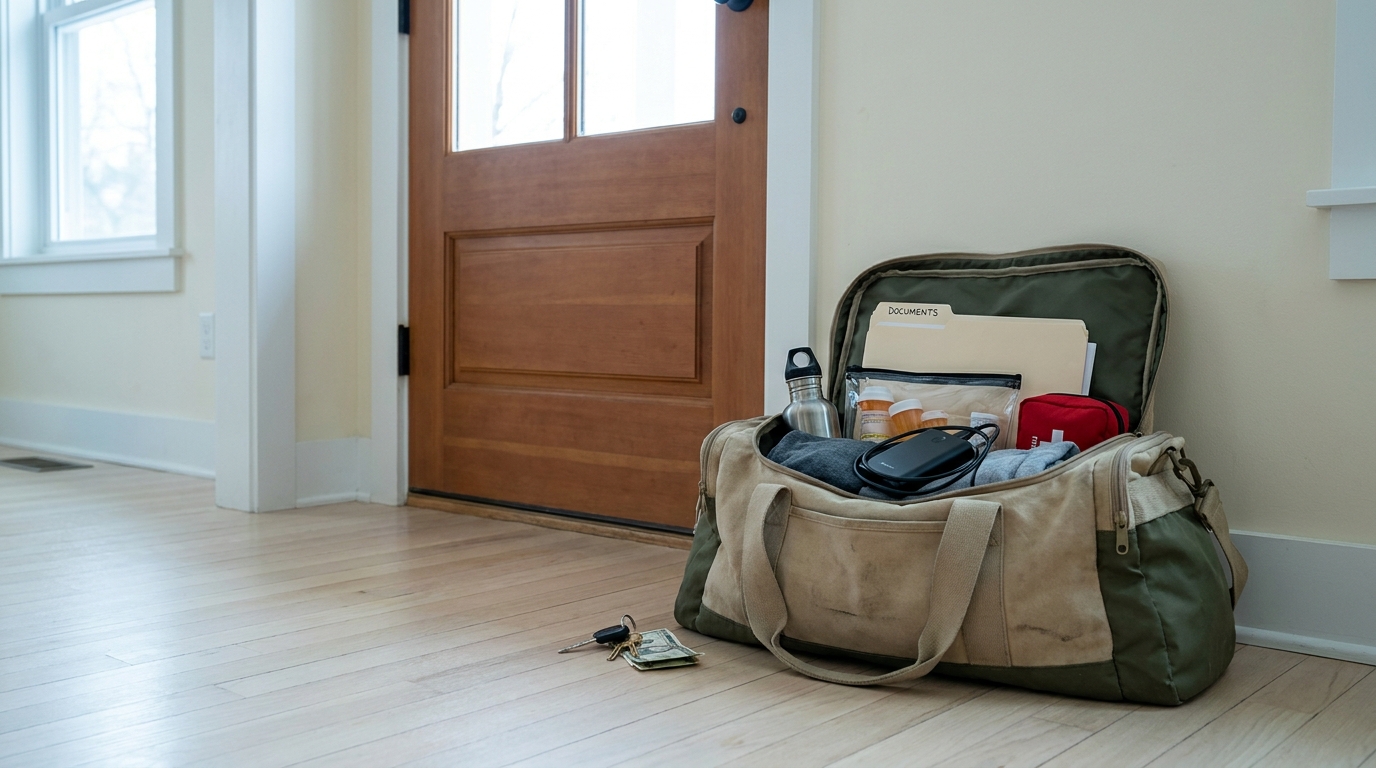
picture your bug-out bag and you probably picture the woods. a collapse, a long walk, a firesteel and a knife and a tarp. then look at what actually happens when people grab a bag and run: a gas leak two streets over, a wildfire warning, a flooded creek, a chemical spill on the interstate. you have twenty minutes, the family is in the car, and you are driving to your sister's place or a Holiday Inn off the highway.
that is the real scenario. and almost nothing in the survival-cosplay bag helps with it.
so before the gear list, the reframe, because it changes everything that goes in the bag.
What a "bug-out" actually is
When people evacuate, they go somewhere with a roof and a toilet. The research on how people actually leave is consistent: most stay with family or friends or in a hotel, and public shelters are the minority option, used most by the people who have nowhere else to go. In a study of Hurricane Florence evacuees, 70 percent of those in shelters had no family or friends to stay with (NCBI, 2021). Even in the unusual 2020 season, when the Red Cross deliberately steered people away from crowded congregate shelters to limit COVID exposure, roughly 90 percent ended up in rented hotel rooms rather than schools and gyms (American Red Cross via Scientific American, 2020). A roof and a toilet, not the woods.
Nobody is walking into the wilderness. They are sitting in a guest bedroom or on a cot for about three days, waiting to go home.
That is what the bag is for. It bridges roughly 72 hours away from your house, in a place that already has water and walls. It is a go-bag, not a survival kit, and not the "I am never coming home" fantasy bag people build and then never lift again. Once you accept that, the priorities flip.
Tier 1: the things only you have
This is the part the gear lists bury at the bottom, and it is the whole point. On the way out of town you can buy water, a flashlight, a phone charger, and a pack of socks at any gas station. You cannot buy your insurance policy, your deed, or your kid's inhaler.
So the bag starts here:
- Documents. A folder (or a single waterproof pouch) with copies of IDs, passports, insurance policies, the deed or lease, birth certificates, and a card listing medications and allergies. Scan all of it to the cloud too, but keep a physical copy, because the network goes down with everything else.
- Medications. This is the one people lose, and it is the one that hurts. A systematic review of disaster evacuations found that losing medication, and not bringing prescriptions, is one of the most common and most dangerous failures, especially for anyone with a chronic condition (Disaster-Driven Evacuation and Medication Loss, 2014). Pack a labeled kit with a supply of daily medications, copies of the prescriptions, and a printed med list. Federal guidance suggests a one-to-two-week supply where your insurance and doctor allow it. Treat the meds like the documents: irreplaceable, and the first thing in the bag.
- Cash. Small bills. Card readers die with the power, and a couple hundred dollars in twenties solves more real evacuation problems than any tool in the bag.
- Keys and contacts. A spare set of car and house keys, and a printed list of phone numbers plus one out-of-area contact, because you will not remember a single number when your phone is at 4 percent.
If you only ever pack Tier 1, you have done more than most people with a 40-pound rig.
Tier 2: the 72-hour basics
Now the boring competence, the stuff that carries you through three days and a possible night in the car before you reach the guest room.
- Water. A liter or two per person, plus a way to refill. You are headed somewhere with taps, so this bridges the drive and the wait, it does not replace a faucet.
- Food that needs zero prep. Bars, jerky, nut butter, trail mix. Not freeze-dried meals that need boiling water you will not have. Calories you can eat one-handed in a moving car.
- Warmth and a place to sit out the gap. A change of clothes, a compact blanket or an emergency bivvy, a rain layer. Enough to be fine on a cot or in a reclined seat overnight.
- Light. A headlamp beats a flashlight, because it leaves your hands free. Spare batteries.
- Power and comms. Your phone, a charged power bank, the cables, and a small battery or hand-crank radio for when the cell network is down.
- First aid and hygiene. A small kit for cuts and the usual aches, wet wipes, a toothbrush, hand sanitizer, and spare glasses or contacts if you wear them.
This is the layer most "bug out bag list" articles spend all their words on. It matters, but it is Tier 2, not Tier 1.
Tier 3: where the cosplay creeps in
Everything past the basics is a trade against weight and the speed you will actually grab the bag. Add with a clear reason, not because a video told you to:
- A real water filter, but only if a plausible scenario for you is being stranded somewhere genuinely remote. For a drive to a relative's house, skip it.
- A multi-tool, a roll of duct tape, a paper map of your region for when the phone navigation is down.
- Skip the machete, the survival saw, the fishing kit, and the 5,000-lumen tactical light. They are for the movie, and they are why the bag weighs more than your kid.
The honest test for any Tier 3 item: would you carry it for the evacuation that is actually likely to happen to you, or for the one you imagine?
The logistics nobody plans for
Gear is the easy part. The failures are almost always logistics.
- A bag per person. Each adult carries their own. Kids carry a light one with their own comfort item and snacks, which also keeps them busy and calm.
- The pets. A carrier, a leash, a few days of food, and a copy of vaccination records, because hotels and shelters will ask. The pet is also the thing people run back into a burning house for, so plan it in advance.
- The 30-second plan. Decide now who grabs what, where you are going, and where you meet if you get separated. Nobody should be looking for the cat while the house fills with smoke.
The two rules that make it real
A bug-out bag that fails the next two tests is not a bug-out bag, it is a hobby.
It has to be grab-and-go. If you cannot pick it up and be in the car in five minutes, it is a project, not a plan. Pre-pack it. Do not assemble it during the emergency.
It has to be where you are. A perfect bag in the attic is useless. Keep it by the door you actually leave through, or in the trunk. And check it twice a year, because medications expire, batteries die, and kids outgrow the spare clothes you packed two winters ago.
TL;DR
A bug-out bag is a 72-hour go-bag to a known safe place, not a survival kit for the apocalypse. Lead with the irreplaceables, your documents, medications, and cash, because those are the only things you cannot re-buy on the way out of town. Add the 72-hour basics, stop before the cosplay, pack a bag per person, and keep it light enough and close enough that you will actually grab it and go.
The fantasy bag is the one you build once and admire. The real one is boring, half-empty, sitting by the door, and the only one that has ever saved anybody.
The bag is the evacuation layer. For what rides in your pockets every day, see Everyday Carry: What's Actually Worth Carrying. For a hazard-specific build, see the 13 items in my wildfire bag. Size water, food, and meds for your household at the Supply Calculator.
Sources
- American Red Cross, 2020 disaster-shelter data, via Scientific American (2020): https://www.scientificamerican.com/article/2020-is-a-record-year-for-disaster-shelters-red-cross-says/
- Pilot Study on the Experiences of Hurricane Shelter Evacuees, National Academies / NCBI (2021): https://www.ncbi.nlm.nih.gov/books/NBK565441/
- Tomio et al., Disaster-Driven Evacuation and Medication Loss: a Systematic Literature Review, PLoS Currents / NCBI (2014): https://www.ncbi.nlm.nih.gov/pmc/articles/PMC4169391/