
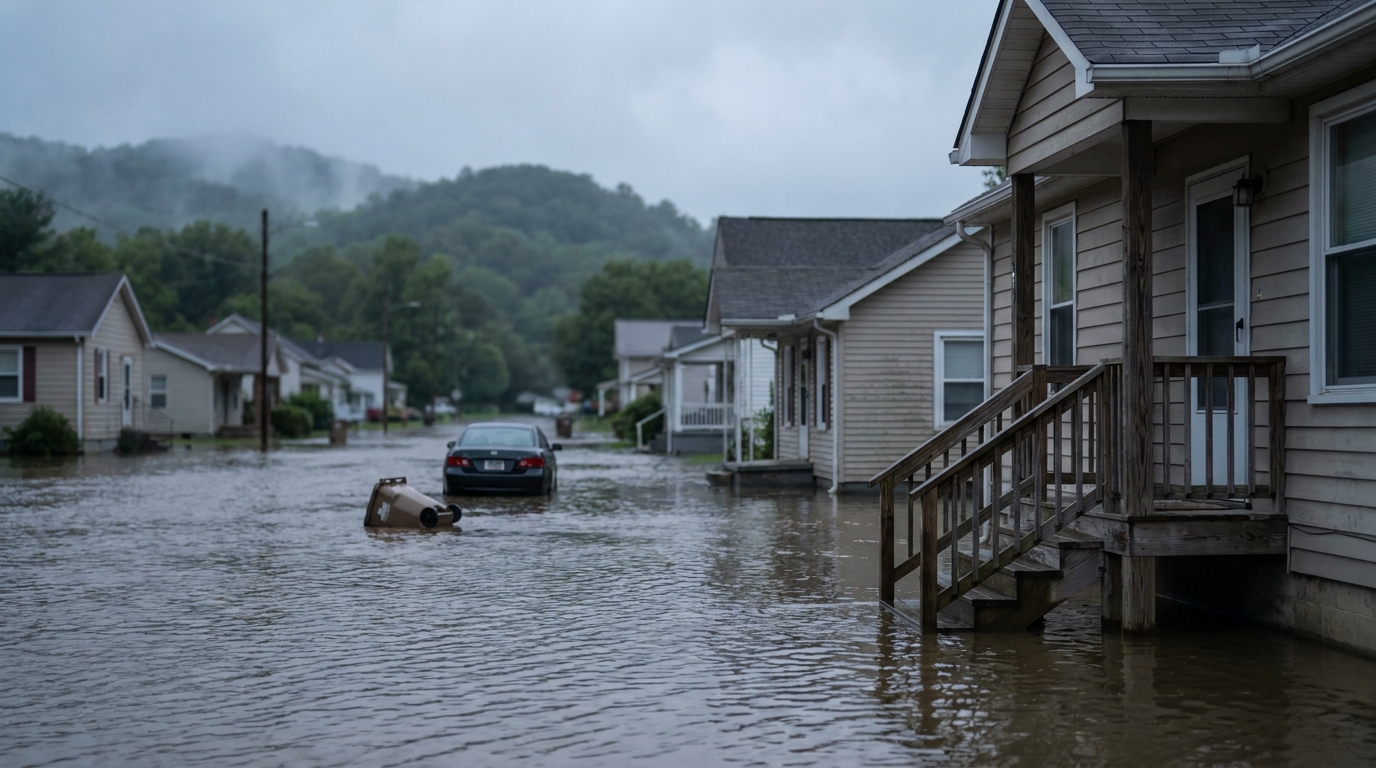
everyone preps for a hurricane like it is a wind problem. board the windows, grab a flashlight, wait for it to blow over. then the wind does less than you feared, and the water you didn't think about comes up through the floor or down through the ceiling and takes the whole house with it.
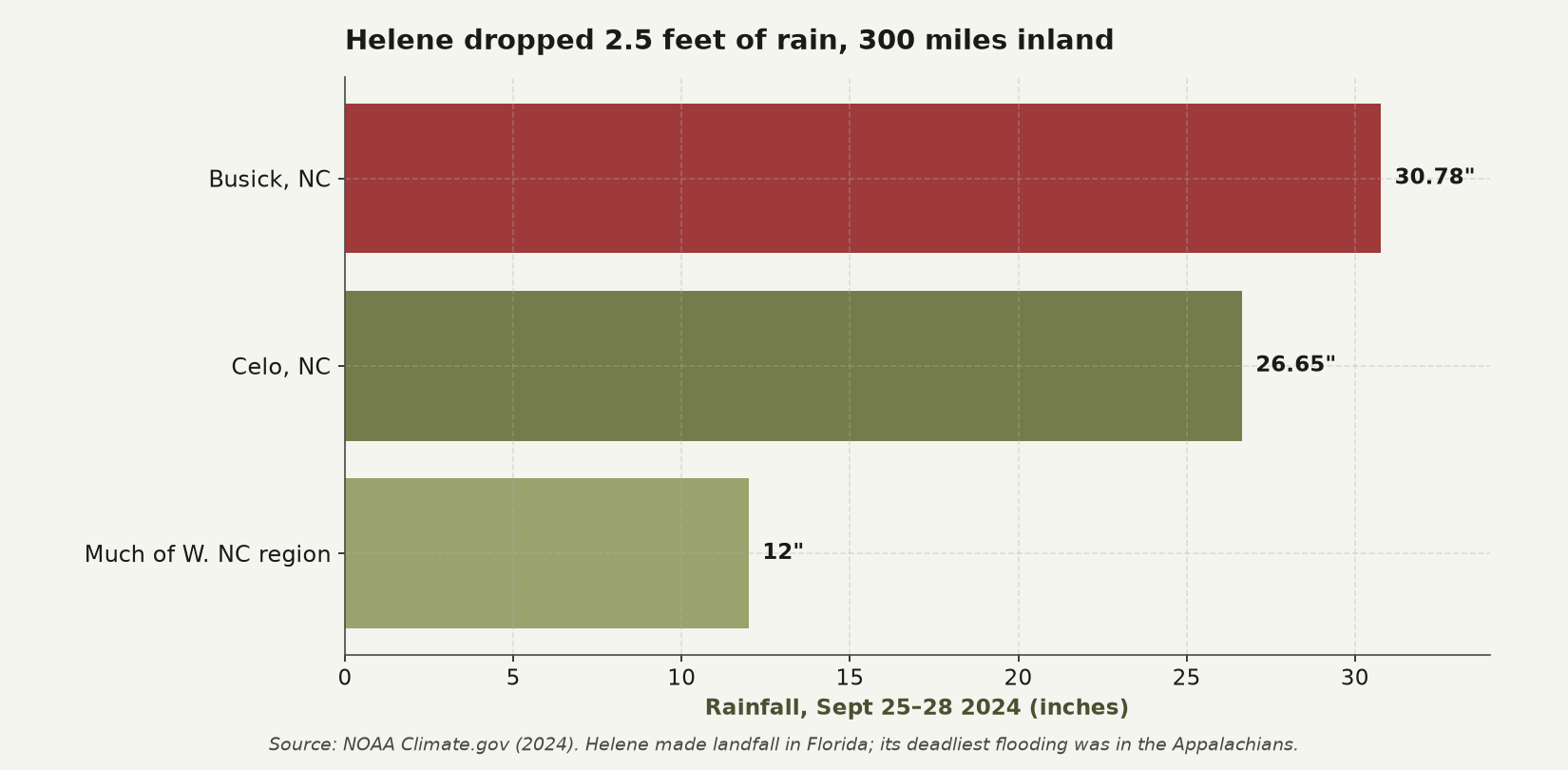
in 2024, Helene came ashore in Florida as a category 4. the worst of it happened in the mountains of western north carolina, hundreds of miles inland, in towns people had literally moved to because they thought they were safe from this. one community got over 30 inches of rain. one county alone lost 43 people. most of them to water. none of them on a beach.
that is the whole point. so before the checklist, the reframe.
The thing the checklists get backwards: it is the water, not the wind
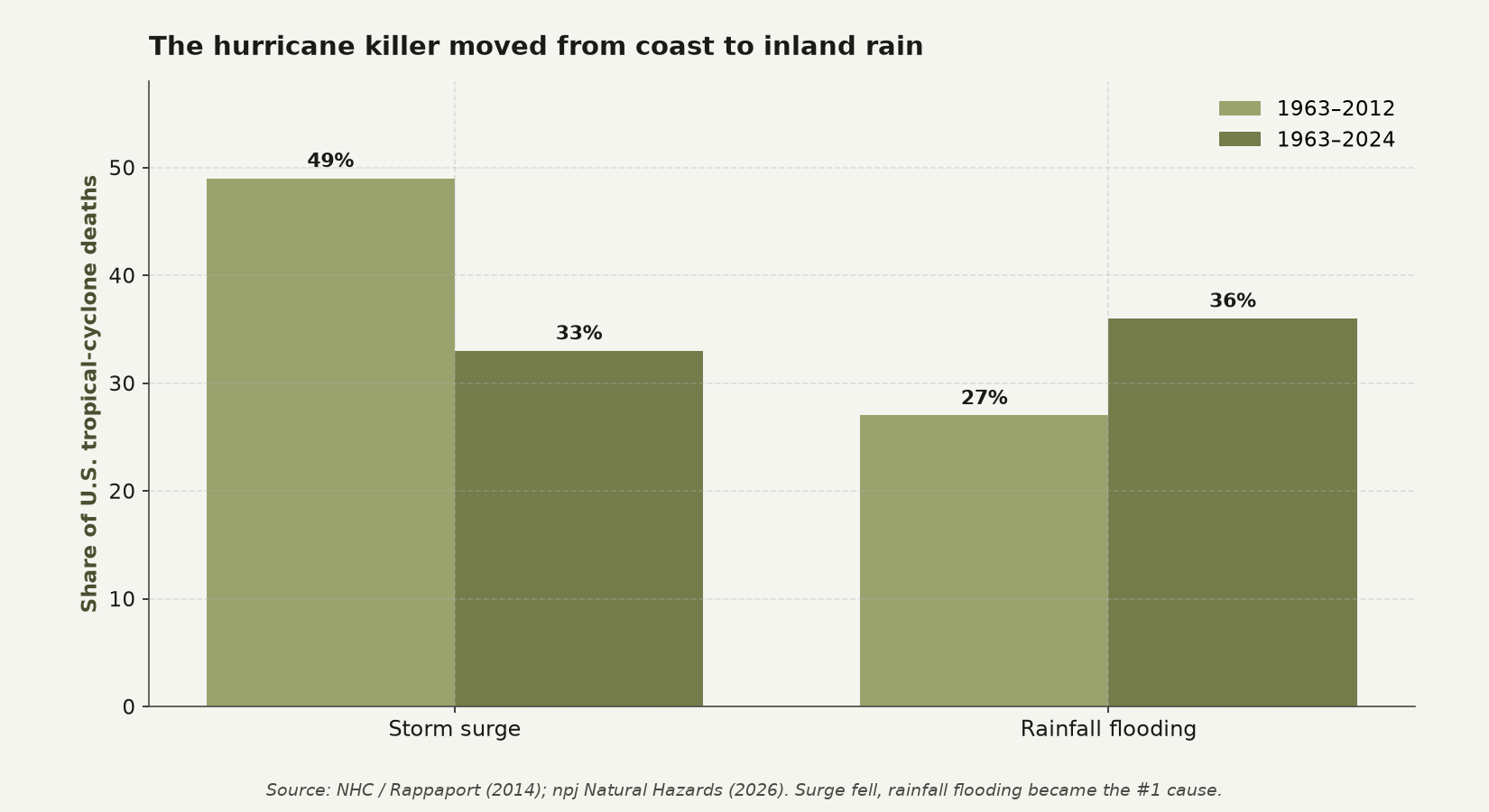
For the fifty years from 1963 to 2012, nearly 9 out of 10 deaths from U.S. hurricanes and tropical storms came from water, not wind. Storm surge caused about half, rainfall flooding about a quarter. Wind, the thing everyone preps for, was a small minority (NHC / Rappaport, 2014).
And the threat has moved. Looking across 1963 to 2024, the single leading cause of death is no longer coastal storm surge. It is freshwater flooding from rainfall, at about 36 percent, now ahead of surge at about 33 percent (npj Natural Hazards, 2026).
Translation: hurricane danger is not a beachfront problem anymore. Rain bands stall over hills, the terrain forces the moisture up, and a tropical system dumps two feet of water on a valley three states from where it made landfall. Helene's rain totals in the Appalachians hit 30.78 inches in Busick, North Carolina. The mountains turned creeks into rivers in a day (NOAA Climate.gov, 2024).
So we prep in that order. Water first, wind second. And "I am inland" is not a reason to skip it.
Two moves nobody leads with: do them now, before a storm is named
Most of what actually protects your house cannot be done when the cone is already pointed at you. These two are the highest-value things on this entire page, and almost no checklist puts them first.
1. Buy flood insurance today, not when the storm appears
Here is the gut-punch most homeowners learn the hard way. Your homeowners insurance does not cover flood. Wind damage, yes. Water that rises from the ground, surge, a rising creek, overwhelmed storm drains, no. That is a separate policy (FEMA).
And you cannot buy it on the way to the storm. A new National Flood Insurance Program policy has a 30-day waiting period before it takes effect, built specifically to stop people from buying coverage once a storm is named. If your house floods during that window, you have nothing (FloodSmart / NFIP).
The exceptions are narrow. There is no wait if you buy it as part of a mortgage transaction, and private flood policies sold outside NFIP often have about a 14-day wait. But the rule of thumb is simple. If a storm is in the forecast and you do not already have flood insurance, you are too late for this one. Buy it in the off-season, well before June 1.
This matters most for exactly the people who skip it: inland homeowners outside the official high-risk flood zones, who assume "flood zone" means "someone else." A large share of flood damage every year happens to homes that were never mapped as high-risk.
2. Harden the house the way the data says matters: roof, garage door, openings
When the Insurance Institute for Business and Home Safety (IBHS) studied real hurricanes, they found three upgrades do most of the work. Homes built to their FORTIFIED standard were 70 percent less likely to file a claim after Hurricane Sally, a strong Cat 2, than standard homes nearby (IBHS, 2021).
In order of how much they matter:
- The roof. Most catastrophic damage starts when the roof opens up. A FORTIFIED roof seals the deck, locks the edge with a drip edge, and re-attaches the deck with ring-shank nails, which roughly double how well the deck stays put in high wind versus the smooth nails most homes were built with (FORTIFIED Roof).
- The garage door, the sneaky one. A door that gets pushed in lets wind pressure build inside the house and lift the roof off from below. It is a cascade failure from the cheapest big opening you own. IBHS wants a door rated for 130 mph or higher (FORTIFIED).
- Windows and doors. Once one breaks, you have the same pressure problem as the garage. The fix is impact-rated glass or hurricane shutters that meet a real testing standard, not duct-tape Xs, which do nothing.
None of these are storm-week jobs. IBHS is blunt that inland homeowners need to do them too.
When a storm is actually coming: the 72-hour runbook
The cone includes you. Now it is about water, power, and not making a 24-hour panic out of a 3-day window.
72 hours out. Fuel both vehicles and the cans, get cash (card readers die with the power), refill prescriptions, and store water: one gallon per person per day, three days minimum. Freeze jugs and bottles now. They buy your fridge hours later and become drinking water as they melt. Charge everything, including a power bank.
48 hours out. Protect the openings (shutters up, or pre-cut plywood over windows). Bring in anything the wind can throw: patio furniture, the grill, the trash cans. Sandbag the low doors if you are anywhere water pools. Photograph and video the entire house, inside and out, and send it to the cloud. This is your insurance evidence and it takes ten minutes. Turn the fridge and freezer to coldest.
24 hours out. Fill bathtubs and containers with water for flushing and washing (a bathtub bladder like a WaterBOB is cleaner if you have one). Park on the highest ground you have, away from trees. Scan your documents, IDs, policies, deeds, to the cloud. Stage the go-bag by the door. And make the honest call below.
During. Interior room, lowest floor that will not flood, away from windows, off the roads. Do not go outside during the eye. The calm is the middle of the storm, not the end, and the back wall hits from the opposite direction.
Stay or go: run from water, hide from wind
The oldest rule in emergency management is still the right one. You hide from wind and you run from water. A well-built house is a reasonable place to ride out wind. It is a death trap in a flood or a surge.
So the decision is about water, not category. If you are in a storm-surge zone, an evacuation zone, or a low spot that floods in an ordinary thunderstorm, leave early. Roads and shelters fill up, and the last cars out drive through rising water, which is how a lot of people die. Look up your evacuation zone before the season, not the night before.
After the storm: where the second wave of deaths happens
More people are hurt after the hurricane than during it. Three things matter most.
The generator will try to kill you. Portable generators cause roughly 85 to 100 carbon-monoxide deaths a year in the U.S., the largest single source of engine-driven CO deaths, and they spike after every storm. CO is invisible, odorless, and faster than you would believe. The rules are not flexible. Run it outside only, at least 20 feet from the house, with the exhaust pointed away. Never in a garage, basement, crawlspace, shed, or on a porch, even with the doors open. Opening a window does not save you. Buy a model with a built-in CO shutoff, and put a battery CO alarm on every floor (CPSC).
Do not drink or wade floodwater. It is a mix of sewage, fuel, chemicals, and debris, and it hides downed power lines and missing manhole covers. Assume tap water is unsafe until the utility says otherwise. This is what your stored water is for.
Start drying within a day. Mold takes hold in 24 to 48 hours on wet drywall and carpet. Once water is out, get air moving and pull soaked materials. But document the damage with photos before you touch anything, or you will fight your own insurance claim later.
The gear that earns its place
Skip the bunker cosplay. For a hurricane house, the short list that matches the actual threats:
- Water storage, jugs and containers for a gallon per person per day, plus a bathtub bladder.
- A CO alarm (battery) plus a portable CO detector.
- Power, a generator (with CO shutoff) or a large battery power station for the fridge, phones, and any medical device.
- A real water filter for after, when the tap is suspect.
- A NOAA weather radio for when the cell network is down.
- A moisture meter to know when walls are actually dry.
TL;DR
If you do nothing else: buy flood insurance in the off-season (homeowners will not cover the water, and you cannot buy it once the storm is named). Strengthen the roof, garage door, and windows before the season. When one is coming, store water and protect the openings. Run from water, hide from wind. And after, keep the generator 20 feet outside and do not touch the floodwater.
Hurricanes do not kill the way the movies show. They kill quietly, with water, farther from the coast every decade, and most of the damage is decided long before landfall, by what you did or did not do months earlier.
Build a hurricane supply list for your household at the Supply Calculator (water, power, and meds for N people times M days). Tracking active systems and grid strain on the signal map.
Sources
- National Oceanic and Atmospheric Administration / National Hurricane Center (Rappaport), Inland flooding: a hidden danger of tropical cyclones: https://www.noaa.gov/stories/inland-flooding-hidden-danger-of-tropical-cyclones
- Continental United States direct Atlantic tropical cyclone fatalities, 1963–2024, npj Natural Hazards (2026): https://www.nature.com/articles/s44304-026-00178-8
- NOAA Climate.gov, Hurricane Helene's extreme rainfall and catastrophic inland flooding (2024): https://www.climate.gov/news-features/event-tracker/hurricane-helenes-extreme-rainfall-and-catastrophic-inland-flooding
- FEMA, Flood Insurance: https://www.fema.gov/flood-insurance · NFIP, Buy a Policy: https://www.floodsmart.gov/get-insured/buy-a-policy
- Insurance Institute for Business & Home Safety (IBHS / FORTIFIED): Hurricane Sally claim study (2021): https://ibhs.org/ibhs-news-releases/study-shows-ibhss-fortified-program-reduced-hurricane-sally-damage/ · FORTIFIED Roof: https://fortifiedhome.org/roof/ · Reinforce your property: https://fortifiedhome.org/article/reinforce-your-property-against-hurricanes/
- U.S. Consumer Product Safety Commission, Generators and Engine-Driven Tools: https://www.cpsc.gov/Safety-Education/Safety-Guides/Carbon-Monoxide-Home/Generators-and-Engine-Driven-Tools