
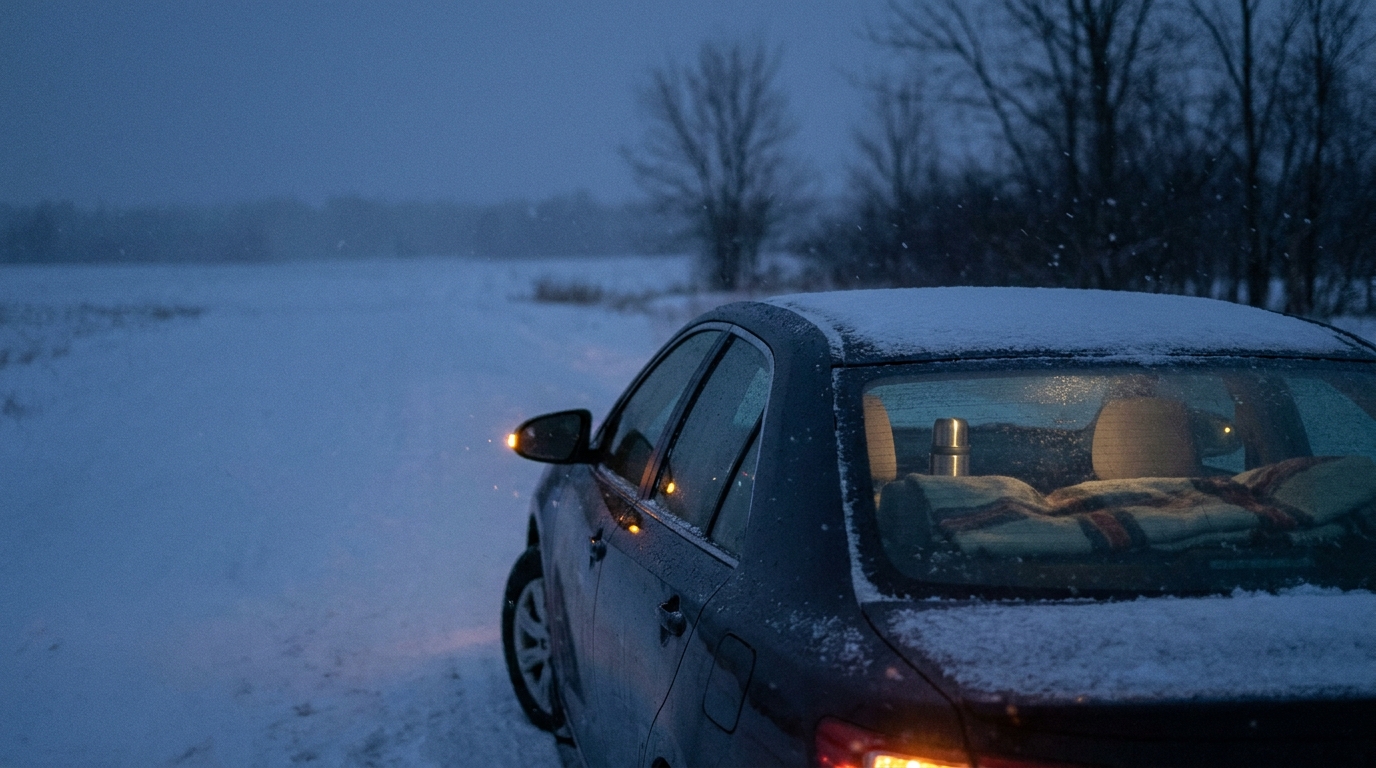
in january 2022 a snowstorm shut down about fifty miles of interstate 95 in virginia. trucks jackknifed across the lanes and everything behind them stopped. hundreds of people sat in their cars through the night in the teens, engines dying one by one as the gas ran out. a united states senator, tim kaine, was in that line. a drive that normally takes him two hours took twenty seven. he said afterward that the only thing he had eaten was an orange a stranger handed him from another car.
nobody died on i95 that night. that is the part worth sitting with. it was close, and it was luck, and the difference between a bad story and an obituary was mostly what people happened to have in the trunk.
that is the whole subject here. not overlanding gear, not the apocalypse. the boring, specific problem of surviving your own car for a day when the road stops moving, and the small decision, made on a dry afternoon, that puts you on the right side of it.
This is the most likely way winter actually kills you
We picture winter death as a mountaineer in a whiteout. The data says look at your driveway instead. The National Weather Service puts it flatly: about 70 percent of deaths related to ice and snow happen in automobiles, and about 25 percent are people caught out in the open by a storm. Not on summits. On roads, in cars, often a few miles from a warm bed.
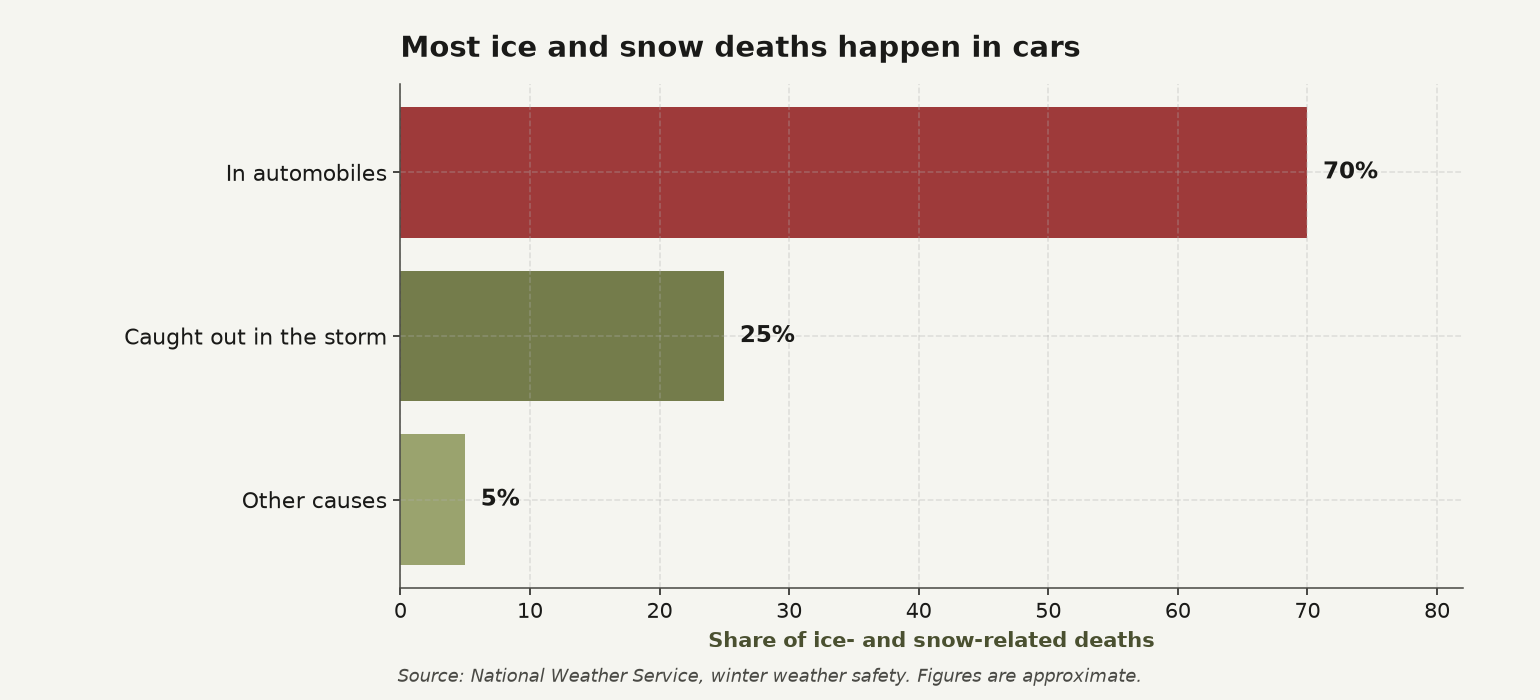
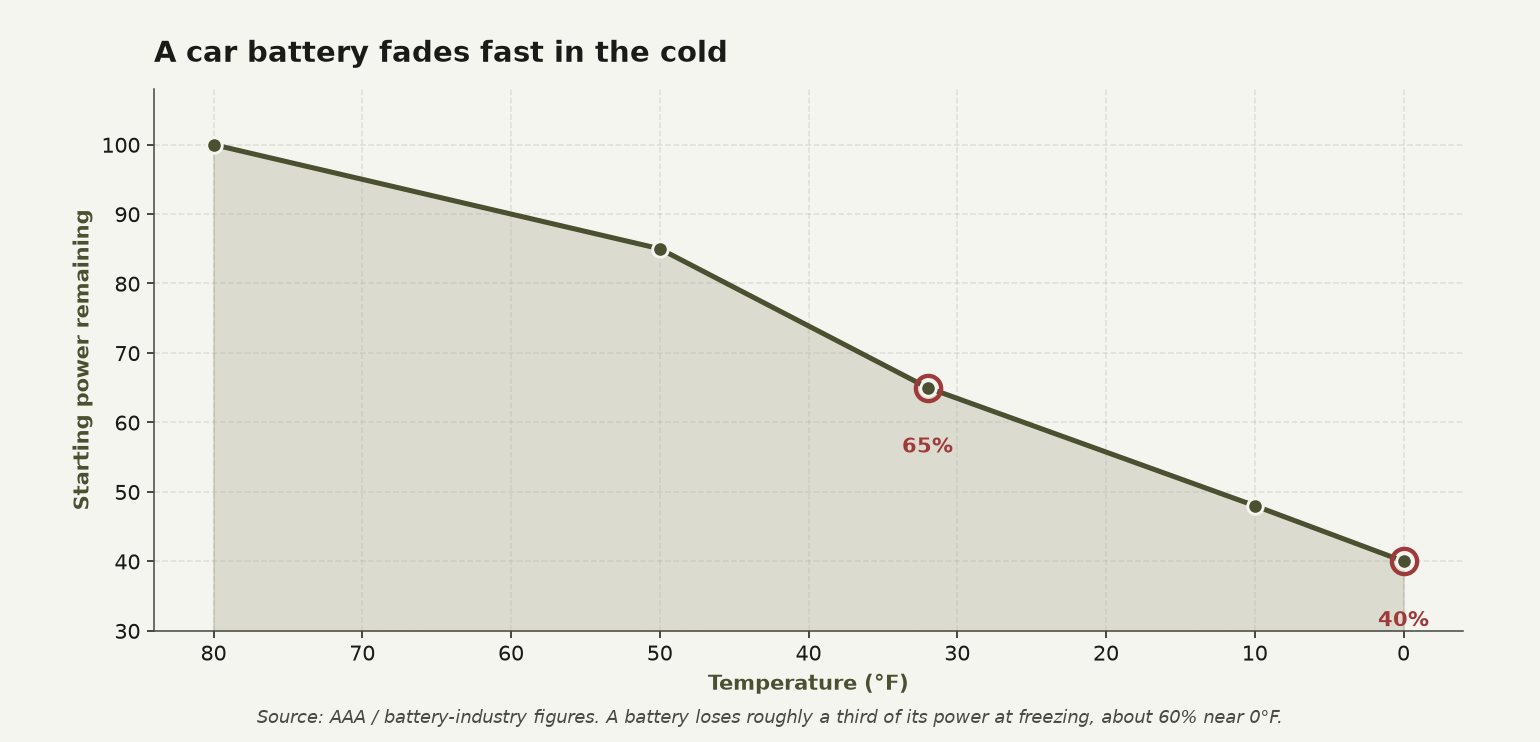
And it does not take a record blizzard to strand you. It takes one bad commute behind one stuck truck. AAA responds to more than 30 million roadside calls a year, and batteries are the top winter culprit, because a cold battery is weak exactly when it has the hardest job. By commonly cited industry figures, a typical car battery loses roughly a third of its starting power at freezing and well over half of it near zero degrees. The morning it will not turn over is almost always the coldest one.
The reframe: you are surviving the car, not the wilderness
Here is where people spiral before they buy a thing. They imagine bushcraft and shelter-building and give up. Wrong picture. You are not lost in the backcountry. You are twenty feet from a road, inside a metal box that blocks the wind and holds heat, with a battery and a heater and a horn.
Your job for the next twenty four hours is small and specific: stay warm, stay visible, stay fed and charged, and do not do anything dramatic. Add those up and it is not a survival epic. It is a short list you can solve on a normal Tuesday.
Which brings up the single most important rule, and it runs against every instinct: stay with the car.
Stay with the car (the mistake that gets people killed)
In 2006 the Kim family got snowbound on a remote logging road in Oregon. After days stuck with two young kids, James Kim did the thing that feels brave and correct. He set out on foot to find help. He died of hypothermia in the wilderness. His wife and both daughters, who stayed with the vehicle, were spotted from the air and rescued. The ones who stayed lived. The one who left to get help did not.
That is not a fluke, it is the pattern, and it is why the National Weather Service and NHTSA both say the same thing: stay with your vehicle. The Weather Service allows one exception, unless you can actually see shelter you can reach. NHTSA is blunter and drops even that: do not leave your car. The car is warmth and it is a giant signal a search plane or plow can find. A person walking in wind-driven snow is invisible within a block and disoriented within minutes. Your car is the most useful thing you own in that moment. Do not walk away from it.
The thing that quietly kills the people who do everything else right
So you stay with the car and run the engine now and then for heat. Correct. But there is a trap inside that good decision, and it is the one that catches careful people.
If snow packs around your tailpipe, the exhaust has nowhere to go but back into the cabin, and carbon monoxide, a gas you cannot see or smell, fills the car while you doze off comfortably warm. After a 1996 blizzard the CDC traced a cluster of poisonings to exactly this: people sitting in idling cars with snow-blocked exhaust pipes. It is a warm, quiet, invisible way to not wake up.
The protocol when you are stranded: clear the snow fully away from the tailpipe and the area around it before you start the engine, and keep it clear. Run the motor only about ten minutes an hour for heat rather than continuously. Crack a downwind window while it runs. One honest caveat the safety research is blunt about, so we will be too: cracking a window is not a magic shield. A controlled study of a snow-buried car measured lethal carbon monoxide inside within minutes even with a window cracked open, and dangerous levels even after the tailpipe tip was brushed clear. The thing that actually keeps you breathing is a fully open exhaust path. Clear the whole tailpipe and the snow packed around it, and keep it that way every time the engine runs.
What actually goes in the kit
The federal checklist for a winter car emergency kit (this is NHTSA's) sorts cleanly into the three jobs above. Buy for the jobs, not for the aisle.
Stay warm. Real blankets, a wool one or a cheap sleeping bag, not the tinfoil space blanket alone. A warm hat and gloves left in the car year round. Hand warmers. A spare set of layers. A candle in a metal can throws a surprising amount of heat in a sealed cabin and does not drain the battery.
Stay unstuck and visible. A folding shovel to clear the tailpipe and dig a tire out. A bag of sand or cat litter for traction under a spinning wheel. An ice scraper. Jumper cables, or better, a self-contained lithium jump starter so you do not need a second good samaritan with a working car. A flashlight. Flares or reflective triangles so the plow sees you before it hits you.
The jump starter earns its place because the cold itself is why so many cars quit. A battery loses a big chunk of its punch as the temperature drops, right when a cold engine is hardest to turn over.
Stay fed and charged. Water, and calorie-dense food that shrugs off freezing, nuts and bars rather than anything that turns to a brick. A phone power bank, because your phone is your radio, your map, and your 911, and its battery dies fast in the cold. Any medication you actually depend on. A small first aid kit.
And the two that cost nothing and matter most: keep your tank above half all winter, because half a tank is hours of intermittent heat, and tell someone your route and your expected arrival, because a known route is what sends people looking for you before you become a news story. The senator on I95 had hundreds of witnesses. On a rural road at night, the person who knows where you were headed is your entire rescue plan.
TL;DR
The most likely place winter kills you is a car, not a mountain. If you get stuck, stay with the vehicle, run the engine only in short bursts with the tailpipe kept clear, and plan to be there for a day, not an hour. The kit is boring by design: warmth, traction, light, food, a charged phone, a tank you never let run low. None of it is expensive and almost none of it is exciting.
Tim Kaine got twenty seven hours and one orange and walked away fine. Almost everyone who keeps a blanket and a jump starter in the trunk never needs them. That is not wasted money. That is the whole point of the thing in the trunk you hope to forget about.
This pairs with keeping the lights on during a power outage and knowing what real backup power looks like at home. Size your household's wider needs at the Supply Calculator.
Sources
- National Weather Service, winter weather safety (70% of ice/snow deaths in automobiles): https://www.weather.gov/safety/winter-education
- National Weather Service, if stranded stay with your vehicle + run engine ~10 min/hour with a cracked window: https://www.weather.gov/lwx/winter_car-pr
- NHTSA, winter driving tips and emergency car kit checklist: https://www.nhtsa.gov/winter-driving-tips
- CDC, clear snow from your tailpipe (carbon monoxide): https://www.cdc.gov/natural-disasters/psa-toolkit/clear-snow-from-tailpipes.html
- CDC MMWR, carbon monoxide poisonings from idling cars with snow-blocked exhaust, 1996 blizzard: https://www.cdc.gov/mmwr/preview/mmwrhtml/00039929.htm
- BMC Emergency Medicine, lethal carbon monoxide in a snow-buried car even with a window cracked and the tailpipe brushed clear: https://pmc.ncbi.nlm.nih.gov/articles/PMC526190/
- Washington Post, Senator Tim Kaine stranded 27 hours on I-95, January 2022: https://www.washingtonpost.com/dc-md-va/2022/01/04/tim-kaine-i95-stranded-snow/
- James Kim, died leaving a stranded vehicle in Oregon, 2006 (family who stayed survived): https://en.wikipedia.org/wiki/James_Kim
- AAA, more than 30 million roadside assistance calls annually: https://www.acg.aaa.com/aaa-membership.html