
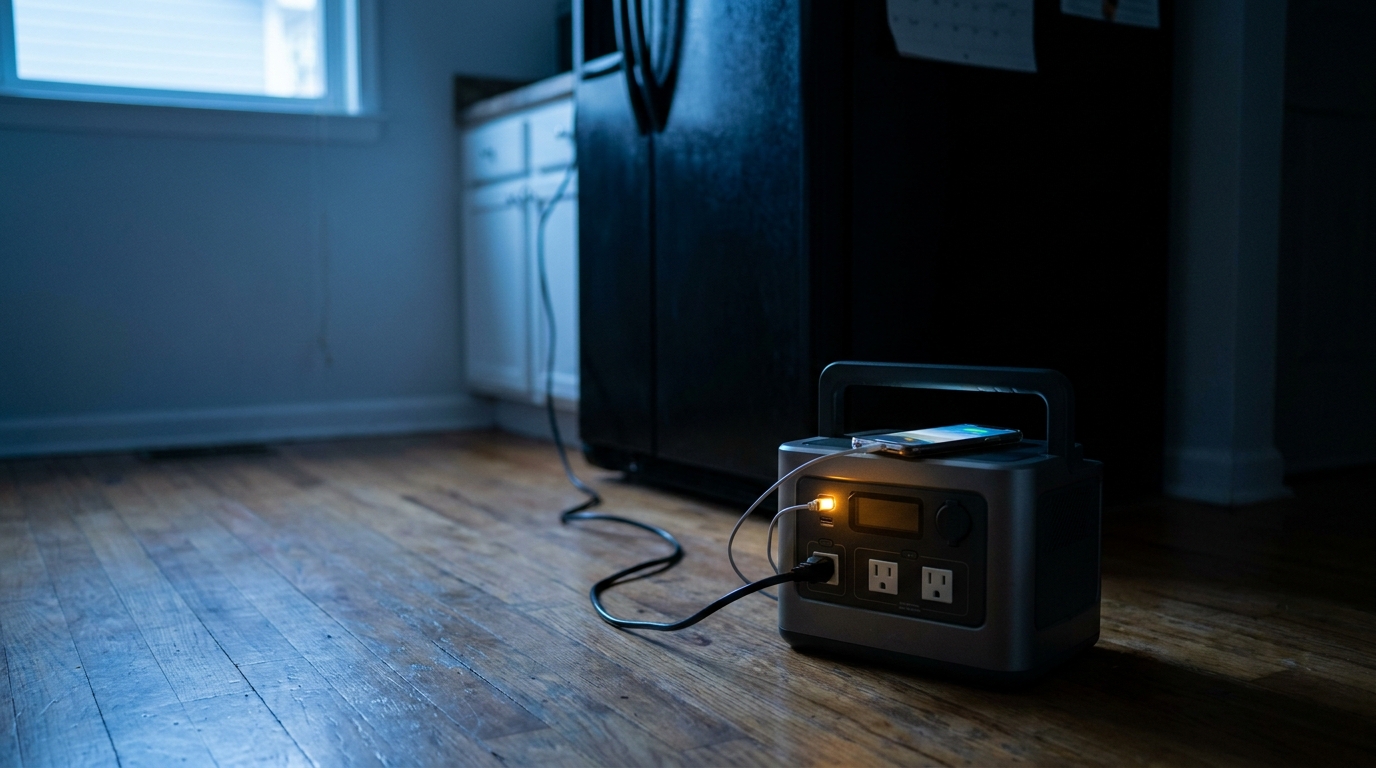
in february 2021 the texas grid went down and stayed down. not for an hour. for days. ten million people in the dark, in single-digit cold, watches the fridge warm up and the phone drop to four percent and the house get colder than the air outside.
and then the part nobody wants to talk about. people did what people do when they are freezing in the dark: they brought the heat inside. a charcoal grill in the living room. a car running in an attached garage. a generator on the porch by an open window. carbon monoxide killed at least nineteen of them and poisoned more than three hundred more (Texas power crisis, 2021). most of the 246 people who died that week died not from the storm, but from being cold and out of good options.
that is the real subject here. not gadgets. the difference between a power outage that is an inconvenience and one that is dangerous, and the boring decision, made on a normal day, that puts you on the right side of it.
This is not a freak event anymore
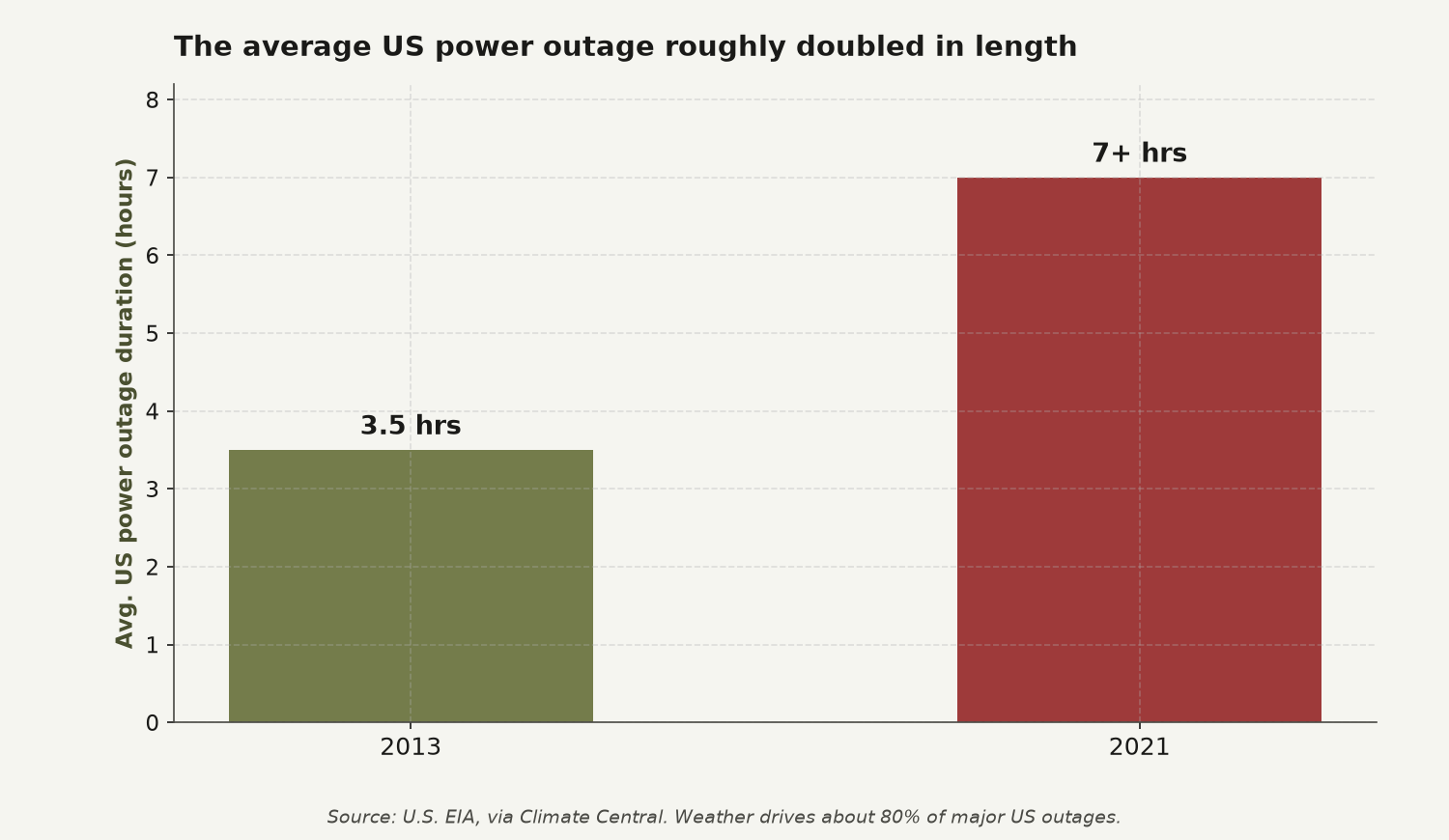
It is easy to file Texas under once-in-a-lifetime. The data says otherwise. The American grid is getting less reliable, not more. The average US power outage roughly doubled in length between 2013 and 2021, from about 3.5 hours to more than seven (Climate Central / EIA). Weather causes about 80 percent of the big ones, and there were roughly twice as many weather-driven outages in the last decade as in the one before it.
And it keeps happening. In June 2025, with a record heat wave and 160 million people under extreme-heat alerts, the Department of Energy declared a power emergency to shore up the Southeast grid and head off blackouts (U.S. Department of Energy). It did the same again this past week, in late June 2026, for PJM, the largest grid in the country, as record demand loomed (Utility Dive). Aging wires, bigger storms, and more demand are meeting in the same place, and the place is your breaker box.
You do not need to believe the grid is going to collapse. You just need to notice it is getting shakier, and that the outages that matter are not the twenty-minute flickers. They are the multi-day ones, in a heat wave or a freeze, when the flicker becomes a problem.
The reframe: you are not powering your house
Here is where most people go wrong before they spend a dollar. They picture backup power as running the house, so they price out a whole-home generator, get sticker shock, and do nothing.
You are not powering the house. You are powering the handful of things that keep your family safe and sane for three days:
- The fridge, in cycles, so the food and the insulin do not spoil.
- Phones and a way to charge them, because that is your weather radar, your contact with family, and your 911.
- One room's worth of comfort, a fan in a heat wave or a small heater in a freeze, so there is one survivable room.
- Any medical device you actually depend on, a CPAP, an oxygen concentrator, a nebulizer.
- A few lights, so nobody is navigating a dark house with a candle.
Add those up and it is a modest list. It is not a house. It is five things, and five things is a problem you can actually solve.
The two wrong answers (one of them is the one that kills people)
Too small: the phone power bank. A pocket battery keeps your phone alive, which is not nothing, but it will not touch a fridge or a CPAP. If phones are genuinely all you need, a good power bank is a fine answer and you can stop reading. Most families need more.
Too dangerous: the gas generator indoors. This is the one that killed people in Texas, and it kills people after every hurricane. A gasoline generator makes real power, but it also makes carbon monoxide, a gas you cannot see or smell that drops you before you know anything is wrong. It is an outdoors-only, twenty-feet-from-the-house, never-in-the-garage-even-with-the-door-open tool. In a freeze or a storm, when you most want to bring it closer, is exactly when it is most likely to kill you.
Which is why, for most homes, the right answer is neither. It is a battery power station, also sold as a portable power station, and paired with a panel, a solar generator: a big rechargeable battery with normal wall outlets on it. It makes no fumes, so it runs safely indoors, right next to the crib or the CPAP. It is silent. And for a multi-day outage you pair it with a solar panel so it refills during the day, which is the part that turns "a few hours of backup" into "we are fine until the grid comes back." A battery station that recharges from the sun is what people mean when they say solar generator.
How to size one without an engineering degree
Two numbers, and you can ignore the rest of the spec sheet.
- Watts (W) is how much it can push at once. Add up what you would run at the same time. A fridge pulls a lot for a second when its compressor kicks on (call it 1,200W of surge), a CPAP is small (30 to 60W), a box fan is small, a space heater is a hog (1,500W all by itself). You need a station whose output watts clear your biggest simultaneous draw.
- Watt-hours (Wh) is the size of the tank, how long it lasts. A 1,000Wh station runs a modern fridge (which only actually draws power in cycles) for the better part of a day, or a CPAP for two or three nights, or phones for a week. One warning if you depend on a CPAP: turn the heated humidifier off when you run it on battery. With the humidifier on, the draw jumps enough that the same station may not clear a single night, and that is not a number you want to learn at 3am. Size it on your machine's measured draw, not a rule of thumb.
So: a small station is a night of phones and a CPAP. A ~1,000 to 1,200Wh station is the fridge-and-essentials sweet spot most families should buy. A 2,000Wh-plus station, with a solar panel, is the multi-day and medical answer.
What to actually buy, by need
These are the picks from our store, in the three tiers above. Full disclosure: those are affiliate links, we earn a small commission if you buy through them, and that is what keeps this site running. We only list gear we would tell our own family to buy, and the honest guidance above matters more than any single model.
| If you need | The pick | Size | ~Price |
|---|---|---|---|
| Phones, lights, a CPAP for a night | BLUETTI EB3A | 268 Wh | $199 |
| The fridge + essentials (most homes) | BLUETTI AC180 | 1,152 Wh | $429 |
| The same, cheaper | ALLPOWERS R1500 LITE | ~1,150 Wh | $350 |
| Multi-day + medical, add solar | BLUETTI AC200L | 2,048 Wh | $749 |
| The big one, expandable | BLUETTI Apex 300 | ~2,700 Wh | $1,499 |
If your only worry is phones, skip all of this and buy a power bank. If you are rural, medically dependent, and lose power for a week at a time, a battery station is not enough on its own and you should price a proper standby system. For the family in the suburbs who wants the fridge, the phones, and one comfortable room to survive the next multi-day outage, the middle row is the answer, and adding a solar panel is what makes it last.
TL;DR
The grid is getting less reliable, and the outages that hurt are the multi-day ones. You do not need to power your house, just the fridge, the phones, one comfortable room, any medical device, and a few lights. The power bank is too small for that and the gas generator is the thing that quietly kills people trying to stay warm indoors. For most homes the answer is a battery power station around 1,000 to 1,200Wh, and a solar panel to refill it if the outage runs long. Buy it on a normal Tuesday, not the night the forecast turns.
The people who died in Texas were not careless. They were cold, in the dark, out of good options, at 3am. The whole point of a boring battery in the closet is that you never have to make that choice.
This is the deep version of one line in the Power Outage Kit, and it pairs with staying safe in a heat wave or a hurricane. Size your household's needs at the Supply Calculator.
Sources
- Climate Central, Weather-related Power Outages Rising (EIA outage-duration data): https://www.climatecentral.org/climate-matters/weather-related-power-outages-rising
- U.S. Department of Energy, emergency order to secure the Southeast grid amid the June 2025 heat wave: https://www.energy.gov/articles/secretary-wright-issues-emergency-order-secure-southeast-power-grid-amid-heat-wave
- Utility Dive, DOE emergency order for PJM (largest US grid), late June 2026: https://www.utilitydive.com/news/pjm-doe-emergency-order-curtail-data-centers/820571/
- 2021 Texas power crisis (deaths, duration, carbon-monoxide poisonings): https://en.wikipedia.org/wiki/2021_Texas_power_crisis
- U.S. CPSC, portable generator carbon-monoxide safety: https://www.cpsc.gov/Safety-Education/Safety-Guides/Carbon-Monoxide-Home/Generators-and-Engine-Driven-Tools