
picture a flood and you probably picture a river coming up through the living room floor. slow, brown, somebody's sofa turning in the current on the evening news. sandbags. a sump pump. a man in waders looking at his garage.
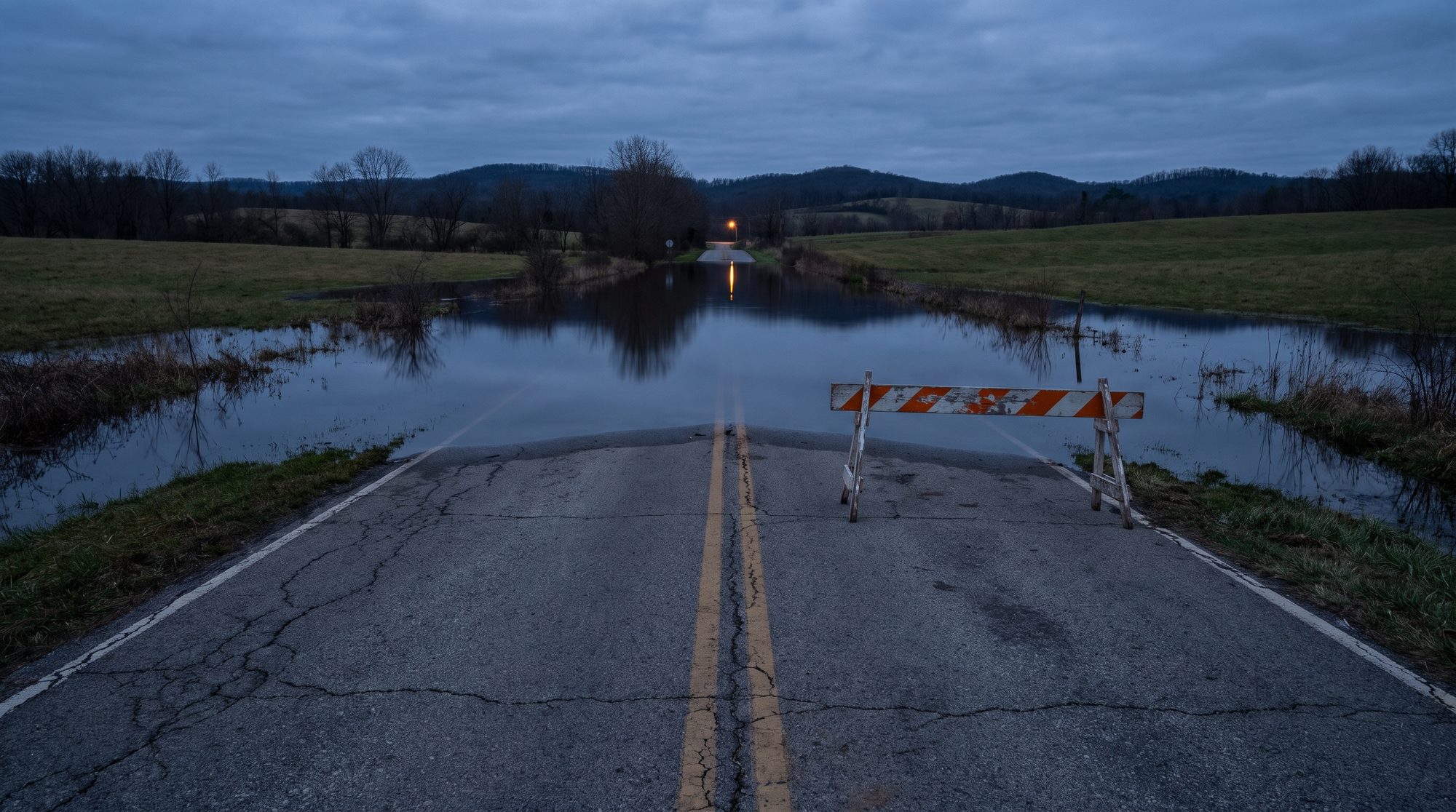
now picture the flood that actually kills people. it is a Tuesday, it is dark, it is raining hard, and there is a dip in a road you have driven four thousand times. there is eighteen inches of moving water sitting in that dip and you cannot see it, because water at night is just black road. you are doing 35. you are two miles from your house.
More than half of everyone who drowns in a flood in the United States drowns in a vehicle.
That one fact should reorganize how you prepare for flooding, because nearly every flood guide you will find leads with the house — and the house is not where the bodies are.
Where flood deaths actually happen
The National Weather Service is blunt about it: "over half of all flood-related drownings occur when a vehicle is driven into hazardous flood water." The CDC reports the same split. The next largest group is people who walked into or near floodwater, most of them not trying to be heroes — just crossing what looked like a wet street.
Flooding is the second-deadliest weather hazard in the United States, behind heat. But unlike heat, which kills slowly and indoors and mostly kills the vulnerable, flooding kills fast and kills the confident. The people who drive into water are overwhelmingly ordinary drivers making one ordinary decision on a familiar road.
So here is the honest ranking of what to prepare, sorted by what actually ends lives:
- Your driving decisions. Over half the deaths.
- Your walking decisions. Most of the rest.
- Your house. Nearly all of the money, almost none of the deaths.
Third place is not "unimportant" — flooding is the most expensive natural disaster in the country and we will get to the house. But if you spend your entire flood preparation budget on the building and none of it on the two decisions above, you have insured the thing that can be rebuilt and ignored the thing that cannot.
The three numbers that decide it
Everything about floodwater and vehicles comes down to depth, and the depths are far lower than anybody guesses:
- 6 inches of fast-moving water will knock an adult off their feet.
- 12 inches will float most cars.
- 18 to 24 inches will carry away SUVs and pickup trucks.
That upper number deserves an honest note, because the NWS's own pages do not agree with each other. The Turn Around Don't Drown page says two feet carries away SUVs and trucks; the flood safety page says 18 inches carries away large vehicles. Take the lower one. The difference between 18 and 24 inches is not a judgment you get to make from the driver's seat, in the dark, through a windshield, with rain on it.
The physics is unforgiving in a way that surprises people. A car is mostly air. Once it displaces enough water it floats, and a floating car is no longer a vehicle — it is a two-ton boat with no steering, no brakes and no keel, and it goes where the water goes. The water only has to win once.
And the water is rarely as shallow as it looks, because the reason there is water on that stretch of road is usually that the road is lower there, or the surface underneath it has already washed out. You are not looking at a puddle on a road. You are often looking at the top of a hole.
It is always a road you know
Here is the part that gets competent people. Flood deaths cluster on familiar roads.
That is not a coincidence, it is the mechanism. Familiarity is what supplies the confidence: you know this dip, you have been through it in heavy rain before, you know it drains. What you cannot know from the driver's seat is how much is in it tonight, or whether the culvert under it is still there. The knowledge that makes you comfortable is precisely the knowledge that is out of date.
Two practical consequences:
Barricades are not a suggestion, and they are not aimed at other people. If a road is barricaded, the water has already been judged by someone who got out and looked. Driving around a barricade is the single most reliably fatal decision in this entire subject, and in many states it is also a crime that bills you for your own rescue.
Flash floods do not wait for the rain to reach you. Water arriving in your street can come from rain that fell miles upstream, on ground you cannot see, hours earlier — which is why a flash flood warning can arrive under a clear sky. Burn scars and paved suburbs both shed water instead of absorbing it, so the flood shows up faster and higher than the same rainfall would have produced a decade ago.
Know the difference between the two alerts, because they ask for different things:
- Flash flood watch — conditions are right. Move the car uphill, charge things, decide your route now.
- Flash flood warning — it is happening or about to. Go to higher ground. This is not a "keep an eye on it" alert.
If the water is already there
In the car, water rising, engine still running: turn around. Not through, not "it's only a few car lengths", not behind the truck that made it. Reverse out the way you came, because you know that ground was dry thirty seconds ago.
In the car, stalled, water rising: get out and get to high ground while opening the door is still possible. A stalled car in rising water is the worst place you can be, and the instinct to stay with the vehicle — dry, familiar, expensive — is the instinct that drowns people. The car is insured. Leave it.
On foot: do not walk it. Six inches. And if you cannot see the ground through the water, you do not know whether there is still ground there — floodwater routinely hides open manholes, washed-out shoulders and downed power lines, all of them invisible under three inches of brown.
Trapped in a building: get to the highest level, and call 911 if you can. But do not climb into a closed attic. Ready.gov is explicit about this, and the reason is grim: an attic with no roof access is a sealed box with water rising in it. Only go onto the roof if you have to, and once there, signal for help.
That single piece of guidance — highest floor yes, closed attic no — is probably the least-known high-stakes fact in flood safety, and it costs nothing to know it before the night you need it.
The house: third place, but it's where the money goes
Flooding is extraordinarily expensive. FEMA's figure is that one inch of water in a house can cause about $25,000 in damage. Not one foot. One inch.
And it is not only happening to the people with a river out back. In 2024, flood damage in the US totaled roughly $8.8 billion, and about $3.9 billion of it — a shade under half — was in communities that are not designated high-risk. The maps describe the risk that has been assessed, not the risk that exists.
The two structural things worth knowing:
Your homeowners policy almost certainly does not cover flood. "Most homeowners insurance does not cover flooding" is FEMA's own phrasing, and this is the single most common unpleasant surprise in the whole subject. The full runbook on that — including the 30-day waiting period that stops you buying it once a storm is named — is in the hurricane piece, because it is the same policy and the same trap.
Elevation beats absorption. Sandbags are a marginal, exhausting, short-duration tool. Getting the furnace, water heater, electrical panel and anything irreplaceable above the expected water line is permanent and works while you are asleep. If your important documents live in a cardboard box in the basement, that is a twenty-minute fix that is worth more than every sandbag you will ever fill — and the go-bag checklist covers what belongs in that folder.
After the water goes down
The flood is not over when the water leaves. Two hazards outlast it.
Everything it touched is contaminated. Floodwater is not rainwater — it has been through streets, storm drains, sewers, fuel tanks and whatever was stored in the garages upstream. Treat all of it as sewage: boots, gloves, no bare skin, and nothing that touched it goes near food. Assume the tap is unsafe until the water utility says otherwise, and store water in advance so you are not making that decision thirsty.
Mold starts in 24 to 48 hours. That window is the consistent guidance from the CDC and EPA, and it starts while the water is still going down, not when you get back. Anything wet for more than about two days will generally grow mold — drywall, insulation, carpet, subfloor. Which means the recovery clock starts immediately: get air moving, get humidity down, and be ruthless about pulling out soaked porous material rather than hoping it dries. Sentiment is what turns a flood into a rebuild.
And the electricity. Do not touch electrical equipment if it is wet or if you are standing in water. If the panel is submerged, that is not a homeowner job.
TL;DR
Over half of flood deaths are people in cars, most of the rest are people on foot, and the house — where all the money goes — is a distant third for danger. Six inches knocks you down, twelve floats a car, eighteen takes a truck, and the road that kills you will be one you know well, at night, in a dip that drains fine every other time. Turn around. Never drive past a barricade. If you are trapped, go up but never into a closed attic. Afterwards, treat every wet thing as sewage and start drying inside forty-eight hours.
The flood you should prepare for is not the one on the news with the sofa in it. It is the two hundred yards of familiar road between you and your own driveway.
Everything above as a printable sheet: the flood preparedness checklist — the routes to name tonight, the warning-day list, and the 48-hour clock afterward. For the storm version of the same water, see preparing your house for a hurricane, water first. For what to grab on the way out, the bug-out bag checklist is printable too. And every scenario we cover — with what actually kills people in each — is indexed at Prepare.
Sources
- National Weather Service, Turn Around Don't Drown®: https://www.weather.gov/safety/flood-turn-around-dont-drown
- National Weather Service, Flood Safety — During a Flood: https://www.weather.gov/safety/flood-during
- Centers for Disease Control and Prevention, flood safety guidance: https://www.cdc.gov/floods/safety/index.html
- Ready.gov, Floods (guidance on trapped occupants, attics and roofs): https://www.ready.gov/floods
- FEMA / National Flood Insurance Program, The Cost of Flooding (2024 damage totals, high-risk vs non-high-risk split, homeowners coverage): https://www.floodsmart.gov/know-your-risk/cost-of-flooding
- FEMA, Flood Insurance ($25,000 per inch of floodwater): https://www.fema.gov/flood-insurance
- CDC, Homeowner's and Renter's Guide to Mold Cleanup After Disasters (24-48 hour mold window): https://www.cdc.gov/mold-health/communication-resources/guide-to-mold-cleanup.html
- US EPA, Mold Cleanup in Your Home: https://www.epa.gov/mold/mold-cleanup-your-home