
Most people file earthquakes under "California problem," somewhere between celebrity gossip and the price of avocados. It is one of the more dangerous things a person can quietly believe, and the proof is buried in the winter of 1811.
That December the ground convulsed, not on the West Coast, but in the bootheel of Missouri, along a fault most Americans have never heard of. Over the following weeks the New Madrid seismic zone produced a sequence of enormous earthquakes, with mainshocks estimated today at roughly magnitude 7 to 8. They were felt across most of the eastern United States. They knocked down chimneys in Cincinnati, more than three hundred miles away, and reportedly set church bells ringing as far off as the East Coast. For a short, strange interval, stretches of the Mississippi River appeared to run backwards, water shoved upstream where the riverbed had buckled and risen.
The faults that did that are still there. So are a lot of others, in places nobody associates with earthquakes.
Disclosure: As an Amazon Associate, s1gma earns from qualifying purchases. Some links below are affiliate links. If you buy through them, s1gma may earn a small commission at no extra cost to you. It doesn't change what gets recommended.
The map is bigger than California
In January 2024 the U.S. Geological Survey released an updated National Seismic Hazard Model, built by more than fifty scientists. Its headline finding is the one worth taping over the "it can't happen here" reflex: nearly 75% of the United States could experience damaging earthquake shaking. Thirty-seven states have had earthquakes exceeding magnitude 5 in the last two hundred years. The number of people exposed runs into the hundreds of millions.
California earns its reputation. It just isn't the whole story, and arguably not even the worst chapter.
The Pacific Northwest sits over the Cascadia Subduction Zone, a fault capable of a magnitude 9 earthquake, the kind that moves coastlines. The last one struck on the night of January 26, 1700. We know the date with unsettling precision because the tsunami it threw across the Pacific came ashore in Japan the next day with no local earthquake to explain it. Scientists later traced that "orphan tsunami" back across nine hours of open ocean to a Cascadia rupture. Drowned cedar forests along the Northwest coast, killed when the land dropped and the sea rushed in, confirm the timing in their tree rings.
Here is the part to handle carefully, because the internet reliably mangles it. Cascadia is not "overdue." The great quakes there recur on an irregular schedule, averaging somewhere around 500 years but ranging from roughly 200 to 1,000 years apart. "Overdue" implies a countdown, and geology doesn't keep one. What the science actually says is alarming enough without the embellishment: the USGS puts the odds of a full-margin magnitude 9 at about 10 to 15% in the next 50 years. For the southern stretch of the fault, off southern Oregon and northern California, a smaller but still enormous magnitude 8 runs closer to 37 to 43% in that same window.
The central US has the New Madrid zone from the story above, centered where Missouri, Tennessee, Arkansas, Kentucky, and Illinois meet. If you live anywhere near Memphis or St. Louis, that is your fault line, not a history lesson. A 2003 USGS forecast pegged the chance of another magnitude 6 or larger there at 25 to 40% within 50 years, with a smaller chance of a true repeat of 1811.
And Alaska is the most seismically active state in the country, no contest. Its 1964 Good Friday earthquake reached magnitude 9.2, the second-largest ever recorded anywhere on Earth.
None of this means Kansas needs a bug-out bag by the door. It means "I don't live in California" and "I don't need to know any of this" are two different sentences, and a lot of people say the first while meaning the second.
The advice that could get you killed
There is a piece of earthquake guidance that has been forwarded around by email, then Facebook, for two decades. It's called the Triangle of Life, and it is wrong in a way that actually matters.
The idea, popularized by a man named Doug Copp, is that when a quake hits you should lie down next to a big solid object, a couch or a desk, instead of under it. The theory goes that when the ceiling collapses it crushes the object and leaves a survivable void, a triangle, in the gap beside it. Copp built this on what he saw inside collapsed buildings overseas, a lot of it in Turkey.
The trouble is that he was looking at a different kind of building. His observations came from unreinforced masonry and concrete that pancakes flat in a strong quake. That kind of total collapse is common where building codes are weak. It is rare in the modern United States, where the typical building shakes hard, throws its contents across the room, and stays standing. In a building that stays standing, the thing that hurts you isn't the roof. It's everything that comes off the walls and shelves at head height.
Both the USGS and the American Red Cross have flatly rejected the Triangle of Life. The USGS says the idea is based on a foreign earthquake and "doesn't apply to buildings constructed within the United States." The Red Cross called the comparison apples and oranges, different codes, different engineering, different materials. Their shared recommendation is the dull one that has measurably saved American lives.
Drop, cover, hold on
When the shaking starts, three moves:
- Drop to your hands and knees, before the quake drops you on its own terms.
- Cover your head and neck, and as much of the rest of you as you can, under a sturdy table or desk.
- Hold on to that shelter, ready to move with it, until the shaking stops.
If there's no table, drop against an interior wall, away from windows, and cover your head and neck with your arms. Do not stand in a doorway. That one is a leftover from old photos of collapsed adobe houses where the doorframe happened to be the last thing standing, and it doesn't transfer to a modern wood-frame home, where the doorway is no stronger than the wall beside it and a swinging door is just one more thing waiting to hit you.
And do not run outside. This is the counterintuitive part, and the important one. The urge to bolt is exactly when people get hurt, because most earthquake injuries come from falling objects and from people going down while trying to move during the shaking. Sprinting through a house that is flinging glass and bookcases is worse than holding still under cover. Outside isn't a refuge either, not while facades and power lines are coming down around the building.
The protocol adapts to where you are:
- In bed? Stay there, roll face down, and cover your head with a pillow. The floor beside the bed is where the broken glass lands.
- Driving? Pull over clear of overpasses, power lines, and buildings, stop, and wait it out in the car.
- Outdoors? Get to open ground away from buildings and wires, then drop and cover your head.
Know your safe spots before it hits
The time to figure out where to dive is not while the floor is moving. Walk each room you actually spend time in and pick the spot now, so your body knows it in the dark.
The rule for a safe spot is simple. Something sturdy to get under, and nothing overhead or beside you that can fall. In practice:
- Away from windows and mirrors. Glass goes first and is the most common way people get cut.
- Away from exterior walls, which take the most stress, and away from tall furniture, hanging shelves, framed art, and heavy light fixtures.
- Under a solid table or desk when there is one. When there isn't, against an interior wall, low, head and neck covered.
Then the room-by-room reality, because not every room is equal:
- The kitchen is the most dangerous room in the house. Refrigerators walk across the floor, cabinets fling dishes, and knives and glass are everywhere at once. If you're in it when the shaking starts and can safely move toward an interior room, do. Otherwise get under the sturdiest thing in reach.
- Living room and home office. The table or desk is your friend. The bookcase, the TV, and the tall lamp are not. This is exactly why anchoring them (next section) is the highest-value hour you'll spend.
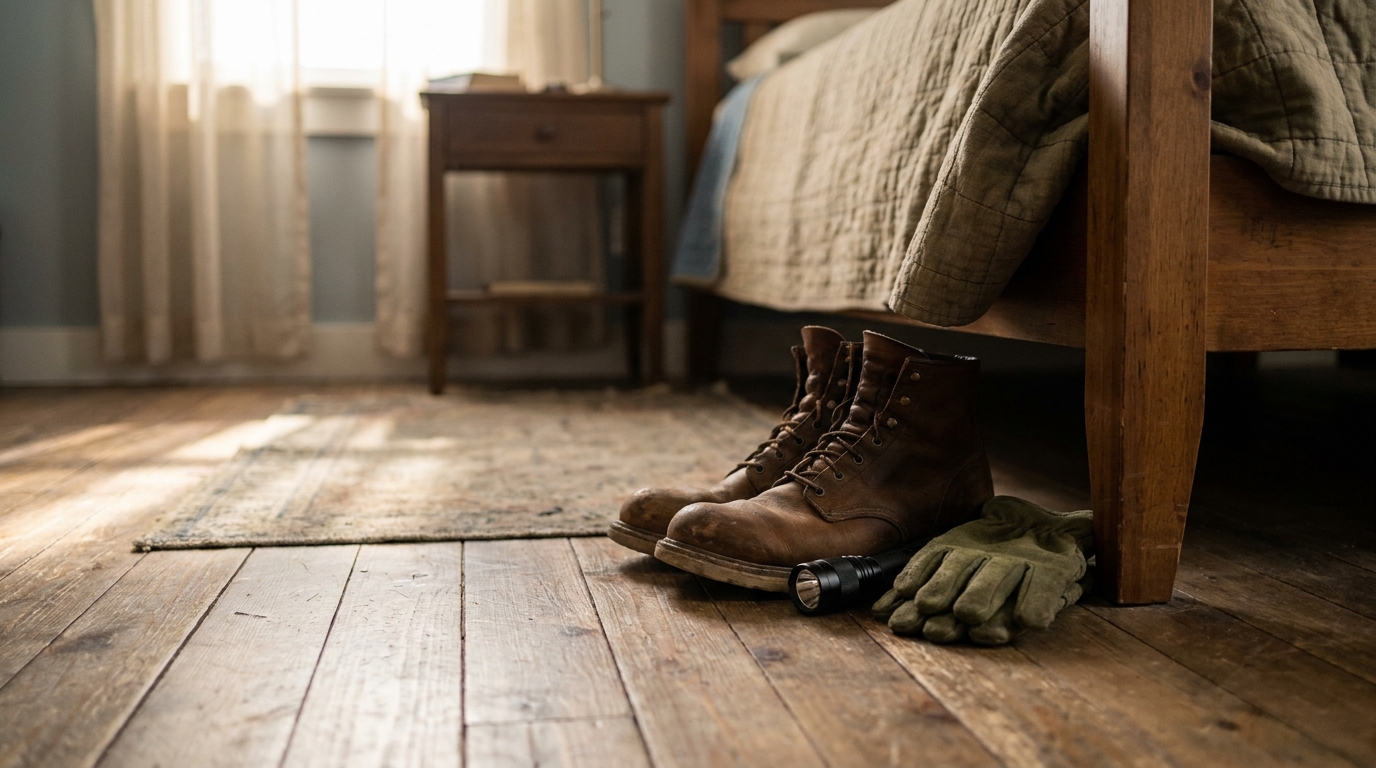
- Bedroom. Stay in bed, face down, pillow over the back of your head. Pre-stage shoes and a light underneath so the 3 a.m. version isn't a barefoot crossing of broken glass.
- Bathroom. Small, usually windowless with an interior wall close by, which is not a bad place to be. Watch the mirror and the medicine cabinet.
- A store, office, or high-rise. Get under a counter or desk, stay clear of windows and tall display shelving, and do not stampede for the exits or the elevators. Jammed stairwells and doorways hurt more people than the shaking does. Take the stairs, never the elevator, only once it stops.
Make the decision once, calmly, so the muscle memory is already loaded before you ever need it. That single walk-through is worth more than any gear on this page.
The few seconds you might get
If you live in California, Oregon, or Washington, you have access to something genuinely new: earthquake early warning. The USGS ShakeAlert system detects a quake in its first instants and pushes a warning out ahead of the shaking, which travels slower than a digital signal can. It reaches you through the MyShake app, through the earthquake alerts built into Android phones, or as a wireless emergency alert on most modern phones.
It is not much. A few seconds, maybe up to thirty if you're far from the epicenter, and possibly nothing at all if you're sitting right on top of it. But a few seconds is enough to get under a table before the floor moves, and that is the entire value of it. The warning doesn't stop the earthquake. It buys you the one thing worth having, which is the chance to already be in position when it arrives.
The boring work that does the most
Most of what hurts people in a US earthquake is not the earthquake itself. It's the unsecured stuff in the room. The fixes are tedious, cheap, and they work, and they are the rare kind of prep you do once and forget.
- Strap your water heater to the wall studs, top and bottom. A loose one can tip over, snap its gas line, and start a fire. A secured one also protects the forty-odd gallons of drinkable water sitting inside it, which you will badly want afterward.
- Anchor tall furniture and bookcases to the studs, latch the cabinets so they can't fling their contents, and move the heavy, breakable things down to low shelves. The bookcase that's stood there safely for a decade becomes a falling hazard in about ten seconds.
- Lock down the TV and the heavy tabletop things with museum putty or straps. A flat-screen becomes a projectile, and a framed photo off a shelf is a face injury.
Then there's the pile you want within arm's reach when it's dark and the power's out. Keep it bagged under the bed, not scattered around a house you may not be able to walk through.
| The grab kit by the bed | Why it's there |
|---|---|
| Sturdy shoes (in a bag, tied to the bed frame) | You cross a floor of broken glass on the way out |
| A headlamp or flashlight | A 3 a.m. quake kills the lights; you want both hands free |
| Work gloves | Moving debris without shredding your hands |
| Emergency water | Mains and taps can be down for days, or weeks in a big one |
| A first-aid kit | The ERs will be swamped; small injuries are on you for a while |
One more, and it's a mistake worth not making in the adrenaline of the moment. Do not rush to shut off your gas. Shut it off only if you actually smell, hear, or suspect a leak, which is easier if you keep a 4-in-1 gas shut-off wrench tied to the meter. Once it's off it generally takes a professional to safely restore it, and after a major quake that can mean days or weeks cold and dark for no reason at all.
After the ground stops
It isn't finished when the shaking ends. Aftershocks follow, sometimes for weeks, and some are large enough to bring down what the first quake only cracked. Drop, cover, and hold on for each one.
Check for gas. If you smell or hear it, get out and shut it off from outside. And until you're certain there's no leak, no open flames, no candles, no lighters. The flashlight by your bed exists for precisely this moment. A match in a house with a hairline crack in the gas line is a second disaster waiting on the first.
If you're on the coast and the quake was long or strong, do not wait for an official tsunami warning. Move to high ground or inland immediately. A locally generated tsunami can come ashore in minutes, faster than any alert can reach you. The shaking is the warning.
And know that the familiar "three days of supplies" rule comes with an asterisk in earthquake country. Emergency managers across the Pacific Northwest tell residents to be "two weeks ready," not three days, because a Cascadia quake could leave water, power, and roads down far longer than an ordinary disaster. If you're in that zone, plan for the bigger number. For the actual mechanics of storing it, that's its own subject: start with how to store water and how long pantry food really lasts.
TL;DR
Earthquake preparedness starts by dropping the idea that it's a California-only problem. The USGS says nearly 75% of the US faces some damaging-shaking risk, from the Cascadia megathrust in the Northwest to the New Madrid zone in the central states to Alaska, the most active of them all. When one hits, ignore the viral "triangle of life" and the old doorway advice. The USGS and Red Cross both say Drop, Cover, and Hold On: get under a sturdy table, protect your head and neck, and do not run. Pick your safe spot in each room before you ever need it, and put the odds in your favor with the boring stuff, strap the water heater, anchor the furniture, keep shoes and a flashlight by the bed. Don't touch the gas unless you smell a leak. And on the coast, a long hard quake is your signal to get to high ground without waiting for anyone's permission.
Sources
- USGS: New map shows where damaging earthquakes are most likely (2024 National Seismic Hazard Model)
- USGS: What is the "Triangle of Life" and is it legitimate?
- USGS: What should I do DURING an earthquake?
- ShakeOut: Drop, Cover, Hold On
- Earthquake Country Alliance: Seven Steps to Earthquake Safety
- USGS: Summary of the 1811-1812 New Madrid earthquakes
- Pacific Northwest Seismic Network: Cascadia Subduction Zone
- USGS: 1964 Great Alaska Earthquake (M9.2)
- USGS ShakeAlert earthquake early warning
- Oregon Emergency Management: Cascadia and "Two Weeks Ready"
- Washington State Dept. of Health: How to secure water heaters