
Someone opens a cupboard, finds a can of black beans stamped with a date four months gone, frowns, and drops it in the trash. The can was fine. It would have been fine a year from now. But the number on the lid did the only job it was ever designed for, which was not to announce that the food had gone bad.
That number is the most misread piece of text in the average kitchen. The USDA estimates that 30 to 40% of the entire U.S. food supply goes uneaten, the equivalent of billions of pounds a year, and a large share of what households throw out is shelf-stable pantry food that was in no danger at all. It gets tossed on the strength of a date that almost nobody reads correctly.
So before the next can goes in the bin, it is worth knowing what those dates actually mean, how long pantry food really keeps, and the one situation where the date genuinely does not matter and you should throw it out anyway.
The date on the package is a quality guess, not a safety deadline
With one exception, food date labels are not required by federal law, and none of them is a safety date. The exception is infant formula, which the FDA does regulate. Everything else, from the crackers to the canned corn, carries a date the manufacturer chose on its own, and it is an estimate of peak quality.
The USDA's Food Safety and Inspection Service spells out three phrases you will see, and none of them means "unsafe after this":
| Label | What it actually means | A safety date? |
|---|---|---|
| Best if Used By / Before | When the product is at its best flavor or texture | No |
| Sell-By | A stocking instruction for the store, not for you | No |
| Use-By | The last day of peak quality, by the maker's estimate | Only on infant formula |
A "Sell-By" date is a note from the manufacturer to the grocery clerk about when to pull a product off the shelf for inventory reasons. It was never written for the person standing at home with the carton. Yet a 2025 national survey by ReFED found that 43% of consumers always or usually throw food away as it nears the printed date, and 88% do it at least sometimes.
The date is a marketing department's guess about flavor. Your nose, your eyes, and the condition of the package are better safety instruments than a stamp from a factory that never met your kitchen.
The agencies know the labels confuse people. In December 2024 the FDA and USDA jointly opened a formal request for public input on standardizing date labels, specifically to cut the waste the current mess produces. For now the wording is still all over the place, so the burden of translation falls on you.
What actually lasts, and for how long
Most of a pantry is built from shelf-stable staples, and the honest answer to "how long does this keep" is usually "much longer than you think." These figures come from Virginia Cooperative Extension and the USDA, for unopened items kept somewhere cool and dry.
| Food | Unopened pantry life | The catch |
|---|---|---|
| Granulated and brown sugar | Indefinitely | Clumps, never spoils |
| White rice | About 2 years | The starch is stable |
| Dried pasta | About 2 years | Same idea |
| White flour | 6 to 12 months | Refined, so fairly stable |
| Whole wheat flour | 3 to 6 months | The wheat germ oil goes rancid |
| Brown rice | About 1 year | The bran oil goes rancid |
| Canned tomatoes, fruit, anything pickled | 12 to 18 months | High acid degrades quality faster |
| Canned vegetables, meat, fish | 2 to 5 years | Low acid, long haul |
| Peanut butter (stabilized) | 6 to 24 months | Natural styles run shorter |
| Honey | Effectively forever | Crystallizes, still good |
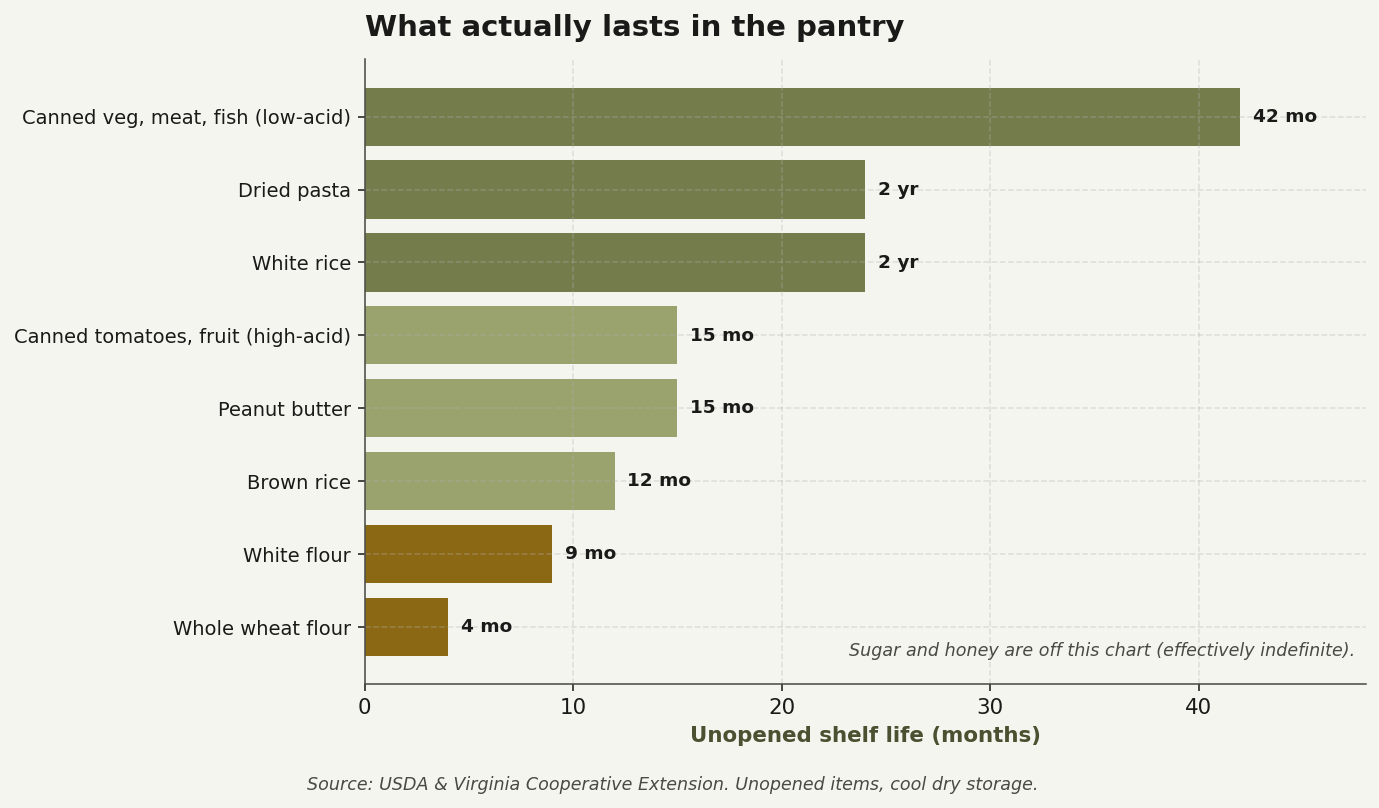
Two things in that table tend to surprise people. The first is sugar and honey, which barely go bad at all. Honey holds so little free water that bacteria and mold cannot get established in a sealed jar, which is why it keeps for years and only ever crystallizes rather than spoils. The second is the gap between white and whole-grain versions of the same food. White rice lasts twice as long as brown, and white flour outlasts whole wheat by months, for the same reason in both cases. The whole-grain version still contains the oily germ and bran, and oil is the part of food most eager to spoil.
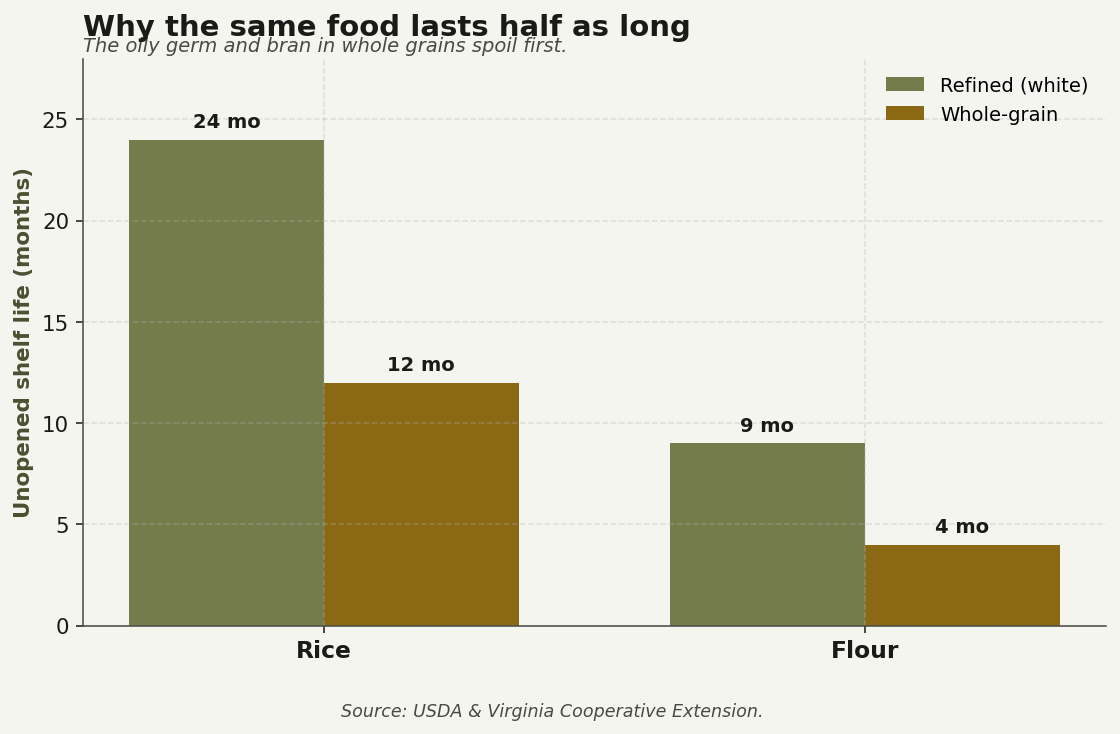
That is the quiet rule under the whole pantry. Sugar and dry starch are nearly immortal. Anything with fat in it, oils, nuts, whole grains, is on a shorter clock, and heat speeds that clock up. A bag of whole wheat flour in a cabinet above the stove is living a much shorter life than the same bag in a cool closet.
Stale is not the same as dangerous
The most useful distinction in this whole subject is between food that has lost quality and food that will make you sick. Different organisms cause them, and they behave in opposite ways.
Spoilage organisms are the ones that announce themselves. They are what make bread go moldy, oil turn rancid, and old cereal taste like cardboard. Michigan State University Extension makes the point bluntly: spoilage bacteria affect smell and taste but are usually harmless. They are loud and mostly benign. Stale crackers are a disappointment, not a hazard.
Pathogens are the opposite. Salmonella, Listeria, and dangerous strains of E. coli can multiply in food without changing how it looks, smells, or tastes. The food that actually hurts people often seems perfectly normal right up until it doesn't.
Here is why that matters for a pantry specifically. Dry shelf-stable goods almost never fail in the dangerous direction. A two-year-old box of pasta does not grow pathogens. It just gets stale, or, if pantry moths got into it, buggy. The failure mode for dry goods is quality, and quality problems are visible. You can trust your senses there.
The one real exception, the place where your senses are not enough, is the can.
The can is where you stop guessing
Commercially canned food is one of the safest things in your house, with a shelf life measured in years, precisely because the canning process sterilizes the contents and seals out everything else. The danger only appears when that seal fails, and the organism you are worried about is Clostridium botulinum, the source of botulism. It is rare, but it is serious, and it does not always make the food smell wrong.
So with cans, you do not rely on the date. You rely on the can itself. Utah State University Extension and the USDA agree on the discard list. Throw a can out, no matter what the date says, if it is:
- Bulging or swollen at either end (the classic botulism warning)
- Leaking, rusted through, or badly dented along a seam
- Spurting liquid or foam when you open it
- Off in smell or appearance once opened
A small dent in the flat face of a can is cosmetic. A sharp dent on the seam, where the seal lives, is a reason to toss it. A lid you can press and feel pop is a sealed can. A lid that is already domed outward is a can that has been doing something it should not, and that one is not worth any meal.
The boring habits that beat the date entirely
Almost everything that shortens a pantry's life comes down to heat, light, moisture, and air, in that order. The fixes are unglamorous and they work.
Utah State University Extension and the USDA both put the ceiling around 85°F, with 50 to 70°F ideal. That single choice does more for shelf life than any product you can buy. A cool closet on an interior wall beats a cabinet next to the oven by a wide margin.
Move flour, rice, pasta, and cereal out of their paper and into airtight glass or heavy plastic once opened. It buys months and it locks out pantry moths and weevils, the small beetles that chew through bags and quietly ruin a shelf of grain.
Rotate. The warehouse trick is "first in, first out," and it needs no app. New cans go to the back, old cans come to the front, and nothing has to be thrown out because it got lost behind the soup for three years. Most of what spoils in a home pantry did not run out of time. It ran out of attention.
None of this requires a prepper bunker or a vacuum sealer the size of a printer. It requires a cool shelf, a few airtight containers, and the willingness to read a can instead of a calendar.
TL;DR
Date labels are quality guesses, not safety deadlines, and only infant formula is legally required to carry one. Dry pantry staples last far longer than their dates suggest, with sugar and honey effectively immortal and anything oily, whole grains, nuts, brown rice, on a shorter clock. Stale is a quality problem you can see and smell, not a danger. The one place to ignore the date and trust the package instead is canned food: a bulging, leaking, or seam-dented can goes in the trash whatever the stamp says. Keep it cool, keep it airtight, rotate front to back, and most of your pantry will outlive its labels by years.
Sources
- USDA FSIS: Food Product Dating
- USDA: Food Waste FAQs
- USDA FSIS: Shelf-Stable Food Safety
- Federal Register: Food Date Labeling RFI (Dec 4, 2024)
- ReFED: Consumer Perceptions of Food Date Labels, 2025 National Survey
- Virginia Cooperative Extension: Food Storage Guidelines for Consumers
- USDA AskUSDA: How long can you keep canned goods?
- Utah State University Extension: Storing Canned Goods
- Michigan State University Extension: Food spoilage and food pathogens, what's the difference?