At 5:02 in the afternoon on June 21, 2026, a tornado touched down in Jefferson County, Illinois, and stayed on the ground for 13.8 miles. The National Weather Service rated it EF3, 140 mph at its peak. Two women were killed, in two different mobile homes, two to three miles apart. Both homes were destroyed. Five other people went to the hospital.
What follows is what I would tell a friend in tornado country who asked me whether a storm shelter is worth the money: where tornadoes actually kill people, what a real shelter has to be rated for, what one costs, who pays part of it back in 2026, and the bin of gear that belongs inside.
Disclosure: As an Amazon Associate, s1gma earns from qualifying purchases. Some links in this article are affiliate links. If you buy through them, s1gma may earn a small commission at no extra cost to you. It doesn't change what gets recommended.
Where tornadoes actually kill people
I added up the National Weather Service's tornado fatality reports for the ten years from 2016 through 2025. There were 513 deaths, and 239 of them happened in mobile or manufactured homes.
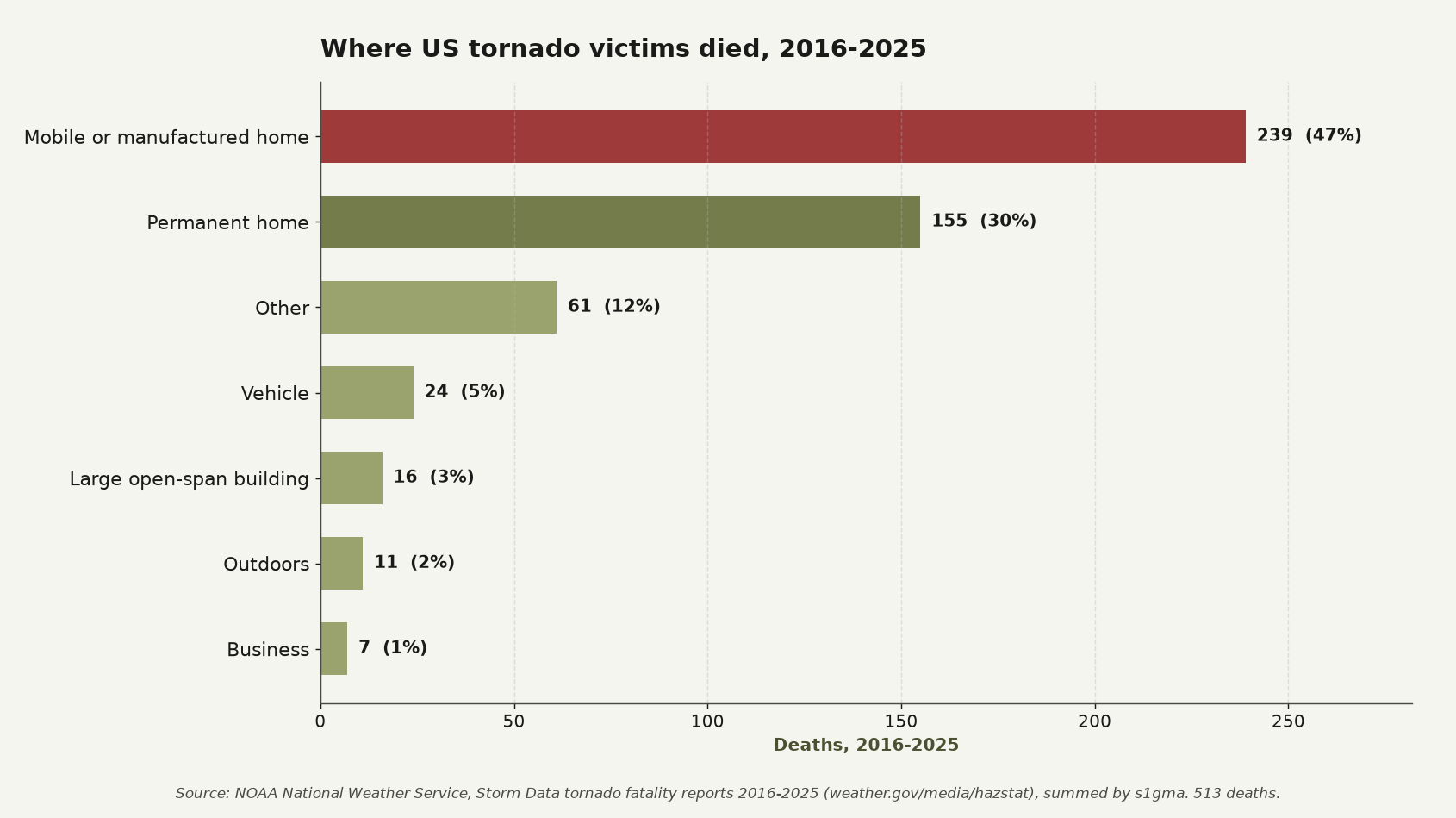
The Weather Service's own fact sheet puts it this way: manufactured homes are about 6% of US housing, yet 54% of the tornado deaths that happen in homes happen in them (citing Strader and Ashley, 2018). The NWS office in Jackson, Mississippi puts it more bluntly: in a mobile home you are 15 to 20 times more likely to be killed than in a permanent one.
The other number on that chart matters too. Permanent homes account for 155 deaths, almost a third, and in two of those ten years more people died in houses than in mobile homes: 2021 (47 against 23) and 2025 (30 against 22). A house without a shelter is safer than a trailer. Safe is a stronger word than it deserves.
2026 has had plenty of tornadoes and few deaths. The Storm Prediction Center's preliminary count is 1,530 tornadoes through November 15, slightly above average, and 15 deaths, where the full-year average for 2023 to 2025 was 68. That gap is luck. The pattern held anyway: the Jefferson County victims were in mobile homes, and on March 6 four people died in Michigan, three of them near Union City, where local news reported three of the victims were in mobile homes.
Storm shelter or safe room: what the label has to say
Two words get used as if they meant the same thing, and they almost do.
A storm shelter is built to ICC 500, the national standard for storm shelters (current edition 2023). A safe room meets ICC 500 too, plus FEMA's stricter criteria in FEMA P-361, and the big difference is wind speed. A FEMA residential safe room is designed for 250 mph wherever you live. A storm shelter can be designed for the mapped tornado wind speed of its location, which may be lower. Every safe room is a storm shelter. Not every storm shelter is a safe room, and only a safe room qualifies for FEMA-backed money.
The test that matters is a 15-pound 2x4 fired end-on at 100 mph, which is roughly what a 250 mph wind does with lumber. A real shelter door carries a label saying it passed. FEMA warns that a substandard door has led to "serious injuries and even death" in past tornadoes, so read the door before you read the brochure.
Here is the buyer fact most sales pages leave out. When FEMA published its homeowner guide (FEMA P-320, December 2024), no in-ground or precast concrete unit had been listed and labeled to ICC 500. The listed prefab units were above-ground steel. An underground shelter can still be engineered to the standard, but then the seller should hand you an engineer's sealed ICC 500 documentation. If they can't, you are buying a hole in the yard with a lid.
Two more rules from the same guide. A shelter is never allowed in a floodway, and not in a coastal high-hazard zone (V or Coastal A) without a variance. In any mapped flood zone it has to sit above the flood elevation, never below ground, and a FEMA-funded one must be outside every hurricane storm-surge area. A sealed room filling with water is its own disaster.
What one costs
These are FEMA's own estimates from P-320, built from national construction averages and adjusted for inflation. The two site-built figures include labor, sales tax and a 15% contingency.
| Type | FEMA estimate |
|---|---|
| Prefab above-ground steel, 4 x 6 ft, delivered and installed | about $5,500 to $6,700, plus the slab (about $1,000 on average in 2021) |
| Safe room built into a new home, 8 x 8 ft | about $12,700 to $16,100, before the door |
| Safe room built into a new home, 14 x 14 ft | about $25,600 to $34,500, before the door |
| A tested safe room door | about $2,500 to $3,200, entry level |
Retrofitting an existing house costs more than building it in, and a garage install costs more if the old slab has to be cut out and poured again. FEMA gives no figure for underground shelters, so I won't either. FEMA also cites a study that found a shelter raised a home's sale price by about 3.5%, roughly $4,200 for a typical house in that study. Nice to know. Nobody should buy one for resale.
For most families in tornado country the small steel unit in the garage is the realistic one. It is the cheapest, and above-ground steel was the only prefab type listed to ICC 500 when FEMA's guide came out. Look your model up in the ICC-ES directory, and make sure the slab and anchors match the maker's tested design.
Who pays part of it back in 2026
This is where the internet is most out of date, so here is the status of each program as of November 21, 2026.
- Alabama: open. The Storm Shelter Tax Credit (Act 2021-540, extended by Act 2024-223) cuts your Alabama income tax by the lesser of $3,000 or 50% of the cost for a qualified shelter at your primary residence, through the 2028 tax year, with a $2 million statewide cap each year, first come, first served. It is non-refundable, so it can only reduce tax you owe. You apply to the Alabama Emergency Management Agency for a certificate, then claim it through My Alabama Taxes before you file. The trap: you must apply in the same calendar year the shelter is installed. If yours went in during 2026, the deadline is December 31, 2026.
- Oklahoma: not open. The SoonerSafe page says the 2026 rebate program is not open, and in March the state told local news it had not received FEMA money to continue it.
- Mississippi: closed for now. The last round (75% of the cost up to $3,500, by lottery) ran from October 31 to November 30, 2025. I found no 2026 round.
- Michigan: new in 2026. Up to 75% of the cost, capped at $7,131.75, for 50 homeowners picked at random. When it opened in May, the state said no FEMA money had been awarded yet.
- Kentucky: law passed, money missing. A 50% rebate up to $5,000 starts in January 2027, and the governor's office said the state does not have the funds yet.
- Arkansas: ended in 2016.
Everywhere else, any money is FEMA's, passed through your state or a regional council, either after a disaster declaration or from FEMA's pre-disaster grants, and handed out by drawing or by waiting list. Indiana, for one, ran rounds in 2026 that have now closed. Call your county emergency management office and ask what is running. And one rule across every rebate program I read: do not install before you have written approval. In Mississippi and Michigan, a shelter built first is a shelter you paid for yourself.
The shelter kit
FEMA's guide has a full supply list for residential safe rooms (P-320, Appendix B). For a tornado it is short on purpose, because you are in there for minutes or hours: one day of water and food, light, a radio, first aid, and the two things people never think of. One is a way to signal rescuers if debris blocks the door, a whistle or an air horn, with hearing protection for everyone. The other is a pry bar or jack to open a jammed door from the inside.
| Item | Why it is in the bin |
|---|---|
| Midland WR400 weather alert radio | It lives by the bed and comes into the shelter with you. Program it with your county's S.A.M.E. code and the siren sounds for your county only, and four AA batteries keep it going when the power is gone. |
| Schwinn Thrasher adult helmet | One per adult. It comes in one size, 58 to 62 cm, which suits a large head, so measure before you order. |
| 80SIX kids' helmet | Three sizes from 49 to 58 cm, certified for age 5 and up. A child under 5 needs a helmet certified to the CPSC standard for age 1 and older. |
| Black Diamond Spot 400 headlamp | FEMA asks for a light for every four people. A headlamp per adult leaves both hands for the kids and the door. |
| General Medi 110-piece first-aid kit | FEMA strongly recommends first aid in every safe room, because people get hurt rushing to it. |
| LuxoGear emergency whistle (2-pack) | The signal for rescuers if debris blocks the door. A whistle outlasts a voice by hours. |
| Superior Glove Endura work gloves | Cut rated (ANSI A4), for the glass and sheet metal between you and the street. |
| 3M Aura 9205+ N95 masks | FEMA lists dust masks. After a direct hit, the air is full of insulation and drywall. |
| Estwing 24-inch pry bar | FEMA lists a crowbar or jack to open a jammed door. This one is too long for the bin, so it hangs on a hook by the door. |
| IRIS 44-quart gasket tote (2-pack) | Keeps damp and dust out of everything above. It is not sold as waterproof, so it lives on a shelf. |
Two things on FEMA's list need no link. Water: FEMA's tornado figure is one gallon per person for one day. A 24-bottle case from the grocery store is about 3.2 gallons, so one case covers three people. I checked the Datrex sealed emergency pouches we link elsewhere: a box of 18 holds 2.25 liters, a little over half a gallon. And a pack of foam ear plugs per person, because FEMA lists hearing protection and a shelter roof under hail is loud.
Helmets come from our list, since FEMA's has none. The reason is the CDC's: head injuries are a common cause of tornado death. The CDC is honest that there is no research on whether helmets prevent head injuries in tornadoes. If you choose to use one, keep it where you can grab it without delay, and never treat it as a substitute for getting to shelter.
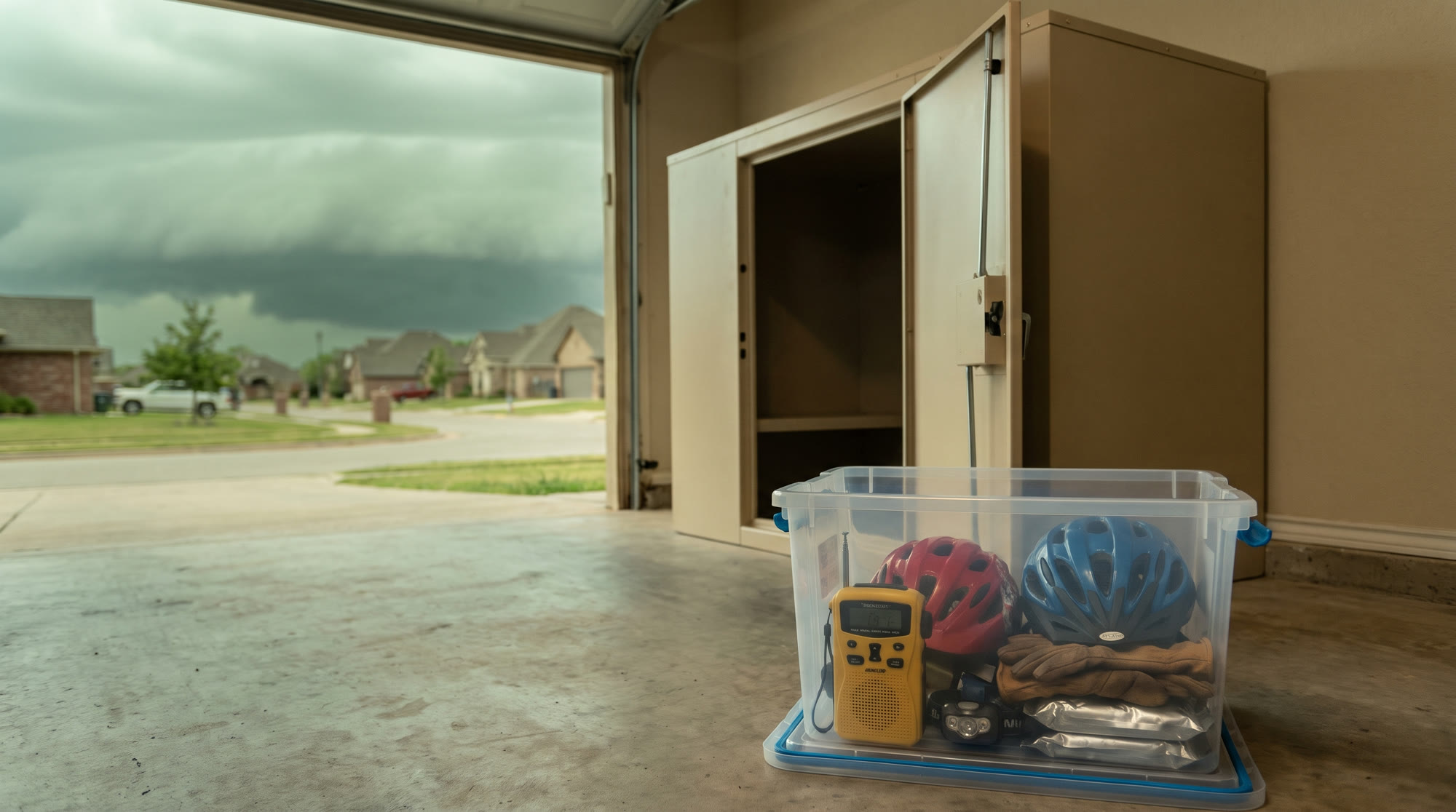
The whole set is the Storm Shelter Kit, every item a listing we read.
Then do the free part. FEMA's guide says to register the latitude and longitude of your shelter entrance with your local emergency managers and fire station as soon as it is built, and to tell family. After a bad night, rescuers search the places they know about.
No shelter? Where to go instead
- A house: go to the basement or safe room if you have one. If not, use a small interior room with no windows on the lowest floor: a bathroom, closet or center hallway. Cover yourself with a mattress, sleeping bag or blankets, and protect your head and neck with your arms (CDC, Ready.gov, NWS).
- A mobile home: leave, with the go bag. The NWS is blunt: no matter what type of manufactured home you live in, it is not a safe place to shelter. NWS Jackson says to go when a tornado watch is issued, not when the warning comes, and if tornadoes are forecast for tomorrow, to arrange tonight to stay somewhere sturdy. If a warning catches you still at home, get to a sturdy building right away if you can, and do not ride it out in the mobile home.
- A car: the CDC calls a motor vehicle the least desirable place to be in a tornado. Don't try to outrun one. If you can, drive to the nearest sturdy building. If wind or flying debris catches you first, park as quickly and safely as you can, out of the traffic lanes. Then either stay in the car with your seat belt on, head down below the windows, covering your head with your hands and a coat or blanket, or, if you can safely get to ground noticeably lower than the road, such as a ditch, get out, lie flat and cover your head with your hands (Ready.gov, CDC).
- Never under an overpass. On May 3, 1999, three people were killed near or under highway overpasses in Oklahoma. The NWS office in Norman explains why: the narrow gap can speed the wind up, climbing the embankment puts you higher into stronger wind, you become a stationary target for flying debris, and the parked cars block the road for everyone behind you. Use the car advice above instead.
How much warning you get
Less than people think. Between 1986 and 2011, a tornado that was warned in advance gave people 18.8 minutes on average. In 2012 forecasters raised the bar for issuing a warning, to cut false alarms. Lead time for 2012 to 2016 fell to 15.6 minutes, and the share of tornadoes warned in advance went from about two in three to about one in two (Brooks and Correia, Weather and Forecasting, 2018). A 2025 Commerce Department Inspector General report found the Weather Service missed its 13-minute lead-time goal in every fiscal year from 2011 to 2022.
So the shelter has to be close enough to reach in a few minutes, at night, with kids, and the warning has to be able to wake you. That second part is a NOAA weather radio with a tone alert by the bed, ideally one with S.A.M.E. coding so it only goes off for your county. The phone alert is good. A radio that does not depend on a cell tower is the backup. Our emergency radio guide covers the rest.
What people get wrong
Buying the shelter and skipping the door label. The door is where cheap shelters fail.
Building before the rebate letter. Every lottery program I read disqualifies a shelter installed before approval.
Waiting for the warning in a mobile home. By the time the warning comes you may have only minutes to reach a sturdy building. Leave at the watch.
Stocking the shelter for a week. A tornado room needs one day of water, light, a radio, first aid, and the tools to get out and be found.
Forgetting the shelter exists until April. Check the bin when the clocks change: batteries in the radio, water dates, the kids' helmets still fit.
Write the latitude and longitude of the shelter door on the lid of the bin, then send the same two numbers to the fire station. It is the cheapest thing on this page.