
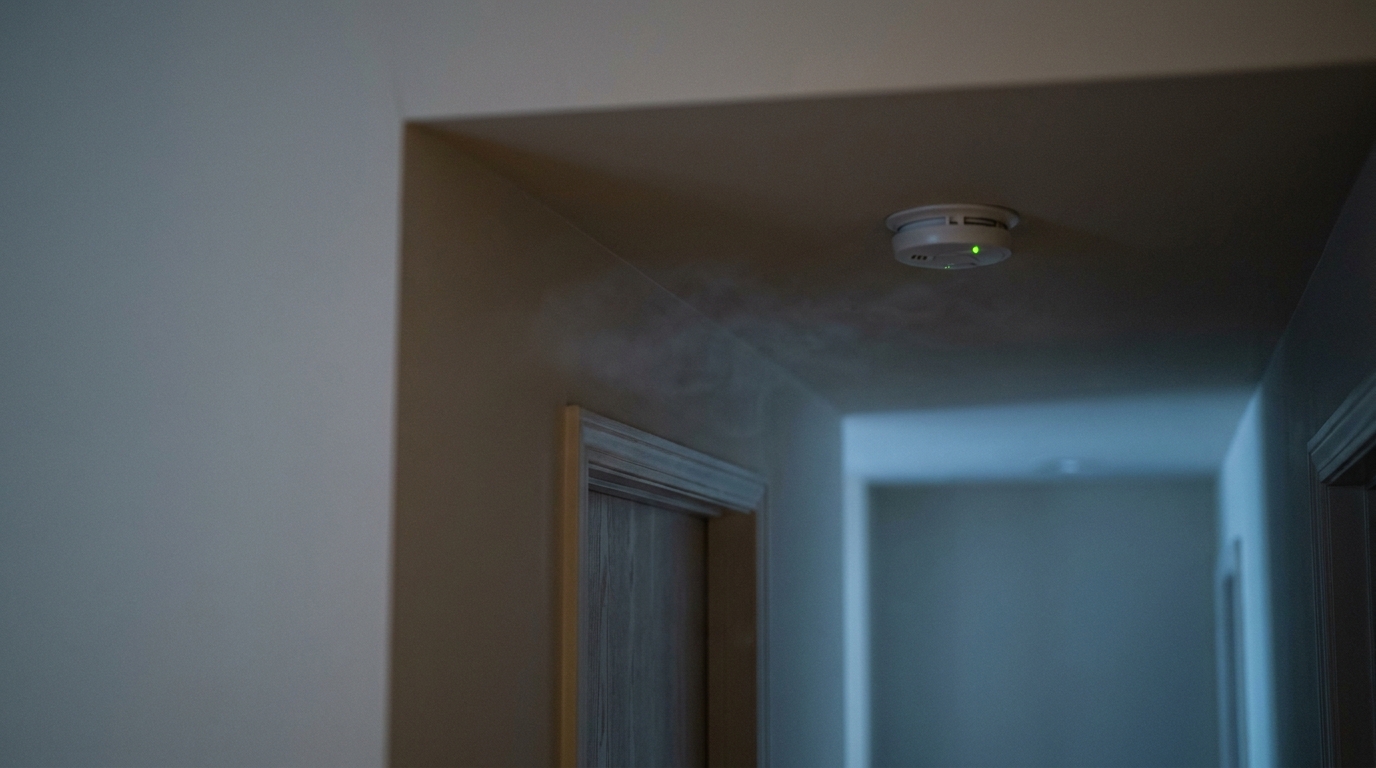
picture a house fire and you probably picture flames. you see yourself grabbing the extinguisher, beating it back, maybe carrying someone out through the orange. that is the movie version.
the real one is quieter and a lot faster. it starts while you are asleep, the smoke reaches you before the fire does, and the clock you did not know was running has about three minutes on it. by the time flames are what you are dealing with, the decision that mattered was already made, months ago, by whether the alarm over your bed had a working battery in it.
so before the gear, the reframe, because it changes what you actually spend your effort on.
The clock nobody tells you is running
Fire is faster than it used to be, and it is not close. When Underwriters Laboratories burned two identical rooms, one furnished the way a living room looked in the 1970s and one furnished the way yours looks now, the old room took about 29 minutes to reach flashover, the moment the whole room ignites at once and becomes unsurvivable. The modern room got there in under four minutes (UL Fire Safety Research Institute).
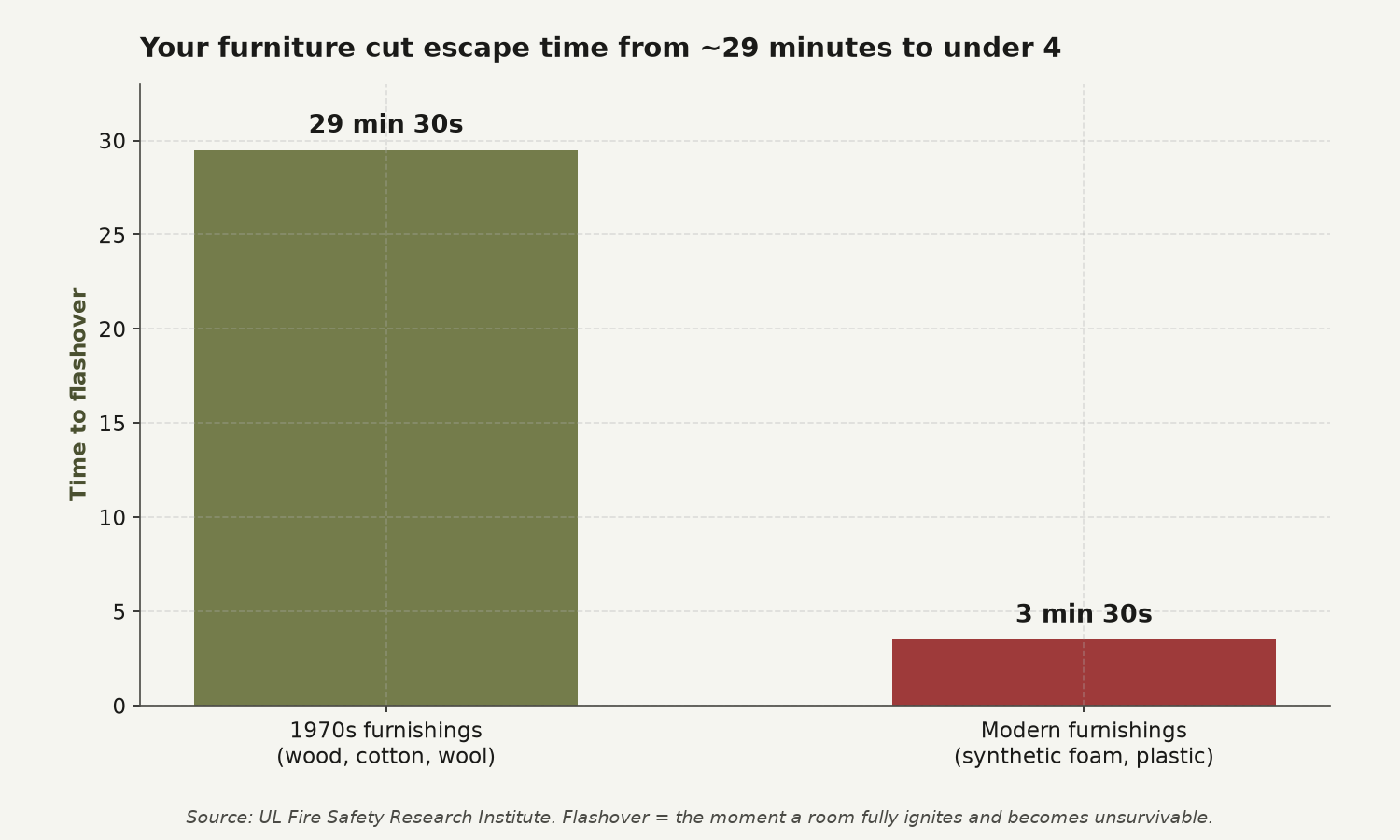
Fire departments used to talk about having roughly 17 minutes to get out of a burning house. The number they use now is closer to 3 (UL Standards & Engagement).
Nothing changed about fire. What changed is your furniture. A 1970s couch was wood, cotton, and wool. Yours is polyurethane foam wrapped in polyester, which is to say it is solid petroleum. Your carpet, your curtains, the TV stand, the mattress, most of it is plastic now. A modern living room is a room full of gasoline arranged as furniture, and it burns like it.
That single fact reorders everything. You do not have time to find the fire, size it up, and fight it. You have time to wake up, get everyone out, and get to the curb. The whole game is buying back seconds at the front end and not wasting them at the back.
What actually kills you (it is not the flames)
Here is the part that surprises people: most people who die in house fires are never touched by fire. They die from the smoke.
The majority of home-fire deaths are caused by smoke and toxic gases, not burns (NFPA). And those synthetic furnishings that burn so fast also burn dirty. Burning plastic and foam release carbon monoxide and hydrogen cyanide, two gases that knock you unconscious before you finish crossing the room. That is why so many victims are found in hallways and near doors, and why so many never wake up at all. The air turns lethal faster than the heat does.
So the threat is not really the fire. It is the air, and how little time you have to breathe it. Which is why the single most important thing in your house is the thing that wakes you up before the air goes bad.
The one device that changes the math
A working smoke alarm cuts your risk of dying in a home fire by about 60 percent (NFPA). Nothing else on this page comes close to that number. And yet roughly three out of five home-fire deaths happen in homes with no smoke alarms, or with alarms that had no working battery (NFPA).
Read that again. A majority of fire deaths are not really about fire. They are about a dead nine-volt battery. This is the single most effective, cheapest safety upgrade in your entire home, and most people get it wrong by neglect.
Getting it right is boring and specific:
- One on every level, one inside every bedroom, and one outside each sleeping area. A fire that starts in the basement has to be loud enough to wake someone on the second floor.
- Interconnect them if you can. When one sounds, they all sound. New homes are wired this way; for older homes, wireless interconnected alarms do the same job.
- Get dual-sensor, or a mix. Ionization alarms react faster to fast flaming fires, photoelectric react faster to the slow smoldering ones that start at night. The smoldering fire is the one that kills you in your sleep, so do not run ionization-only.
- Test monthly. Replace the whole unit every 10 years. The sensor degrades whether it has ever gone off or not.
If you do nothing else after reading this, walk around tonight and press the test button on every alarm in the house. That one act moves your odds more than any extinguisher, ladder, or kit.
Close before you doze
This one is nearly free and almost nobody knows it: sleep with your bedroom door closed.
When UL tested it, the difference was not small, it was the difference between living and dying. In a room with the door open to a fire, temperatures hit over 1,000 degrees and carbon monoxide reached around 10,000 parts per million. In the identical room next door with the door simply closed, the temperature stayed under 100 degrees and CO measured around 100 ppm (UL Fire Safety Research Institute). Their researchers put it plainly: the person behind the closed door was survivable through the entire fire and well after the fire department arrived. The person behind the open door was not.
A closed door is a fire barrier you already own. To be clear, the plan is still to get out, and to close doors behind you as you go. The closed door is what buys you the time to escape, and what keeps you alive if the way out is already gone and you are stuck waiting at a window for the ladder truck. Close the kids' doors when you tuck them in, and close yours when you turn in.
The 3-minute plan (make it before you need it)
Three minutes, in the dark, jolted out of sleep, with an alarm screaming and the air going bad, is not when you want to be improvising. Decide it now:
- Two ways out of every room. The door, and a window that actually opens. If a window is your kid's second way out and it is on the second floor, buy an escape ladder and show them how it works.
- A meeting spot out front. The mailbox, the neighbor's tree, something specific. So nobody runs back into a burning house looking for someone who is already standing outside.
- Practice it, including at night. Kids frequently sleep through smoke alarms. Find out now whether yours do, not during the fire.
- Get low and go. The survivable air is near the floor. Feel a door with the back of your hand before opening it, and if it is hot, use your second way out.
- Once you are out, stay out. Nothing inside is worth walking back into that air. That is what the fire department is for.
The extinguisher, and the honest truth about it
Yes, own a fire extinguisher. Get an ABC-rated one (it handles ordinary combustibles, flammable liquids, and electrical), mount one in the kitchen and one near the garage, and learn PASS: Pull the pin, Aim at the base of the flames, Squeeze the handle, Sweep side to side.
But be honest about what it is for. An extinguisher is for a small, contained fire in its first seconds, a pan that just caught, a wastebasket. It is not a firefighting tool. The rule that keeps you alive: only fight a fire if it is smaller than you, your back is to a clear exit, and the room is not filling with smoke. If the fire is between you and the door, or bigger than a trash can, or you are asking yourself whether you can take it, the answer is no. Get out. People die trying to win a fight they should have walked away from.
Where fires actually start (so you can not start them)
Most of this never happens if you respect the two things most likely to burn your house down.
Cooking is the number one cause of home fires by a wide margin, nearly half of them (NFPA). The cause is almost always the same: someone left the stove. Stay in the kitchen when the burner is on. And if grease catches fire, never throw water on it, that turns a pan fire into a fireball. Slide a lid over it and turn off the heat.
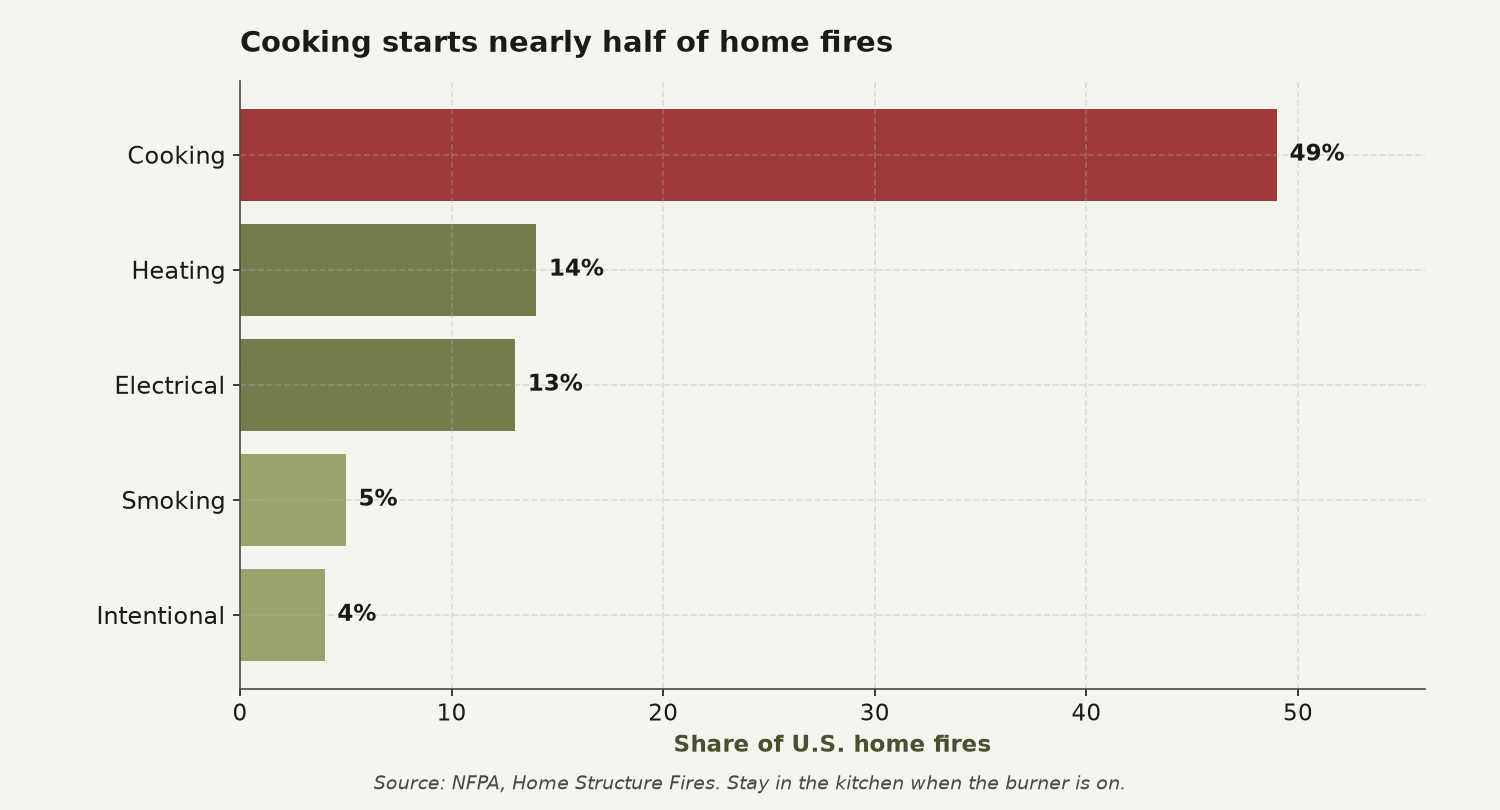
Heating is second, and space heaters do most of the killing. Give them three feet of clearance from anything that burns, plug them straight into the wall and never a power strip, and turn them off when you leave the room or go to sleep.
After those: don't overload outlets, clean the dryer lint trap every load, and if you smoke, do it outside, because smoldering cigarettes cause a wildly disproportionate share of fatal fires.
TL;DR
You have about three minutes, not seventeen, because your furniture is made of petroleum now. Most people who die in fires die from smoke, not flames, in their sleep. So the whole game is: working smoke alarms in every bedroom (they cut your risk 60 percent and a dead battery is behind most fire deaths), sleep with bedroom doors closed (100 degrees versus 1,000), a practiced two-way-out escape plan, and prevention at the stove and the space heater. The extinguisher is for a pan fire, not a house fire. When in doubt, you are already out.
The dramatic version of fire safety is the one you fight. The real version is the one you already escaped, because months ago you put a battery in a small plastic box on the ceiling and closed a door on your way to bed.
Space heaters and generators are the other side of staying warm safely when the grid fails, see Power Outage Kit: what actually keeps the lights and fridge on. Size your household's emergency supplies at the Supply Calculator.
Sources
- UL Fire Safety Research Institute, changing residential fire dynamics (flashover timing, natural vs synthetic furnishings): https://fsri.org/research-update/analysis-changing-residential-fire-dynamics-and-its-implications-firefighter-operations
- UL Standards & Engagement, The Changing Risk of Fire: https://ulse.org/insight/changing-risk-fire-new-materials-new-devices/
- National Fire Protection Association, home fire safety + smoke alarms: https://www.nfpa.org/education-and-research/home-fire-safety/smoke-alarms
- National Fire Protection Association, home cooking fires: https://www.nfpa.org/education-and-research/home-fire-safety/cooking
- UL Fire Safety Research Institute, Close Before You Doze: https://closeyourdoor.org/