
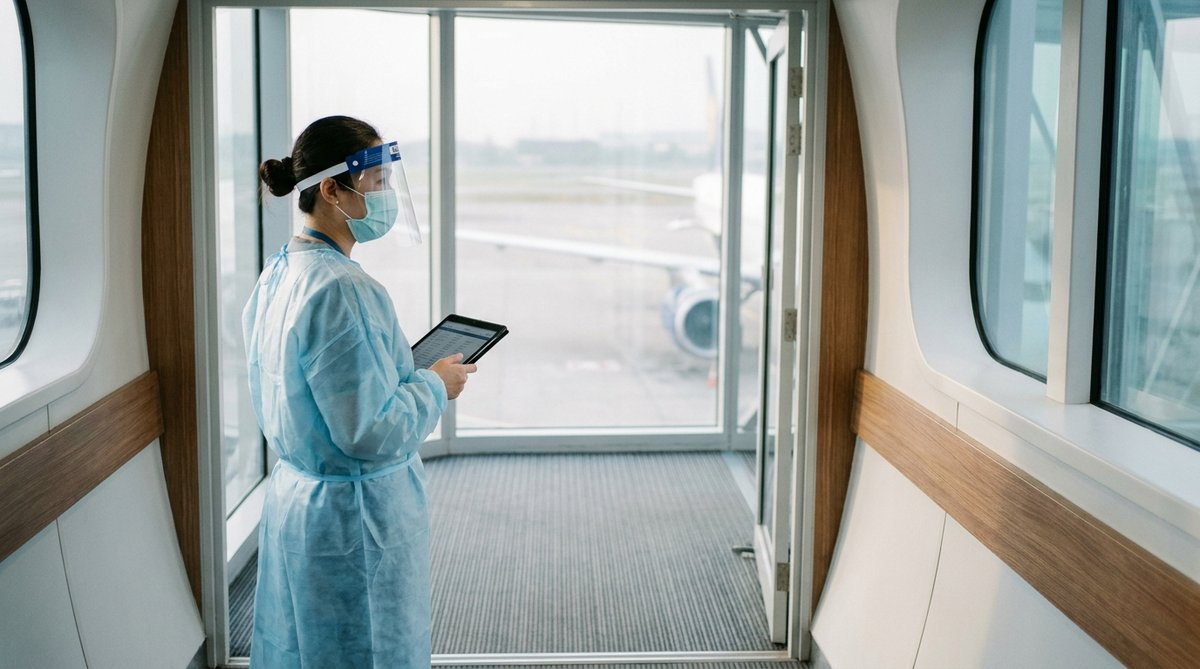
Last week, a flight from Kinshasa landed at Suvarnabhumi airport in Bangkok. Before passengers could collect their bags, a quarantine officer in pale blue PPE met them at the jet bridge. Temperatures were taken. Forms were filled out. A handful of travelers were escorted to a holding area for 21 days of observation. None of them looked sick. None were known to be exposed. That was kind of the point.
This is what a fast pandemic response looks like in 2026, and it's a long way from where we were the last time Ebola made global headlines.
The current outbreak in the Democratic Republic of the Congo, centered around Bunia and Mongbwalu in the country's restive northeast, is now the third-largest in the history of the disease, according to the Wall Street Journal. The Zaire strain that's circulating is the same one that devastated West Africa between 2014 and 2016, when over 28,000 people fell ill and more than 11,000 died. Current numbers are smaller, but climbing, and the geography is harder. Bunia sits in a region scarred by years of armed conflict, where health workers move under militia escorts and entire villages can be unreachable for weeks.
So why call this the best-prepared outbreak in history?
Two reasons. The first is medical. In 2014, when patient zero was exposed to a bat in a Guinean village, there was no licensed Ebola vaccine, no approved treatment, and no playbook for stopping the virus once it reached a city. By the time the international response geared up, the disease was already crossing borders. Today, frontline workers in the DRC are vaccinating with Ervebo, a single-dose vaccine that received WHO prequalification in 2019 and showed roughly 97% efficacy in the field. Patients who do contract the virus are treated with monoclonal antibody cocktails called Inmazeb and Ebanga, both FDA-approved in 2020, which cut mortality from the historical 50% range to under 35% in clinical use.
The second reason is operational. The strategy now is something called ring vaccination. Instead of trying to immunize the general population, contact tracers identify everyone a confirmed case has interacted with, then everyone those people have interacted with, and vaccinate that entire ring before the virus can find a foothold. It's the same idea epidemiologists used to eradicate smallpox in the 1970s. Applying it to Ebola in real time, in a war zone, with a vaccine that has to stay frozen until the moment of use, is something only the last decade made possible.
The international response has been quietly impressive. Thailand started screening passengers from Kinshasa within days of the WHO's initial alert. Indonesia put its hospital network on standby. The UAE issued a travel advisory. Ireland's Health Service Executive confirmed it had isolation protocols ready and was actively tracking returning travelers. None of these countries waited for a confirmed imported case before acting. That's the lesson the world took from COVID. The cheap, boring step you take in week two is the one that lets you skip the catastrophic step in month six.
For people watching from a distance, it can feel like a contradiction. The news says "third-largest outbreak in history," and the mind goes straight to a worst-case spiral. But the size of the outbreak isn't a measure of how dangerous Ebola is. It's a measure of how hard the terrain is. Bunia is hard. Conflict zones are hard. What's actually changing is the world's response, and that response has gotten dramatically better at the precise moment the world has gotten harder to operate in.
A few things worth knowing if you read another Ebola headline this summer.
Ebola does not spread through the air. It spreads through direct contact with bodily fluids of someone who is already showing symptoms, or with surfaces those fluids touched. People who are infected but not yet symptomatic are not contagious. This is part of why ring vaccination works so well, and why airport screening, despite looking dramatic, is a reasonable layer rather than a panicked one.
The incubation period runs two to 21 days. Symptoms start with fever, fatigue, and muscle pain, then escalate. This is why quarantine periods last three weeks, and why "the passenger isn't sick" doesn't automatically mean "the passenger is safe to release." The math is conservative on purpose.
Vaccines exist, and they work. If you live somewhere with even a moderate health system, the realistic exposure scenario is "a returning traveler tests positive, contact tracers visit, you may or may not be on their list, and if you are, you'll be offered Ervebo." That's not nothing. But it's also not the 2014 movie version.
The countries with the most active surveillance right now are doing it not because their populations are at high risk, but because being early is cheap. A quarantine room and a public-health hotline cost almost nothing relative to a real outbreak. The fact that those rooms are being staffed, and those hotlines tested, is the actual story.
There's a habit worth picking up here, and it has nothing to do with stockpiles. It's a way of reading outbreak news. When you see a headline, ask three things. Is this a new pathogen or a known one? Known is much better. Do treatments exist? For Ebola, yes. How fast is the international response moving? For this one, days, not months. If the answers point toward known, yes, and fast, the situation, however serious for the people in the affected region, is not a runaway one for the rest of us.
The DRC outbreak will probably keep growing for some weeks. It may produce a handful of imported cases in countries with flights from Kinshasa, and those countries will isolate, treat, and contain them. There will be scary headlines. There will be a few hard losses, especially among the Congolese health workers who keep going into the hardest terrain to do the contact tracing that keeps the rest of us safe. They deserve our attention.
The deepest story, though, is one of accumulated progress. Every Ebola response since 1976 has taught the world something, and the current one is operating on the cumulative wisdom of fifty years of outbreaks. A vaccine that didn't exist a decade ago. Treatments that didn't exist five years ago. Surveillance systems that were still being designed two years ago. Watching all of it work, in real time, in a corner of Africa most people couldn't find on a map, is a quiet kind of hope.
TL;DR
Unlike 2014, this outbreak meets a licensed vaccine — Ervebo, around 97% efficacy — and two approved antibody treatments, Inmazeb and Ebanga, that cut mortality from roughly 50% to under 35%. They are delivered by ring vaccination, the method that ended smallpox. Ebola does not spread through the air, and people who are infected but not yet symptomatic are not contagious. "Third-largest in history" measures how hard the terrain in eastern DRC is, not how dangerous the disease has become. The real change is that countries began screening within days instead of waiting for a confirmed case, because being early is cheap.