
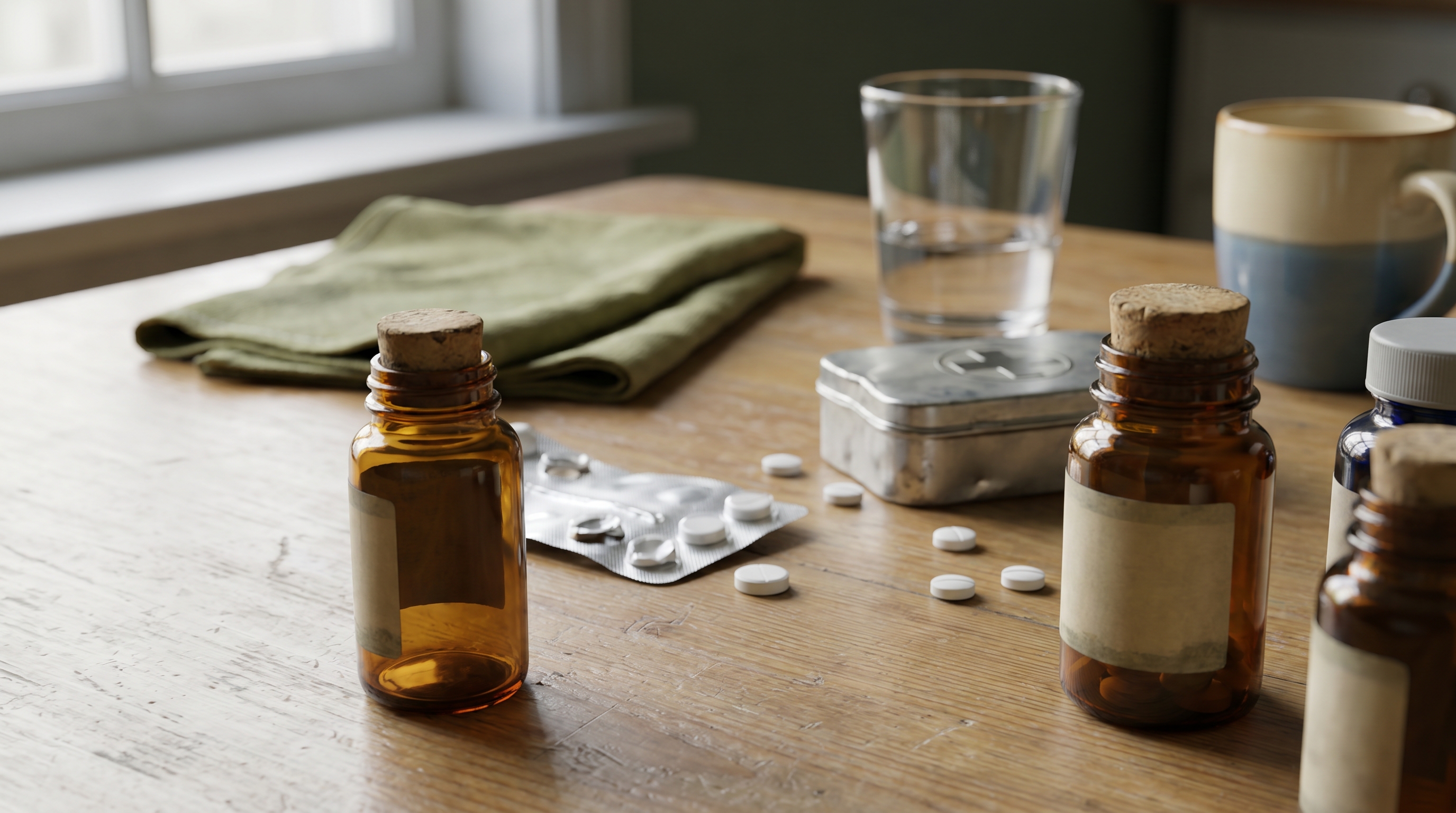
The name on the box already tells you what a drug does, if you know how to read it.
Picture finding a blister pack in a hotel drawer in Lisbon. The box says paracetamol. There's no pharmacist, no signal on your phone, and a kid running a fever. Is it safe to give? You already hold the answer. It's the same molecule the US sells as acetaminophen, the drug inside Tylenol. The label told you, in one word, before you knew to look.
Most people read a medicine box as a brand and a color. People who do well in an emergency read it as a small data sheet: active ingredient, strength, purpose, warnings. Standardized, predictable, and usually more honest than the marketing on the front. This is how to read any of them, whether it's a US over-the-counter panel, a prescription bottle, or a foreign box with a name you've never seen.
This is general education, not medical advice. Follow the directions on the label, and ask a pharmacist or doctor about your own situation.
The front of the box is marketing. Turn it over.
The brand name is the least useful thing on the package. "Tylenol," "Advil," "Benadryl" are trademarks, and they change by country and manufacturer. What matters is the active ingredient, the chemical actually doing the work.
On a US over-the-counter product, the FDA requires a panel called Drug Facts, and its very first line is "Active ingredient," with the amount per dose. On a prescription bottle, the generic name sits under or beside the brand: atorvastatin under Lipitor. Find that one word and you can look up anything about it, what it treats, what it clashes with, what an overdose looks like. The brand tells you who made it. The active ingredient tells you what it is.
The name is a code
Here's the part almost nobody learns. Generic drug names are built on purpose, by committee, to be read. Since 1953 the World Health Organization has coordinated International Nonproprietary Names, and the US adds a second layer through the United States Adopted Names council. Drugs in the same family share a piece of their name, usually the ending, called a stem.
Learn a handful of stems and you can often guess a drug's class from the name alone, even one you've never met.
| Stem | What it signals | Example |
|---|---|---|
| -cillin | Penicillin antibiotic | amoxicillin |
| -mycin / -micin | Antibiotic (from Streptomyces soil bacteria) | erythromycin, gentamicin |
| -pril | ACE inhibitor (blood pressure) | lisinopril |
| -sartan | ARB (blood pressure) | losartan |
| -olol | Beta-blocker (heart, blood pressure) | propranolol |
| -statin | Cholesterol drug | atorvastatin |
| -prazole | Acid reducer (proton-pump inhibitor) | omeprazole |
| -tidine | Acid reducer (H2 blocker) | famotidine |
| -azepam / -azolam | Benzodiazepine (sedative) | diazepam, midazolam |
| -caine | Local anesthetic (numbing) | lidocaine |
| -conazole | Antifungal | fluconazole |
| -vir | Antiviral | aciclovir |
| -mab | Monoclonal antibody | adalimumab |
A stem is a strong hint, not a guarantee. Read it like the first letter of a license plate, not the whole plate. Two honest cautions: -mycin covers several different antibiotic families, not one, so it means "antibiotic," not a specific type. And -azole splits. A -conazole is antifungal, but metronidazole fights parasites and bacteria instead.
The same drug wears different names abroad
A pile of stockpiled or imported medicine will carry names that look foreign even when the drug is identical. The molecule didn't change. The naming committee did.
| Rest of world | United States |
|---|---|
| paracetamol | acetaminophen (Tylenol) |
| adrenaline | epinephrine (EpiPen) |
| salbutamol | albuterol (asthma inhaler) |
| glyceryl trinitrate (GTN) | nitroglycerin (chest pain) |
| lignocaine | lidocaine |
| frusemide | furosemide (water pill) |
| rifampicin | rifampin (TB antibiotic) |
The roots run deeper than any committee. "-mycin" comes from the Greek mykes, fungus, because the first of them, streptomycin in 1944, was pulled from a soil organism in the Streptomyces genus. The "Rx" on a prescription is Latin recipe, meaning "take." None of this is trivia. It's the gap between recognizing a drug and guessing at one.
What the rest of the panel is telling you
A US Drug Facts panel always runs in the same order, so once you know the shape you can skim it in seconds:
- Active ingredient — the drug and the dose per unit
- Purpose — the category (pain reliever, antihistamine)
- Uses — the symptoms it treats
- Warnings — when not to take it, interactions, the overdose line
- Directions — how much, how often, the daily maximum
- Other information — storage
- Inactive ingredients — fillers, dyes, allergens
The format was modeled on purpose after the Nutrition Facts panel on food. For any painkiller, two numbers are worth memorizing: the amount per dose and the maximum per day. Acetaminophen is the cautionary case. It hides inside dozens of combination cold-and-flu products, and stacking them is a quiet, common way people sail past the daily ceiling and damage their liver.
The short list worth understanding
You don't need a pharmacy. A small, well-understood set of over-the-counter drugs covers most of what a household actually runs into. Ready.gov's emergency-kit guidance points at the same basics (pain relievers, anti-diarrheal medicine, antacids), and the American Red Cross keeps a topical antibiotic and aspirin in its first-aid kits.
| What it's for | Active ingredient | Note |
|---|---|---|
| Pain, fever | acetaminophen | Easy on the stomach. Watch the daily max. |
| Pain, fever, swelling | ibuprofen | An NSAID. Harder on stomach and kidneys. |
| Suspected heart attack | aspirin | See the callout below. |
| Allergic reaction, itch | diphenhydramine / cetirizine | The first also makes you drowsy. |
| Diarrhea | loperamide | Slows the gut down. |
| Heartburn | calcium carbonate / famotidine | Antacid vs acid reducer. |
| Minor cuts | bacitracin + neomycin + polymyxin B | The "triple antibiotic" ointment. |
| Dehydration | oral rehydration salts | Recipe below. |
Aspirin and chest pain. For an adult with sudden chest pain, the 2024 American Heart Association and Red Cross guidance is to call 911 first. Then, if the dispatcher agrees and there's no aspirin allergy, have the person chew one 325 mg adult aspirin, or two to four 81 mg "baby" aspirins. Chewing a non-coated tablet starts working in about 5 minutes instead of 12. The aspirin doesn't treat the heart attack. It buys time until help arrives.
The most valuable item on that list during a stomach illness is the rehydration salts, because dehydration is the thing that actually kills. The WHO and UNICEF formula, per liter of clean water: 2.6 g table salt (sodium chloride), 13.5 g glucose, 1.5 g potassium chloride, 2.9 g trisodium citrate. A pre-mixed ORS sachet is safer than eyeballing it, since the salt-to-sugar ratio is what makes it work. The rough home version some people fall back on, roughly six level teaspoons of sugar and half a teaspoon of salt per liter, is a last resort, not the target.
Decoding the shorthand on a prescription
Older bottles, handwritten notes, and many non-US scripts lean on Latin abbreviations. They look cryptic and they're worth knowing, because stockpiled or imported medicine is exactly where you'll meet them:
| Abbreviation | Latin | Meaning |
|---|---|---|
| Rx | recipe | take |
| b.i.d. | bis in die | twice a day |
| t.i.d. | ter in die | three times a day |
| p.r.n. | pro re nata | as needed |
| p.o. | per os | by mouth |
| a.c. / p.c. | ante / post cibum | before / after meals |
One warning attached to these. Some are now officially banned inside US hospitals because they get misread. "q.d." (once daily) has been confused with "q.i.d." (four times daily), a four-fold dosing error, so the Joint Commission's "Do Not Use" list tells institutions to write out "daily" instead. If you see q.d. on an old or foreign label, slow down and read it carefully. When a modern label spells the schedule out in plain words, trust that one.
The expiration date is softer than you think, except when it isn't
Here's where preparedness folklore and the FDA partly disagree, and the real answer sits between them. A federal program called the Shelf Life Extension Program has tested stockpiled drugs since 1986. Across 122 products, it found about 88% of lots stayed good for at least a year past their printed date, with an average extension near five and a half years. A sealed bottle of acetaminophen a year past its date is, in most cases, just that. A year past its date.
That's not a license to ignore expiration. The testing only covered drugs held in controlled storage, and a few medicines genuinely turn on you. The FDA names the ones never to gamble on: nitroglycerin, insulin, liquid antibiotic suspensions, and injectables like epinephrine, all of which lose strength in ways you can't see. Old tetracycline antibiotics are the historical horror story, with degraded tablets once tied to kidney damage. Reformulation made that rare, but it's why the example still gets taught.
Storage does half the work. Heat and humidity age a drug fastest, which makes the bathroom cabinet, warm and steamy twice a day, close to the worst spot in the house. A bedroom closet shelf beats it easily.
When to stop reading and call someone
A label is for understanding a medicine before you take it. It is not the tool for managing a poisoning, an overdose, or a reaction already underway. In the US, the Poison Help line, 1-800-222-1222, is free, confidential, and staffed around the clock by toxicology specialists, and it's faster than searching. Wrong dose, double dose, a child who got into a bottle, a drug mixed with alcohol. That's the call, and you make it before the panic, not after.
A medicine box looks like marketing because it's built to. Underneath the brand and the color is a small, honest data sheet that survives translation, borders, and decades of folklore. The label was never the obstacle. It was the instructions, written in a language worth learning on a quiet afternoon, not the night you finally need it.
TL;DR
- Ignore the brand. Find the active ingredient: first line of a Drug Facts panel, or the generic name under the brand on a prescription.
- Learn a few name stems (-cillin, -pril, -statin, -olol) and you can guess a drug's class from its name.
- The same drug changes names abroad: paracetamol = acetaminophen, adrenaline = epinephrine, salbutamol = albuterol.
- For any painkiller, memorize two numbers: dose per unit and max per day. Acetaminophen overdoses hide in combo products.
- Expiry dates are often conservative, but never trust expired nitroglycerin, insulin, liquid antibiotics, or epinephrine. Store cool and dry, not in the bathroom.
- Poisoning or overdose: 1-800-222-1222, right away.
Sources
- FDA — OTC Drug Facts Label and 21 CFR 201.66 (eCFR)
- FDA — Expiration Dates Q&A and FDA — Don't Be Tempted to Use Expired Medicines
- WHO — INN stem book and "What's in a Name?" J. Med. Chem. 2021 (PMC8154580)
- American Heart Association / Red Cross — 2024 First Aid Guidelines
- Ready.gov — Build A Kit
- FDA/DoD Shelf Life Extension Program (PubMed 24623105) and Mayo Clinic Proceedings 2015
- Joint Commission — Do Not Use List and ISMP Error-Prone Abbreviations
- Poison Help — 1-800-222-1222 (poison.org)