
Cuba Grid Collapse: A Blueprint for Total System Failure
S1GMA Intel
Monday, May 18, 2026
6 min read
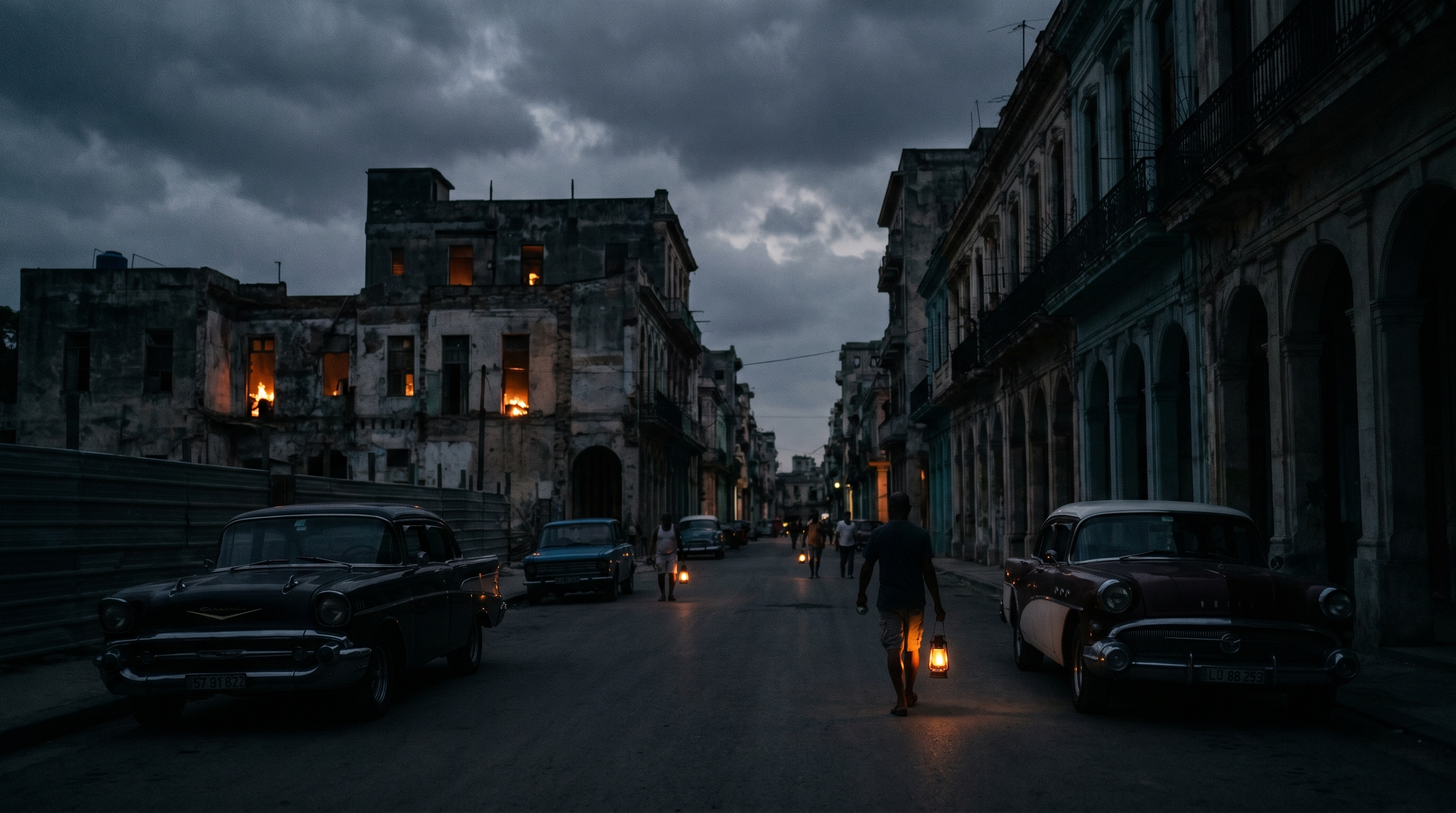
Cuba's total energy collapse and rising US tensions provide a stark lesson in infrastructure fragility. Here is what the crisis teaches us about grid dependence and geopolitical risk.
The lights didn't just flicker in Cuba; they went out entirely. As of May 2026, the island nation has reached a terminal point in its energy crisis, with the national power grid suffering multiple total collapses in a single month. This is no longer a matter of rolling blackouts or scheduled load shedding. This is a systemic failure of a nation's life-support systems. When a country runs entirely out of diesel and fuel oil, as Cuba has now reported, the result is a cascade of failures that impacts every facet of human survival. For those watching from the outside, the situation in Cuba is a case study in how geopolitical pressure, aging infrastructure, and resource scarcity can converge to create a high-threat environment in a matter of days.
What We Know
Cuba is currently experiencing its most severe energy emergency in decades. The Ministry of Energy has confirmed a complete collapse of the national power grid, leaving the majority of the island’s 10 million residents without electricity. This latest failure, the third in March alone, was triggered by a critical failure at the Nuevitas thermoelectric plant, a cornerstone of the island's aging power infrastructure.
The root cause is a total depletion of fuel reserves. Cuban officials have stated that the country has completely run out of the diesel and fuel oil required to keep its power plants operational. This fuel drought is the result of a 'maximum pressure' campaign from the United States, which has intensified its decades-long economic blockade. According to Cuban Deputy Foreign Minister Carlos Fernandez de Cossio, the nation has not received a foreign oil shipment in three months and currently produces only 40% of its own fuel needs.
The crisis is being exacerbated by broader geopolitical shifts. The ongoing war involving Iran has disrupted global energy supplies and diplomatic norms, making it increasingly difficult for Cuba to secure alternative energy partners. Simultaneously, rhetoric from Washington has shifted from containment to potential direct action. Statements from the Trump administration regarding 'liberating' the island and calls for regime change from Secretary of State Marco Rubio have put the Cuban military on high alert. While US Southern Command denies active invasion rehearsals, they have reinforced their readiness to defend Guantanamo Bay and the US embassy. On the ground, the lack of power and fuel has sparked rare and growing civil unrest, particularly in Havana and the eastern provinces, as residents face the reality of a country with no power, no fuel, and dwindling food supplies.
Why It Matters for Preparedness
The situation in Cuba is a stark reminder that infrastructure is a house of cards. For the preparedness-minded, there are three critical takeaways from this collapse:
-
The Interdependency of Systems: When the grid fails, it isn't just about the lights. In Cuba, the lack of electricity has halted water pumping stations, disrupted telecommunications, and compromised food preservation. If you are dependent on the grid for any of these three pillars—water, communication, or food—you are vulnerable. A total grid collapse is a multi-system failure, not an isolated utility issue.
-
Geopolitics is a Local Threat: Many people view international sanctions and diplomatic posturing as abstract concepts. Cuba proves that geopolitical tension is a direct threat to your household's stability. Sanctions lead to fuel shortages; fuel shortages lead to grid failure; grid failure leads to civil unrest. The distance between a diplomatic cable and a riot in your street is shorter than you think.
-
The Speed of Decay: Cuba’s transition from 'struggling' to 'total collapse' happened with alarming speed. Once the fuel reserves hit zero, the margin for error vanished. In a high-stress environment, infrastructure that has been poorly maintained for decades will fail catastrophically rather than gracefully. You cannot rely on 'emergency repairs' when the system itself has reached its expiration date.
What You Can Do
You cannot control the national grid or international sanctions, but you can control your household’s resilience. Based on the failures observed in Cuba, here are the actionable steps you must take now:
Secure Independent Energy Production: A generator is only as good as the fuel you have stored. In Cuba, generators are useless because there is no diesel. Your primary backup should be solar-based. Invest in a portable solar generator (Lithium LiFePO4) and at least 200W of folding panels. This will allow you to maintain communications and small medical devices indefinitely without relying on a fuel supply chain.
Establish Gravity-Fed Water Solutions: If the pumps stop, the taps run dry. Do not rely on electric well pumps or municipal pressure. Store a minimum of three gallons of water per person, per day, for a 14-day period. Beyond storage, have a manual siphon pump and a high-quality gravity-fed filtration system (like a Berkey or Sawyer) to process water from non-potable sources.
Hardening and Security: Resource scarcity inevitably leads to civil unrest. As seen in Havana, desperate conditions drive people to the streets. Ensure your home has basic physical security: reinforced strike plates on doors, security film on ground-floor windows, and a staged 'blackout kit' so you aren't fumbling in the dark. Maintain a low profile (Light Discipline); if the whole neighborhood is dark, your house should not be glowing with lights.
Analog Communication and Intelligence: When the towers go down, your smartphone is a paperweight. Own a high-quality AM/FM/Shortwave radio that runs on batteries or crank power. This is your only way to receive emergency broadcasts and international news when the local infrastructure is dead. Additionally, have physical maps of your local area and a pre-arranged rally point for family members.
Looking Ahead
The situation in Cuba is volatile and likely to escalate. We are monitoring three specific scenarios:
First, the potential for a mass migration event. As conditions become unlivable, a significant exodus toward the United States is probable, which could further strain regional stability and provoke a more aggressive US naval response.
Second, the risk of military miscalculation. With the Cuban military on high alert and US rhetoric intensifying, any minor incident near Guantanamo Bay or in the Florida Straits could serve as a catalyst for direct kinetic conflict. The Cuban government has already stated they are 'ready to strike' if attacked.
Third, the role of external actors. If the US continues its 'maximum pressure' campaign, Cuba may look to other adversaries of the US for emergency support, potentially bringing foreign military assets closer to American shores.
For now, Cuba serves as a grim laboratory for total infrastructure failure. The lesson is clear: the time to build your own grid is while the national one is still functioning. Once the fuel is gone, it’s too late.